lindaikeji35

  • Subscribe to our RSS feed.
  • Twitter
  • StumbleUpon
  • Reddit
  • Facebook
  • Digg

Wednesday, February 23, 2011

First vs Second Winter of Cycling

Posted on 10:10 AM by dvdsvdsdv
With my second winter of cycling drawing to an end, I am thinking about the differences between this year's and last year's experiences. I am certainly a better cyclist this time around, and I've also gone through a great deal of trial and error as far as what works and what does not. Here are some notes comparing this winter to the last:

Choosing the right bike for winter
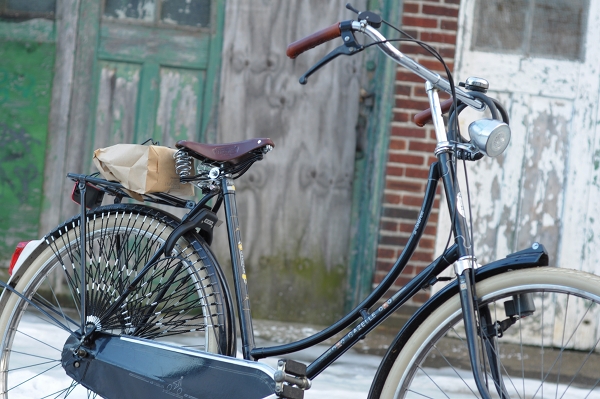
Before last winter began, it seemed that everyone around me was saying that I needed a "winter bike" - a "beater" type mountain bike. I considered it, but ultimately stuck with my Pashley and it worked perfectly well - as did my vintage Gazelle this winter. After my two winters' worth of experience in the snow and salt, I would say that my ideal "winter bike" is one with a chaincase, an internally geared hub, drum brakes, and stable handling. After seeing others struggle with frozen and rusted derailleurs, I would not ride a derailleur bike for transportation in the winter. After getting snow stuck under the calipers on one of my bikes and being unable to stop while going downhill, I will also never ride a rim brakes-only bike in winter.
Road conditions
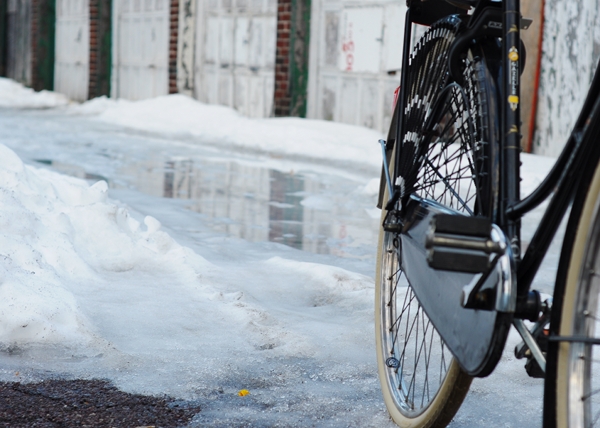
Last year the amount of snow we had was typical for Boston: It snowed regularly, but not overwhelmingly, and the roads were mostly kept clear by the plows. My classic upright bike with its regular tires was just fine under those conditions, and I did not feel the need for studded tires. This winter, I admit it: Had I gotten studded tires from the start, life would have been easier. But who could have predicted that we would have one crazy blizzard after another this time around? It's too late now, but next winter I might buy studded tires and keep them around just in case.
Temperature control
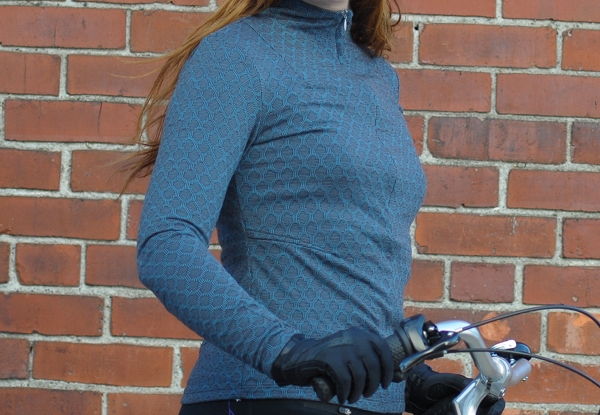
Last winter this was a huge problem for me - my biggest problem in fact. I just could not get the layering right and would constantly feel either too hot or too cold. This winter I embraced wool, and these problems disappeared. I am converted to such an extent, that I have now sold or given away most of my non-wool clothing, and wear a combination of stuff I've knitted myself and stuff I've bought from technical wool brands like Icebreaker, I/O Bio, Ibex and Smartwool (I plan to write a comparative review of different items from these brands soon).
Recreational cycling
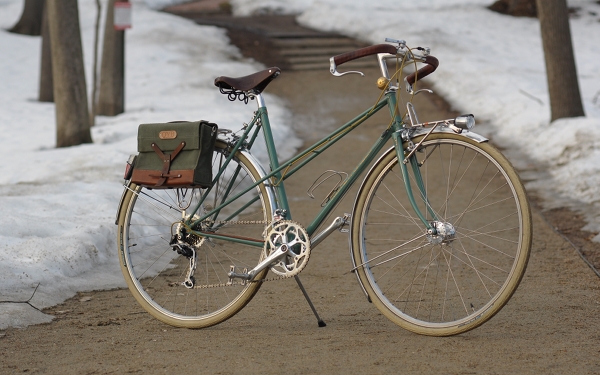
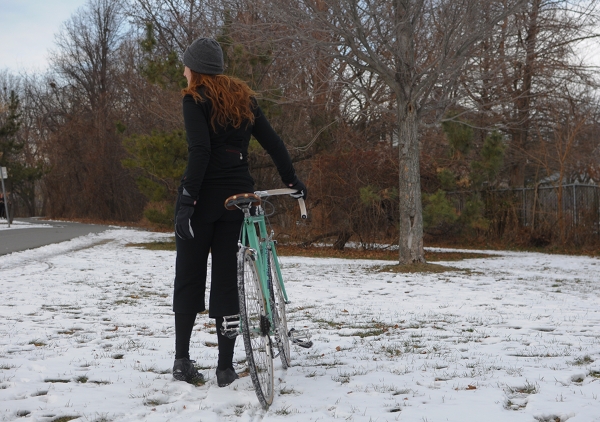
Last winter, I hung up my "sporty bike" (at the time my vintage mixte) in early November and did not retrieve it again until April. This winter I rode recreationally all through November and part of December, and managed to go on a couple of winter rides even after it began to snow. I also got a trainer and began to "cycle" indoors when it became apparent that this winter would me much worse than the last.
Adjusting expectations
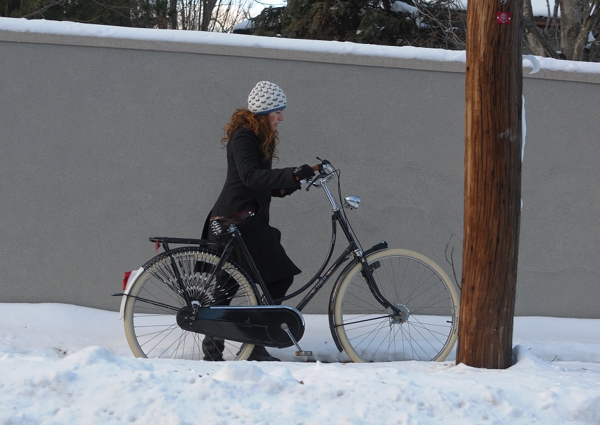
If you live in an area with harsh winters, the simple fact is that you will likely cycle less during the winter season - no mater how tough you are. Though mentally I was aware of that last winter, I was not prepared for it emotionally and found myself in a constant state of frustration as a result. Despite this winter being much worse than the last one, I knew what to expect this time around and it was much easier to take. I still cycle for transportation, but my traveling radius has decreased. I also walk a lot, take public transportation, and spend more time working on projects indoors. That's just how it's going to be until (I expect) mid-March or so, and I have adjusted my expectations accordingly.

I know that many of my readers took up transportation cycling around the same time as I did, and are now going through their second winter as well. Have you noticed any differences? lessons learned that you could share with others? And for those who have been cycling for longer, does it get easier with each winter, or are there ups and downs depending on the year?
Read More
Posted in winter cycling | No comments

Tuesday, February 22, 2011

Budget Roadbike for a Novice? Help a Sister Out!

Posted on 5:33 PM by dvdsvdsdv
[image via fixedgear]
So, I have a younger sister. She lives in Washington DC and works in the legal/financial sector. She does not read this blog, nor would she be interested in my approach to bicycles - which is fine, but it also means that I am not really able to help her. And the thing is, that Sister has signed up for a 60 mile charity ride to promote a cause that is personal and important to us. The ride is this summer, so she wants to buy a roadbike and start training. She has never ridden a roadbike before, and her current bike is a "comfort bike" type of step-through hybrid which she occasionally rides on the local trails. She tried to buy a roadbike at her local bike shop recently, but that experience left her more confused than ever. She can't imagine riding a bike like the ones they had her try, because the positioning felt dangerous and unnatural. But she knows that she can't do the 60 mile ride on her hybrid.

What then am I to suggest in terms of a bike that will feel as "comfortable" and "not scary" as possible? She wants to spend well under $1,000 (she said $500, but I doubt that's an option). She has no desire to mess with a vintage bike. And things like lugs are not even remotely a priority. She wants a modern bike that will feel stable and safe, and will allow her to complete the 60 mile ride while being able to keep up with the others in her group. I should also add that we are not the same size, so sending her one of my bikes is not an option.

[image via Bianchi USA]

Given the circumstances, I am thinking Bianchi Volpe - maybe there will be a 2010 model on clearance at her local bike shop. Or else something by Salsa or by Surley? Alternatively, I recall seeing aluminum Bianchi, Trek and Jamis roadbikes in the $700-800 range, but have no idea what models they are or whether they are any good. But really I am just grasping at straws here. I know that some of my readers ride "normal" modern roadbikes and roll their eyes at my preference for lugged steel and quill stems. Any advice from that camp? I am also thinking of what she should be asking the person who will be helping her at the bike shop. If she wants to get the handlebars higher, does she need to tell them to insert spacers - or how do threadless stems work? She thinks that I "know about bikes" and doesn't understand why I can't just tell her which bike to get. I am out of my depth and at your mercy!
Read More
Posted in bike shopping, roadcycling | No comments

Lug Samesies! Vintage Bianchi vs Trek

Posted on 9:20 AM by dvdsvdsdv
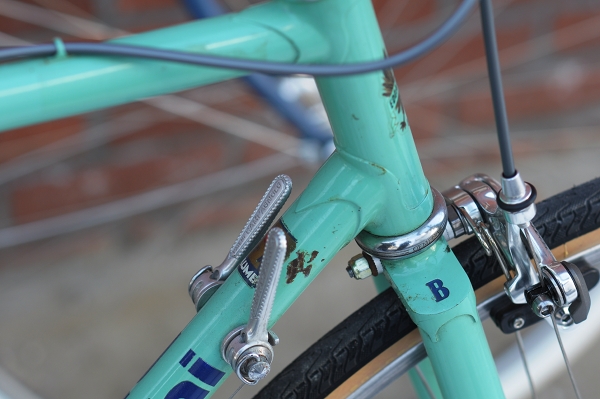
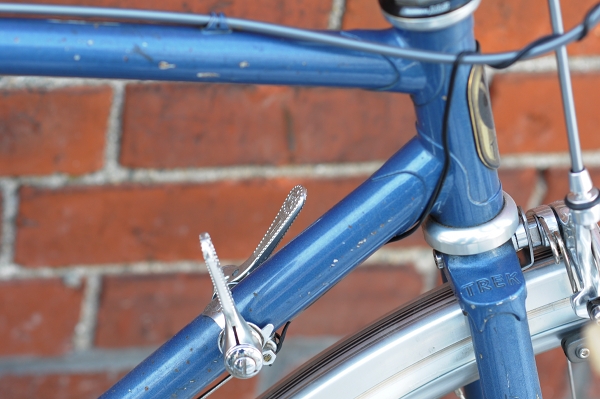
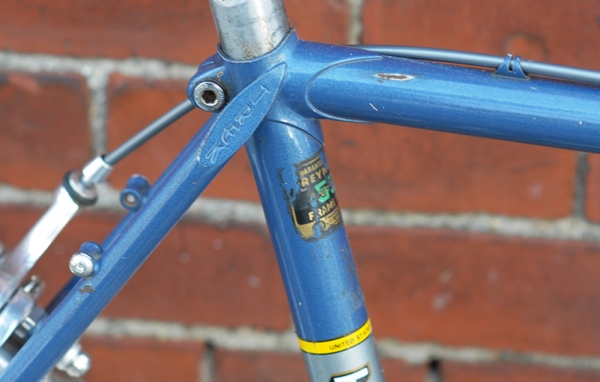
I was initially going to sell my vintage Trek in October, but decided to wait until Spring. Now I am glad to have waited, because it is interesting to compare it to its replacement, the Bianchi. While the two bicycles differ in purpose and geometry (the Bianchi is a racing bike whereas the Trek is a "Sports Touring" model), what amazed me when the Bianchi arrived is that their lugwork is nearly identical. I had camera troubles on the day these pictures were taken, so excuse the quality - but have a look:

Plain and "pointy" lugs on the Bianchi with fork crown.

Identical style of lugs and fork crown on the Trek, only with "Trek" engraved into the crown instead of the Bianchi's "B".

Classic seat cluster engraved with a "B".

Same classic seat cluster engraved with "Trek." I don't have good pictures of the drop-outs, bottom brackets and brake bridges, but those are equally similar. Even the spacing of the braze-ons for the rear brake cable along the top tube is the same.

As far as tubing goes, the Trek is Reynolds 531 for the main triangle and the Bianchi is Columbus, both with cro-moly stays and fork. And they were produced just one year apart - the Trek in 1982 and the Bianchi in 1983. I guess I should not be so amazed that just because one bike is American and a sports turing model while the other is an Italian racing bike, there are such similarities in lugwork. After all, both are factory-built frames and these lugs must have been popular at the time. The Trek and Bianchi ride very differently and there is no mistaking one for another once I am on the saddle. But my disappointment in the generic frame construction makes me aware of how much I value difference in bicycles. I like looking at a bike and being able to distinguish its lineage from another by details of construction and not just by the stamped brand name and the decals.
Read More
Posted in Italian bicycles, lugs, vintage | No comments

Monday, February 21, 2011

Right Up Front

Posted on 10:07 AM by dvdsvdsdv
Some readers notice that I always have the front brake lever set up on the right handlebar on my bikes and ask me why, since the opposite arrangement is more typical in the US.  The quick answer is that I find the "right front" setup more intuitive and more convenient. I have owned bikes with both "left front" and "right front" setups, and consistently began to notice that I prefer to have the front brake lever on the right handlebar. So at some point we rerouted all of my bikes to have the front brake on the right side, and I've been happy since.

Some reasons why I prefer the "right front" set-up:

. My right hand is slightly dominant to my left, and it makes sense to squeeze the front brake - which is the dominant brake - with my dominant hand. 

. On bikes that are coaster brake or fixed gear and have only the front handbrake, it likewise makes sense to squeeze the sole handbrake with my dominant hand.

. Using the right hand for braking leaves my left hand free to signal turns and traffic maneuvers. 

. This one is tricky to describe, but under some conditions I use the front brake as a "stop rolling" device when quickly dismounting my bike, and this maneuver works best when the front brake lever is on the right. 

There are different views out there regarding which set-up makes the most sense, and Sheldon Brown has a nice write-up about it here. Ultimately, I think it is up to the individual cyclist to determine which feels more natural to them. And if the setup with which your bike came from the store doesn't feel right, be aware that this is something that can easily be changed by re-routing the brake cables.  
Read More
Posted in Bella Ciao, comfort, Gazelle | No comments

Sunday, February 20, 2011

Choosing Your Gospel: Rivendell vs Bicycle Quarterly

Posted on 9:38 AM by dvdsvdsdv
For those who are interested in classic touring bicycles that combine speed, maneuverability and comfort, we live in interesting times. Such bicycles have gained in popularity over the past several years, with many custom framebuilders and manufacturers introducing touring models into their line-ups. And while trends like this are not easy to trace, I think it is fair to say that Grant Petersen of Rivendell and Jan Heine of Bicycle Quarterly deserve a great deal of the credit. Rivendell is a small bicycle manufacturer with a distinct philosophy, which they promote with a tireless output of literature. The Bicycle Quarterly (review here) is a niche cycling magazine, with a focus on classic bicycles in the French randonneur tradition.

To the untrained eye, the type of bicycle promoted by these two camps may seem similar, if not identical: lugged steel frames, wide tires, fenders, racks, classic luggage, leather saddles. But in fact, there are major differences as far as geometry and historical lineage go, and these differences have been inspiring impassioned debates among bicycle connoisseurs for years.

Daniel Rebour_Rene Herse_1948_ Bike only
[image via stronglight]

When it comes to frame geometry, Rivendell's emphasis is on relaxed angles and clearance for wide tires. The resulting bicycles are fast, stable, comfortable, and have excellent off-road capacity. The bicycle championed by Bicycle Quarterly is rather more specific. Jan Heine believes that bicycles made in the French randonneur tradition - which had reached its height in the 1940s and 50s before its recent resurrection - offer an unrivaled combination of speed and comfort. These bicycles are aggressive and maneuverable, yet cushy and easy to control. They are super light, yet designed to carry a great deal of weight.  The main difference from Rivendell structurally, is that such bicycles have what is known as "low trail geometry" while Rivendell bicycles have "mid trail geometry." The difference cannot be easily summed up here, but suffice to say that this factor controls the bicycle's responsiveness, and that mid trail is considered classic whereas low trail is more exotic - not often seen outside the early French tradition. In addition, Jan Heine insists on wide 650B tires, lack of toe overlap, and integrated features such as racks and dynamo lighting. Grant Petersen does not place as much emphasis on 650B tires per se, considers toe overlap to be a non-issue, and does not take lighting into consideration when designing frames.

If these differences seem too subtle for those not familiar with frame design, let me rephrase it like this: The bikes may look similar, but they are built differently and ride differently, and there is some debate about which is "better."

[image via protorio]

As a reader of both Rivendell literature and Bicycle Quarterly, I am equally convinced by Petersen and Heine; both arguments make sense while I'm reading them. But they can't both be right, because some of their views are in direct opposition!

Since I own a Rivendell and have now ridden close to 2,000 miles on it, it would be fantastic to try a classic randonneur with low trail and 650B wheels for comparison. The problem is that these bicycles are extremely rare. To try one, I would need to either find a vintage Rene Herse or Alex Singer in my size to test ride - which is next to impossible, as they are not exactly the kind of bike a neighbour would have lying around in their garage, or commission a new one custom built just for me by the handful of framebuilders who specialise in them, or find someone who has commissioned such a bike, is the same size as me, and would be willing to lend it to me for a test ride. As neither option is realistic, my interest in classic randonneurs seems destined to remain hypothetical. Has anybody out there actually tried both a Rivendell and a traditional randonneur?
Read More
Posted in bicycle industry, randonneuring, Rivendell, vintage | No comments

Saturday, February 19, 2011

Tricks of the Camera

Posted on 9:03 AM by dvdsvdsdv
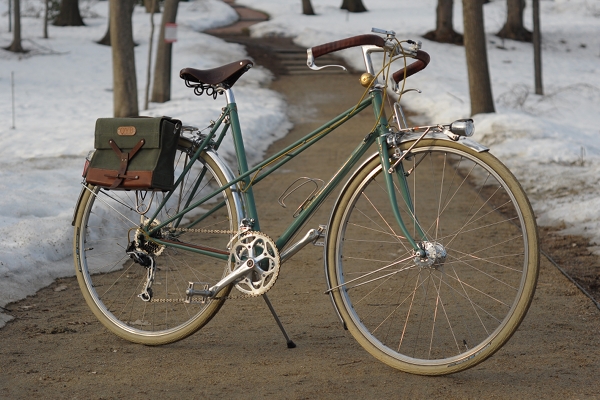
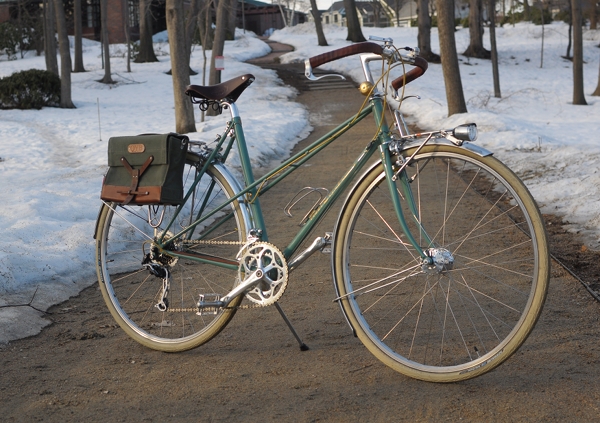
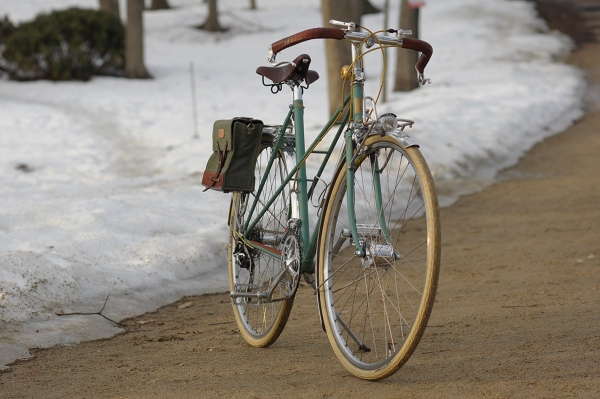
I had three lenses with me in the camera bag yesterday, so I thought it would be neat to illustrate how different lenses affect the way a bicycle looks in pictures. Here are three photos of my mixte standing in the same position, taken with (left to right:) an 85mm lens, a 50mm lens, and a 35mm lens, using identical camera settings. Notice any differences?

Here is a closer look at the picture taken with the 85mm lens. First off, notice the relationship of the bicycle to the trees: In this picture the bike looks like it is positioned in between the trees. There are hardly any trees in the frame itself and if I wanted to I could crop them out all together, making the bike an isolated object in the midst of snow and sand. There is also not a great deal of background information in the space above the bike: a few stairs, but that is all. Furthermore, the things in the background are kind of blurry in comparison to how sharp the bicycle itself looks. And finally, take a look at the size of the bicycle's wheels. The bike is slightly turned toward the camera and the front wheel is closer to me than the rear. But despite this, the front wheel does not look much larger than the rear; the bicycle looks proportional. The 85mm lens is considered a "portrait lens" precisely because it creates these effects: It isolates the subject from the clutter of surrounding objects and reduces unflattering foreshortening effects in the subject's face and body.

Now the same scene, but taken with a 50mm lens. Notice how much more background information is visible in this picture. And it's impossible to crop out, because all that extra stuff is directly behind the bike, rather than around it. The same trees that were spread out to the right and left in the previous picture, now overlap with the bike's wheels and can't be cropped out. More stuff in the space above the bike is visible as well - now we see not just the stairs, but a winding path. And the background scenery is in sharper focus than in the previous picture. It's a nice composition as far as narrative goes (we get more of a sense of the bicycle being in the woods), but a portrait or product photographer would tell you that the background is starting to compete with the subject of the photo. One of the trees looks like it's growing out of the pannier, and the winding path draws the eye away from the forms of the bike itself.

And same scene once again, but with a 35mm lens. The entire patch of woods and the street behind it have now been wrangled into the shot. The background scenery is just as sharp as the bicycle itself, and there's so much of it, that the scene looks altogether cluttered. Also, notice that the front wheel of the bicycle looks considerably larger than the rear, as a result of being closer to the camera. Foreshortening effects are pretty strong with this lens: If I were photographing a person's face, their nose would appear exaggeratedly large in comparison to their eyes for the same reason as the mixte's wheels look to be different sizes.

There is much more to be said about differences between these lenses, and in fact I haven't given a proper introduction to camera lenses at all - but that would take ages and it's nothing you can't find in an online reference. Hopefully, these pictures illustrate the way in which lenses play a role in bicycle photography, and why sometimes it seems like you just can't compose the shot you want with your camera. For those of you who use digital SLRs with interchangeable lenses, which do you prefer to use for bicycle photos?
Read More
Posted in Constance, mixte, winter cycling | No comments

Friday, February 18, 2011

The Pashley Princess: a Retrospective from a Former Owner

Posted on 10:57 AM by dvdsvdsdv
While we are still in hibernation season, I wanted to write a retrospective review of the Pashley Princess I used to own. My existing review of this bike was written after only a month of ownership and leaves a great deal out. I hope to make this review more representative of my overall experience, while providing the sort of information that might be helpful to those shopping for a new bike.

I owned a Pashley Princess Sovereign from June 2009 until August 2010. A lugged steel bicycle made in England, the Princess is a thing of beauty and quality. It was my first "nice" adult bicycle, and the first bicycle I've ever ridden for transportation. As such, it saw me through a period of almost continuous transformation as a cyclist - defined by changes in skill level, confidence, knowledgeability, and preferences. For that reason, I will arrange this review chronologically - from the start of ownership to the end.

The Decision to Purchase
My Pashley was not an impulse buy. I did a lot of research, test rode a number of bikes, and took my time deciding. Among the other bicycles I test rode at the time were Gazelle, Batavus and Velorbis. During those test rides, I remember that I did not feel comfortable with my ability to control the Dutch bikes (Gazelle and Batavus) in comparison to the Pashley. I did not understand why at the time, but now I think I do: Dutch bikes have a light front end, which can take some getting used to. The Pashley's handling felt natural from the start. As for Velorbis, I remember thinking that it was similar to the Pashley, but not quite as nice, and so it was out of the running. I also admit that my deep attachment to England - where I spent a good part of my twenties - influenced me as well. I liked the idea of having an English bicycle.

First Impressions
I purchased the Pashley Princess Sovereign in June 2009 from Harris Cyclery (not a sponsor at that time), together with my husband's Pashley Roadster Sovereign. I chose the 20" (medium) bike in "regency green," and immediately made a number of modifications to it, including the installation of a 7-speed coaster brake hub, netted dress guards and Brooks leather washer grips, as well as extra lights to supplement Pashley's lighting system. All lady's Pashleys have 26" wheels. Detailed specs can be found in my earlier review.

The bicycle's saddle height traveled steadily upward over the course of my ownership. When I first began cycling as an adult, I was extremely nervous about it and felt that I needed to be able to have my feet almost flat on the ground while remaining in the saddle. Over time this nervousness went away as I began to pick up bicycle handling skills. The 20" frame accommodated me throughout this process.

As far as ride quality, initially I was quite pleased with it. What I liked the most about the Pashley Princess was its stability and feeling of "solidness." It made me feel very, very safe - which in turn "empowered" me to try vehicular cycling. Pretty soon, I - a clumsy novice - was cycling for transportation daily in Boston traffic. What I didn't like so much about the ride almost from the start, but could not immediately express, was how much I struggled to pick up speed and go up hills on this bike. But at the time I thought that this was normal for classic upright transportation bicycles, and did not see it as a problem.

One thing that caused some frustration in the beginning, but was entirely my fault and not the bike's, was  the question of how to transport my laptop. I did not trust the idea of clip-on panniers, and the front basket did not feel entirely stable with a huge bag in it. So, for the first few months of owning this bike, I carried a messenger bag. But eventually I stabilised the front basket by securing it with a myriad of zip ties and began to transport my laptop bag inside it - which was fine. However, had I just bought a clip-on pannier, such as the Fastrider I now own, it would have been even better.

Discovery of Limitations
The first inkling that my Pashley may not be the right bike for me, came after I acquired and refurbished a vintage Raleigh Roadster. Despite being larger and clunkier, the old Raleigh DL-1 was considerably faster to accelerate and easier to ride up hill than the new Pashley. I was stunned by the discovery of these differences, and my interest in frame geometry and ride quality was launched largely as a result.

With the arrival of Winter 2009-2010, my qualms about the Pashley's handling were temporarily forgotten, because as a winter bike it was truly fantastic. Since I ride slower in the winter anyhow and stick to shorter distances, acceleration and climbing long hills no longer played an important role in day to day transportation cycling, and I was once again happy with the bike. But as soon as the snow began to subside, the frustration began anew.

The more skilled and confident I became as a cyclist, the farther I started to travel, and the more torn I began to feel about the Pashley Princess. It was such a sweet, well-made, picturesque and iconic bicycle - How could I even think of giving it up? But beyond gentle trails and neighborhood streets, I felt limited on it.

Experimentation and Modifications
In Spring 2010, I began to experiment with the Pashley's positioning and components in order to address my complaints: I lowered the handlebars, raised the saddle, replaced the sluggish Marathon Plus tires with the faster Delta Cruisers, and even removed the front wicker basket in hopes of reducing wind resistance. Each of these changes indeed made a difference, and to my delight the bike now handled similarly to the vintage Raleigh.

I also installed a set of Wald rear folding baskets, which improved my quality of life immensely.

The Decision to Sell
At this point, I was once again happy with the Pashley Princess and had decided to keep it after all. I rode it for most of the summer without complaints. But then, something unexpected happened. By some bizarre stroke of luck I came across a 1990s Gazelle, which I was able to acquire for less than the cost of a Brooks saddle. The second-hand Gazelle handled similarly to my vintage Raleigh, but it was newer and I felt more comfortable using it for transportation. Once I had the Gazelle and found myself riding it all the time, I could not financially justify keeping the Pashley. I decided to sell it and did so swiftly to avoid further agonising over the decision. It was a beautiful bicycle, and I basically learned transportation cycling while riding it. But I do not regret my choice.

In Conclusion
I would describe the Pashley Princess as an elegant and well-made bicycle that is perhaps best suited for those who prefer to cycle slowly and do not live in a hilly area. But ride quality is highly subjective, and so I would recommend reading as many reviews of this bicycle as you can to get a sense of how others feel about it. After all, Katie Doncaster toured across Europe on hers and found it to be well suited for the trip. It is also worth noting, that the Princess model should not be compared to the men's Roadster model, as the latter has 28" wheels and possibly different frame geometry (it looked like it, but we didn't measure when we had both bicycles). While I decided to sell my Princess, my husband continues to ride his Roadster [edited to add: and has now posted a 2-year review].
Read More
Posted in bicycle reviews, Eustacia Vye, Pashley | No comments
Newer Posts Older Posts Home
Subscribe to: Posts (Atom)

Popular Posts

  • Computer Games
    I have never liked computer games, but with the influence of the Co-Habitant I am finally starting to get into them. Here he is, taking a br...
  • Upside Down!
    Fate has been kind to Marianne! Rather than being torn apart for donor components , she has been spared, and fitted with new handlebars. Wha...
  • Matters of Identity
    Well... I thought that I could quietly change my blogspot username without anybody noticing or caring, but it's caused some confusion. S...
  • Celestial Beings
    [image via Spernicelli ] Depending on who you speak to, it is either the most over-rated vintage bicycle in existence, or the Holy Grail: Th...
  • The Pashley Roadster Sovereign: Review After Two New England Winters
    If you are a regular reader, you probably know that the Co-Habitant owns a Pashley Roadster Sovereign. We bought a pair of Pashleys  when I...
  • Crime vs. Accident?
    I was cycling across town with a friend today, who suggested that we take the side streets instead of my usual route along the major roads. ...
  • Putting Your Foot Down
    Enough people have asked me about this now that I thought it worth writing about: How do I put a toe down in traffic while remaining on the ...
  • Pulling the Trigger vs Doing the Twist: Thoughts on 3-Speed Gear Shifters
    On bicycles with internally geared hubs, we typically see two types of gear shifters. The trigger shifter (pictured above) is a small gadget...
  • Manufacturers with 'History': Does Continuity Matter?
    What does it mean, when we say that a bicycle manufacturer has a long history? There are manufacturers out there, whose names are legendary ...
  • An Igleheart and a 'Sex Hub'
    At the New England Bicycle Expo  a couple of weekends ago, I had the pleasure of meeting legendary New England framebuilder Christopher Igle...

Categories

  • ANT
  • art
  • bags
  • basket
  • beginners
  • Bella Ciao
  • bicycle events
  • bicycle industry
  • bicycle reviews
  • bike friends
  • bike shopping
  • blog development
  • blogiversary
  • books
  • Boston
  • Brompton
  • Brooks
  • Cape Cod
  • cargo bikes
  • cars
  • cats
  • children
  • clipless
  • clothing
  • Co-Habitant
  • coaster brake
  • comfort
  • Constance
  • countryside
  • diamond frame
  • DIY
  • DL-1
  • dress guards
  • drop bars
  • Eustacia Vye
  • fashion industry
  • fenders
  • films
  • fixed gear
  • flowers
  • food
  • framebuilding
  • Gazelle
  • Geekhouse
  • gender
  • give-away
  • grips
  • handlebars
  • handmade
  • holidays
  • Interbike
  • Italian bicycles
  • Jacqueline
  • knitting
  • lights
  • local bike shops
  • locking up
  • loop frame
  • lugs
  • Maine
  • Marianne
  • mercian
  • Mercier
  • mixte
  • Moser
  • Motobecane
  • Myles
  • night time cycling
  • North Shore
  • paceline
  • Pashley
  • pilen
  • poll
  • product reviews
  • racks
  • rain
  • Raleigh
  • Randonneur
  • randonneuring
  • restoration
  • Rivendell
  • roadcycling
  • rod brakes
  • Rodney
  • Romania
  • Royal H
  • Royal H. Mixte
  • saddles
  • safety
  • Seven
  • shop visits
  • silliness
  • skirt
  • social commentary
  • Soma
  • somervillain
  • stories
  • summer cycling
  • sun and heat
  • Surly
  • tandem
  • technique
  • test rides
  • tires
  • tools
  • traffic
  • trails
  • transportation options
  • travel
  • unpaved
  • urban cycling
  • Urbana
  • Velo Orange
  • Velouria
  • Vienna
  • vintage
  • winter cycling

Blog Archive

  • ▼  2011 (236)
    • ▼  September (17)
      • Frills or Basics?
      • European City Bikes and the North American Market
      • Thoughts on Fixed Gear Cranksets?
      • From Holsters to Corsets: The Cycling Accessory Fe...
      • Yeah Baby! Transportational Elegance Reigns at Int...
      • Handmade Bicycles at Interbike
      • Bleak Prognosis for the Dutch Bicycle?
      • GB Components Are Back! ...And You Can Have Their ...
      • Song, Dance and Bicycle Romance: The Interbike Fas...
      • On Bicycle Reviews
      • What's the Difference?
      • In the Raw
      • Frames of Mind: Why Did We Not Cycle?
      • Embracing Wrinkles
      • Reunited
      • The Art of the Ride Report: a Touring Bicycle Give...
      • If a Branch Falls in a Forest...
    • ►  August (22)
    • ►  July (26)
    • ►  June (27)
    • ►  May (27)
    • ►  April (26)
    • ►  March (30)
    • ►  February (30)
    • ►  January (31)
  • ►  2010 (262)
    • ►  December (28)
    • ►  November (29)
    • ►  October (24)
    • ►  September (23)
    • ►  August (25)
    • ►  July (25)
    • ►  June (20)
    • ►  May (19)
    • ►  April (20)
    • ►  March (17)
    • ►  February (18)
    • ►  January (14)
Powered by Blogger.

About Me

dvdsvdsdv
View my complete profile