lindaikeji35

  • Subscribe to our RSS feed.
  • Twitter
  • StumbleUpon
  • Reddit
  • Facebook
  • Digg
Showing posts with label beginners. Show all posts

Wednesday, July 20, 2011

Everyone Wants Stability

Posted on 10:27 AM by dvdsvdsdv
Blue and Green
In discussions of a bicycle's ride quality, one thing that always comes up is stability. We want a bike that is stable and we complain when it is not. Of course the problem with "stability" is that the concept is largely dependent on our skill level and cycling background. Those who are unaccustomed to riding roadbikes will often find them unstable at first, while those who ride roadbikes exclusively will often find upright bikes unstable. This does not mean that either is actually unstable, but rather that the two cyclists are used to radically different means of weight distribution. Similarly, what's "unstable" to one cyclist can be "responsive" to another. It seems that perception of stability has at least as much to do with the person riding the bicycle as it does with the bicycle itself. How useful is it, then, to tell a salesperson or a framebuilder that we want a bicycle that is stable? And how useful is that term in reviews? Clearly we need further qualification.

When I talk to new cyclists who are uncomfortable operating their bikes, instability is often cited as the problem: It can make a bicycle difficult or scary to ride, making the cyclist feel not entirely in control. In the process of teasing out what exactly is meant by this elusive concept, I've identified a number of distinct points that I would like to share, and see what others think: 

Pilen, Balance
Starting from a stop
Some bicycles are described as shaky when starting from a stop, as if the front wheel is wobbly and wants to turn just as the cyclist is trying to get the bike rolling forward. This is a complaint I hear a lot from women about vintage mixtes that came with dropbars, but have been converted to upright bikes and also, interestingly, about classic Dutch bikes. The feeling is sometimes referred to as "light steering" or a "light front end," and has to do with a complicated combination of the bicycle's geometry and the height of the handlebars. With some bikes, I have found that lowering the handlebars helps - in particular when it comes to the mixte conversions - but ultimately it is a matter of getting used to it. Some cyclists do get used to it, but others can't and feel inherently uncomfortable with the bike. 

Cycling at slow speeds
Similar to the above, only extended to cycling at slow speeds: The bike wants to weave (i.e. feels "squirrely" or "twitchy") when the cyclist attempts to ride slowly, making it difficult to control. Aggressive roadbikes are known for this quality, but cyclists report the feeling about some upright bikes as well (albeit often they are upright bikes that are roadbike conversions). One thing I have found useful when riding bicycles like this at slow speeds, is to pedal in slow motion while feathering the brake, instead of coasting. I would be interested to know whether this works for others. 

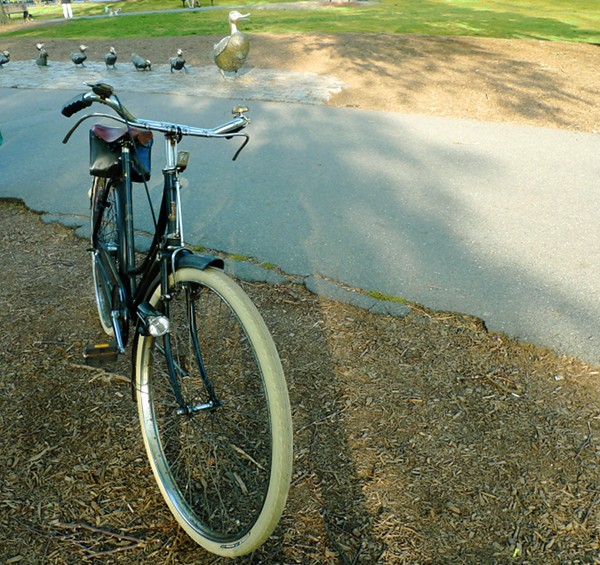
Pilen Bicycle, Castle Island
Cycling at fast speeds, downhill
When riding at fast speeds, and particularly downhill, some cyclists are alarmed to notice that the font end of their bicycle will begin to vibrate in the region of the stem and handlebars. Assuming that nothing is loose on the bike or mechanically wrong with it, this is known as "shimmy" and there are ongoing debates regarding what causes it, whether it's a problem, and whether it is even a real phenomenon. This is something that a cyclist either gets used to, learns to avoid by abstaining from high speeds on that particular bike, or deals with by getting a different bike. 

Turning
When cyclists describe a bicycle as unstable on turns, they can mean a number of things by this. One type of complaint is that the bike turns too aggressively or, "too much," overreacting to the turn. Another type of complaint is the opposite: that the bike keeps trying to straighten itself while the cyclist is still continuing the turn. Either of these qualities can make turning stressful, with the cyclist struggling to make the bicycle follow the course they would like it to follow. How to deal with this, other than developing handling skills in line with the bicycle's tendencies (or getting a different bike) I cannot say.

Tire and Rock
Rough surfaces
To some cyclists it is important how stable a bicycle feels when going over rough or uneven surfaces. While wide tires play a role, at least to some extent this seems to be also about the bicycle itself - with some bikes seemingly "unfellable" off road or over potholes, while others relatively easy to wipe out on, especially for novices. In the realm of upright city bikes,  there is an increasing number of manufacturers (Pilen, Retrovelo, Urbana) infusing classic transportation bicycles with mountain bike characteristics in a way that works well in this context. Converting an old hardtail mountain bike to an upright bike can work as well. Upright roadbike conversions on the other hand, tend to be problematic in this respect - particularly for beginners. 

Tire width
Whether on smooth or rough surfaces, I have noticed that tire width can have a lot to do with a novice cyclist's perception of a bicycle's stability: Narrow tires are simply more difficult to balance on across a wide range of circumstances. If the bicycle's clearances allow for wider tires, this is an easy way to improve the feeling of a bicycle's stability. 

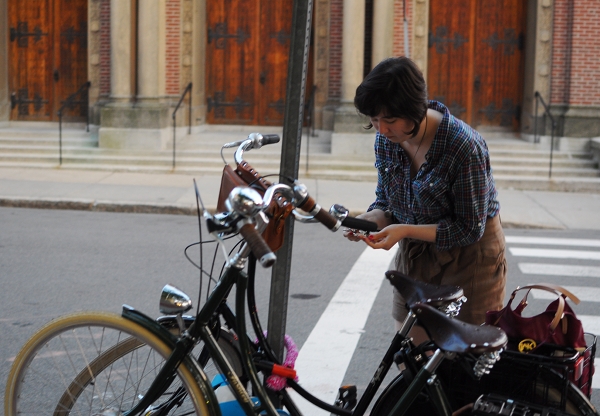
Mixte with Camera Bag, Pannier and Packages
Cycling with a load
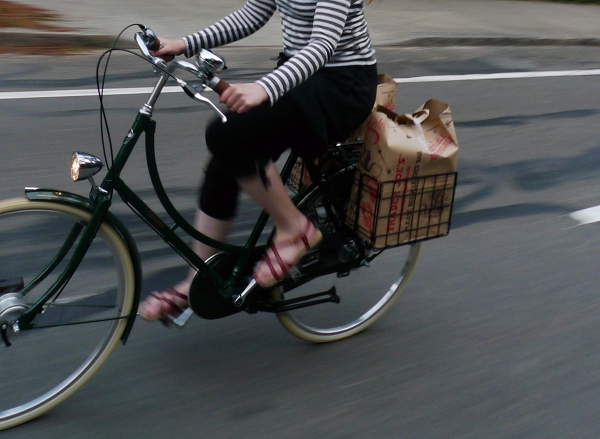
Finally, whereas a bicycle might feel perfectly stable unloaded, some notice that introducing weight in the front basket or on the rear rack can disrupt that stability. Most of the time, this happens with a front rather than rear load: the bicycle begins to weave or wobble if the front is overloaded. There can be a myriad of causes for this, and subsequently a myriad of ways to deal with them. Generally speaking, carrying weight lower on the bike (i.e. not mounting a basket on the handlebars) is said to improve stability. But some bicycles are just not intended for a front load no matter what.

Pilen Bicycle, Castle Island
While it might be difficult to express what we mean by stability, breaking it down into specifics can be helpful - both in communicating with others and in gaining more insight into our own preferences. In attempting to understand the nuances of ride quality, it continues to amaze me how the same idea can be echoed by so many people, yet mean something slightly (or even not so slightly) different to each. Does a novice who finds their bicycle unstable need a different bike, or merely wider tires? Could be either.
Read More
Posted in beginners, comfort, mixte, pilen | No comments

Wednesday, May 4, 2011

If Not Bike Month, Then What?

Posted on 10:13 PM by dvdsvdsdv
A couple of weeks ago I wrote this post explaining why I do not believe that "Bike Month" is effective at making transportation cycling accessible to non-cyclists and beginners. In the discussion that followed, many different opinions were expressed - which I appreciate. In addition, a couple of readers suggested that, since I criticised the approach, perhaps I could follow up with my own ideas. If not bike month, then what alternative would I propose? That was a good point, and I have now prepared my response. This is far from the first time I've considered the issue. But it's one thing to have my head full of ideas, and quite another to express them lucidly. Let me give it a try.

A Support System for Cyclists
If the goal of a city, community, or organisation is to make cycling an accessible form of transportation, I propose a year-round support system permanently in place. This support system could exist in the form of a small department within the local government structure, or in the form of an independently funded non-government organisation. The sole mission of this department or organisation would be to provide a range of services - in the form of literature, materials, counseling, classes and workshops, and more - to persons interested in transportation cycling. It is crucial that the office or organisation providing these services be non-partisan - which includes independence from political groups, environmental organisations, or any other entities with specific agendas to pursue. The goal of this office or organisation would not be to promote cycling, but to support cyclists or those considering cycling - which is a crucial distinction. Trained employees would work with person, families, and groups to determine their level of comfort, their concerns and their goals - responding appropriately and providing them with relevant resources. The existence of this office or organisation would be made known to the public via an online presence, via brochures available at relevant local venus, and via announcements in the local media.

While I have quite detailed and concrete ideas of how this fictional entity would function, outlining all of them would require its own post - or more like a multi-page proposal. But I think you get the gist of what I envision. Having a solid, well-developed support system in the community that any cyclist can rely on is, would in my view, be more effective than a month-long annual event that is dense in activities while it lasts, only to end abruptly. A year-round support system would also send the message to the community that cycling is an accepted and attainable means of transportation.

A "How, Not Why" Approach
It is my belief that the chances of non-cyclists finding the idea of transportation cycling appealing are diminished, rather than improved by the "hard sell" tactics employed by the majority of bicycle activists (and by the very notion of bicycle activism, for that matter). When people try too hard to convince us that something is "good for us" or morally superior, our natural response is to be skeptical, to resist. After all - if it's so wonderful, then why are they trying so hard to persuade us and why isn't everyone already doing it? For this reason, I think it is misguided to "sell" cycling. Moreover, cycling doesn't need to be sold: It is a trend on the rise, particularly in large cities that are centers of popular culture. People everywhere are already enjoying riding their bicycle for transportation, and we need merely to communicate this fact as a given. Instead of telling people why they should cycle, make it an implicit assumption that they already want to do it (of course! doesn't everyone?) and focus on the how. I believe that this approach must underlie any initiative or outreach program designed to encourage new cyclists.

Ideas for a How-To Brochure
One thing discussed with particular zeal in the comments of my post about bike month, was the Bike to Work Week commuter booklet - a transportation cycling guide offered as promotional literature by the organisers of Bike Month. Here I described the ways in which nearly every page of the brochure portrays transportation cycling as a challenging and possibly dangerous athletic activity, which I believe makes the brochure intimidating rather than inviting. In response, I will outline my vision for an alternative brochure.

Title:
"A Guide to Cycling for Transportation"

Introduction:
Start by mentioning that cycling for transportation is becoming increasingly popular, and many people are wondering how to go about starting. This brochure is for them.

How to begin:
Explain how easy it is to commute by bicycle, dispelling myths that athleticism, energy bars, or special cycling clothing are necessary in order to commute to work on a bike.

Choosing a bicycle:
Inform of the existence of comfortable transportation bicycles, and explain which accessories are necessary in order to commute in work clothing. List bicycle shops that specialise in commuter bicycles and perhaps websites that focus on reviewing them.

Road rules:
Using clear and simple language, outline the basic cycling laws in your area, providing link to full version.

Safety:
Be objective and positive. Cite statistics that reveal bicycling to be a relatively safe activity. Stress the necessity of good brakes, proper lighting, and adherence to road rules first and foremost. Explain that opinions on helmets are mixed, and while some choose to wear them, others do not.

Illustrations:
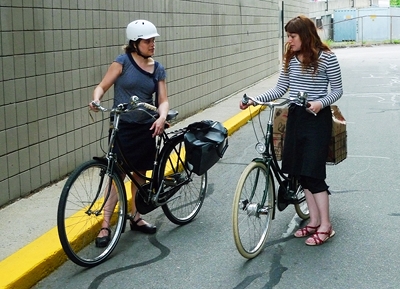
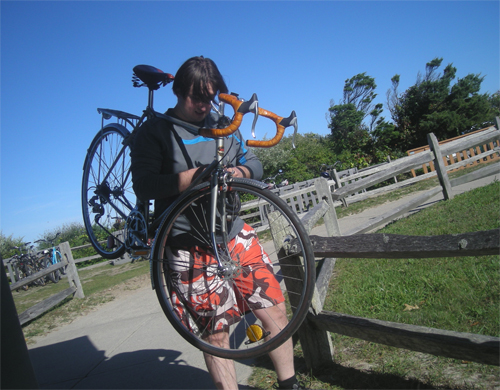
Choose appealing images where persons are shown cycling at a relaxed pace while wearing street clothing and riding transportation bicycles with appropriate accessories. Include signs of normal, everyday activities: parents transporting children, persons in suits cycling with briefcases strapped to rear racks, grocery panniers with flowers sticking out, and so on. Images should communicate that cycling is easy, convenient and pleasant. Helmet use can be portrayed in a manner that represents freedom of choice: Some cyclists can be shown wearing one and other cyclists not, in a way that both come across as natural (see image above, or this image from a recent bike advert).

Further Resources:
Provide a list of popular websites focusing on transportation cycling.

Given that small, specific things are easier to implement than grandiose plans, I think that creating a brochure such as the one I outlined to counteract the one promoted via Bike Month would in itself be useful to those who are considering cycling for transportation and do not know where to begin. But making one - as well as thinking up the means of distributing it - is a project that would require hours of my time and is beyond the scope of this blog. Putting forth ideas is far more difficult than merely criticising, and I am exhausted from writing this post. Your thoughts on all of this are, of course, welcome.
Read More
Posted in beginners, social commentary, transportation options | No comments

Friday, June 11, 2010

Expanding Comfort Zones

Posted on 5:30 AM by dvdsvdsdv
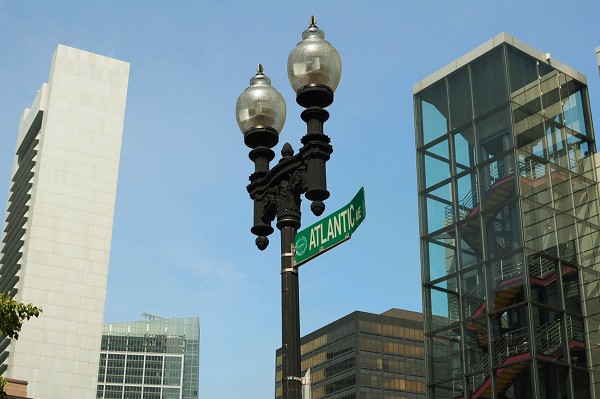
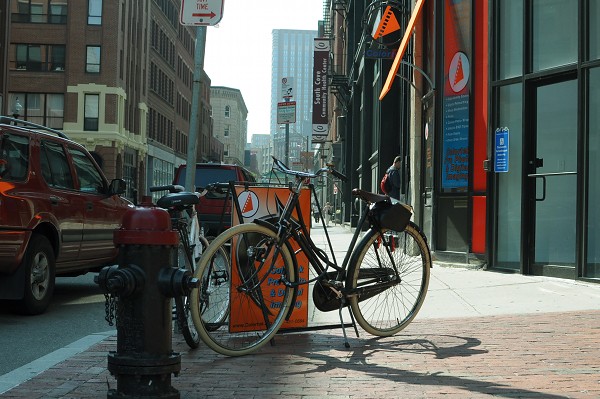
Over the past couple of weeks I've had things to do in downtown Boston and the Financial District, so I have been going there more than usual. As I cycle through this dense urban area, my company includes mainly bumper-to-bumper car traffic and bike messengers weaving through it. It was a hot afternoon and I was waiting in the left lane at a red light - a black SUV behind me and a gray pick-up truck on my right - when it suddenly occurred to me: I was quite comfortable. Any moment now, the light would turn green and I would make a left turn in a way that would not conflict with oncoming vehicles. The awareness of this was not one of nervous anticipation, but one of calm preparedness. Perhaps I am no longer quite the "beginner" I still tend to think of myself as being.

I say all of this not to brag (and I am sure many would mock the idea of cycling in downtown Boston as any sort of accomplishment), but to point out that the "baby steps" principle really does work if you are patient and allow yourself to expand your comfort zone at your own pace. Last summer, I wrote this post about overcoming my anxieties and cycling outside my immediate neighborhood. Now those anxieties seem in the distant past, as I cycle all over greater Boston and beyond.

Of course the city's ever-expanding bicycle infrastructure helps as well. Not so much because the bike lanes are spectacular (note the amount of debris on the left and how close the car gets on the right), but because the sheer act of painting all sorts of bicycle signifiers seems to make drivers more aware of cyclists' existence in general. Overall, conditions for cyclists are improving here.

If I wanted to cross the river to Boston last year, I would cycle along the Charles River Trail at a snail's pace. Now I just go right on the roads and cross the main city bridges. It takes 15-20 minutes to get where I need to be, and I no longer feel anxious to cycle in this manner. I make no secret of the fact that I am a neurotic wimp with a poor sense of balance. So, at the risk of perpetuating a cliché: "If I can do it, anybody can." Choose a bicycle you love, take it one neighborhood at a time, and expand your comfort zone.

Just be sure to make way for ducklings...

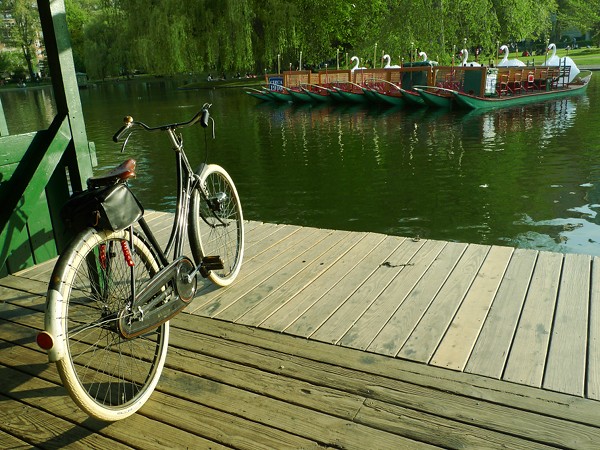
And don't tease the swans!
Read More
Posted in beginners, Boston, DL-1, loop frame, Raleigh, technique, urban cycling | No comments

Sunday, May 16, 2010

'So My Husband Wants Me to Get a Bike...'

Posted on 7:42 PM by dvdsvdsdv
Since the start of the Spring season, I have been getting emails from women that read something like this:
My husband/boyfriend is a cyclist and he wants me to get a bike so that we can ride together. I am not very good at cycling, or sports in general. What bike do you recommend? My husband/boyfriend sent me a link to your blog and said that you would know.
Nice. Notice that the phrasing is not "I would like to get a bicycle so that I can accompany my husband/boyfriend on rides," but that the desire and intent are attributed entirely to him. This is something he has probably been convincing her to do for a while, and finally he sent her to my website, as if to say "See? Other women can do it!" (Great way to make her hate me, fellows!)

Of course if he does succeed in convincing her to buy a bike and join him, I can already see how that will go. He: the man dressed like a professional racer on a $2,500 road bike. She: the woman in ill-fitting bike shorts, cotton tank-top and sneakers, on a $600 hybrid. He: stern and professorial, explaining the importance of proper cadence and posture in a tireless monologue. She: red in the face and panting, sneaking longing glances at the families picnicking on the grass. Eventually it ends in bickering and tears - or worse, a fall. I see this on the local trails all the time. Please, don't be that couple.

If you are a cyclist and want to share your favourite pastime with your spouse, that's fantastic. But please understand that in order for someone to enjoy cycling as much as you do, the interest must come from within - and that you are essentially killing any chance of that happening by pushing too strongly or making the person's first cycling experience too difficult and stressful.

So what should you do instead? Well, for starters don't try to be your spouse's teacher or mentor. Unless she has absolutely never pedaled a bike before, there is no need to "instruct" her, as tempting as that may be. Even if you think she is "doing it wrong", leave it. She did not sign up for a bicycle course; she just wants to have fun with you out in nature. Give her that, and she will associate cycling with the nice time she had - and therefore will want to do it again.

Also, even if you have been cycling since age 5 and can compete in timed half-centuries in your sleep, consider downplaying your prowess and adapting a "leisure cycle" mode. Don't kit up. If you have an old beater bike, ride that when you are together instead of your super-fast roadbike. I would even go so far as to suggest buying an old vintage upright-ish bike for yourself, to match the level of the bike your spouse will be riding. This will even out the playing field between the two of you and will make you less intimidating.

In general, I think that getting your spouse to cycle is not about what she should do to keep up with you, but about what you should do to make her comfortable with her current level of skill. If it's going to work, that's the only way. Only if she enjoys cycling, will she become motivated to improve her skills, and perhaps will even start asking you for advice - giving you plenty of opportunity to play "coach" when the time comes for it. But that initial enjoyment is key, and it is up to you to set things up in a way to make it happen. Think about it from that perspective, start slow, let her figure things out for herself... And perhaps before you know it, your special lady might delight you by becoming a bona fide obsessed cyclist, entirely on her own accord. She may even start a blog.
Read More
Posted in beginners, comfort, gender, social commentary, technique | No comments
Older Posts Home
Subscribe to: Posts (Atom)

Popular Posts

  • Computer Games
    I have never liked computer games, but with the influence of the Co-Habitant I am finally starting to get into them. Here he is, taking a br...
  • Upside Down!
    Fate has been kind to Marianne! Rather than being torn apart for donor components , she has been spared, and fitted with new handlebars. Wha...
  • Matters of Identity
    Well... I thought that I could quietly change my blogspot username without anybody noticing or caring, but it's caused some confusion. S...
  • Celestial Beings
    [image via Spernicelli ] Depending on who you speak to, it is either the most over-rated vintage bicycle in existence, or the Holy Grail: Th...
  • The Pashley Roadster Sovereign: Review After Two New England Winters
    If you are a regular reader, you probably know that the Co-Habitant owns a Pashley Roadster Sovereign. We bought a pair of Pashleys  when I...
  • Crime vs. Accident?
    I was cycling across town with a friend today, who suggested that we take the side streets instead of my usual route along the major roads. ...
  • Putting Your Foot Down
    Enough people have asked me about this now that I thought it worth writing about: How do I put a toe down in traffic while remaining on the ...
  • Pulling the Trigger vs Doing the Twist: Thoughts on 3-Speed Gear Shifters
    On bicycles with internally geared hubs, we typically see two types of gear shifters. The trigger shifter (pictured above) is a small gadget...
  • Manufacturers with 'History': Does Continuity Matter?
    What does it mean, when we say that a bicycle manufacturer has a long history? There are manufacturers out there, whose names are legendary ...
  • An Igleheart and a 'Sex Hub'
    At the New England Bicycle Expo  a couple of weekends ago, I had the pleasure of meeting legendary New England framebuilder Christopher Igle...

Categories

  • ANT
  • art
  • bags
  • basket
  • beginners
  • Bella Ciao
  • bicycle events
  • bicycle industry
  • bicycle reviews
  • bike friends
  • bike shopping
  • blog development
  • blogiversary
  • books
  • Boston
  • Brompton
  • Brooks
  • Cape Cod
  • cargo bikes
  • cars
  • cats
  • children
  • clipless
  • clothing
  • Co-Habitant
  • coaster brake
  • comfort
  • Constance
  • countryside
  • diamond frame
  • DIY
  • DL-1
  • dress guards
  • drop bars
  • Eustacia Vye
  • fashion industry
  • fenders
  • films
  • fixed gear
  • flowers
  • food
  • framebuilding
  • Gazelle
  • Geekhouse
  • gender
  • give-away
  • grips
  • handlebars
  • handmade
  • holidays
  • Interbike
  • Italian bicycles
  • Jacqueline
  • knitting
  • lights
  • local bike shops
  • locking up
  • loop frame
  • lugs
  • Maine
  • Marianne
  • mercian
  • Mercier
  • mixte
  • Moser
  • Motobecane
  • Myles
  • night time cycling
  • North Shore
  • paceline
  • Pashley
  • pilen
  • poll
  • product reviews
  • racks
  • rain
  • Raleigh
  • Randonneur
  • randonneuring
  • restoration
  • Rivendell
  • roadcycling
  • rod brakes
  • Rodney
  • Romania
  • Royal H
  • Royal H. Mixte
  • saddles
  • safety
  • Seven
  • shop visits
  • silliness
  • skirt
  • social commentary
  • Soma
  • somervillain
  • stories
  • summer cycling
  • sun and heat
  • Surly
  • tandem
  • technique
  • test rides
  • tires
  • tools
  • traffic
  • trails
  • transportation options
  • travel
  • unpaved
  • urban cycling
  • Urbana
  • Velo Orange
  • Velouria
  • Vienna
  • vintage
  • winter cycling

Blog Archive

  • ▼  2011 (236)
    • ▼  September (17)
      • Frills or Basics?
      • European City Bikes and the North American Market
      • Thoughts on Fixed Gear Cranksets?
      • From Holsters to Corsets: The Cycling Accessory Fe...
      • Yeah Baby! Transportational Elegance Reigns at Int...
      • Handmade Bicycles at Interbike
      • Bleak Prognosis for the Dutch Bicycle?
      • GB Components Are Back! ...And You Can Have Their ...
      • Song, Dance and Bicycle Romance: The Interbike Fas...
      • On Bicycle Reviews
      • What's the Difference?
      • In the Raw
      • Frames of Mind: Why Did We Not Cycle?
      • Embracing Wrinkles
      • Reunited
      • The Art of the Ride Report: a Touring Bicycle Give...
      • If a Branch Falls in a Forest...
    • ►  August (22)
    • ►  July (26)
    • ►  June (27)
    • ►  May (27)
    • ►  April (26)
    • ►  March (30)
    • ►  February (30)
    • ►  January (31)
  • ►  2010 (262)
    • ►  December (28)
    • ►  November (29)
    • ►  October (24)
    • ►  September (23)
    • ►  August (25)
    • ►  July (25)
    • ►  June (20)
    • ►  May (19)
    • ►  April (20)
    • ►  March (17)
    • ►  February (18)
    • ►  January (14)
Powered by Blogger.

About Me

dvdsvdsdv
View my complete profile