There is also the question of safety. Driving in protest is safer than cycling in protest, as on a bicycle a person is more vulnerable to recognition, apprehension, and potential attack.
Showing posts with label gender. Show all posts
Monday, June 20, 2011
Vehicles of Equality
Posted on 11:38 AM by dvdsvdsdv
There is also the question of safety. Driving in protest is safer than cycling in protest, as on a bicycle a person is more vulnerable to recognition, apprehension, and potential attack.
Tuesday, March 8, 2011
On Bicycles, Women and Politics
Posted on 8:37 AM by dvdsvdsdv
Today is the 100th anniversary of International Women's Day - what began as a European political movement in 1911, but evolved into what is now more like a "women's appreciation day," or, in the former socialist countries, a sort of Mother's Day and Valentine's day rolled into one. As ironic gestures, friends have sent me cards with messages such as "Woman, With Your Daily Acts of Goodness You Inspire Us!" showing a Polyanna-esque maiden feeding forest animals amidst flower blossoms.
Though I am fairly well versed on gender in the academic sense, I did not personally care much about gender "issues" until I became interested in bicycles and cycling. Something about the latter turned the former into a more poignant topic, and I find myself writing about gender-oriented themes here that would not have been on my mind a few years ago. I feel vaguely unsettled about the way female cyclists are perceived and depicted by the very cycling community they belong to. I get the same feeling of unease from the pictures on Copenhagen Cycle Chic as I do from that Woman's Day card showing the angelic girl feeding forest animals.
Equally distasteful to me is the school of thought that women cyclists "bring it upon themselves" by being all sexy and frivolous on their bikes wearing skirts and high heels. If they want to be taken seriously as cyclists, they must don practical shoes and high-vis wear. It's been decades since similar rhetoric about women has been acceptable in Western society. But apparently the cycling community is an exception.
Besides, don't roadies and tri-athletes wear far more revealing clothing than women going grocery shopping in a dress and heels? At the heart of it, it's really all about how one chooses to twist it politically, which in turn is based on personal preferences and prejudices.
And what is the difference between politics and personal philosophies? Let's Go Ride a Bike has a post today where they ask "Is bicycling political?" - which I think is more or less a trick question: a contemporary truism, whereby any "no" answer will inevitably be demonstrated to be just as political as a "yes" answer. It reminds me of the arguments I had in college with people who would tell me that being a woman is political, whether I wanted it to be or not. According to those arguments, everything I do is inherently political because I am a woman, and I have no way of escaping that. But don't I?
I think that in order for the political question to be addressed meaningfully, we have to distinguish the way others perceive us from our inner world - and while the two are connected, they are not one and the same. Any action on our part, as well as our very existence, can be perceived as political by others. But if we don't experience it politically, then it is a basic human right for our inner experience to be recognised as valid. A woman's cycling and her gender may be politically perceived by others, but they may not be politically experienced by her - with both points of view having equal merit.
Tuesday, February 1, 2011
The 'Lady's Bicycle': Descriptive, Offensive, or Merely Obsolete?
Posted on 11:20 PM by dvdsvdsdv
There has been some discussion lately about how appropriate it is to refer to diamond and step-through frame bicycles as men's and ladies' bikes. After all - gender roles are flexible these days, women are no longer expected to wear elaborate skirts, and a low standover height can be convenient for everyone. So why use gender specific terminology? Am I just intentionally being quaint?
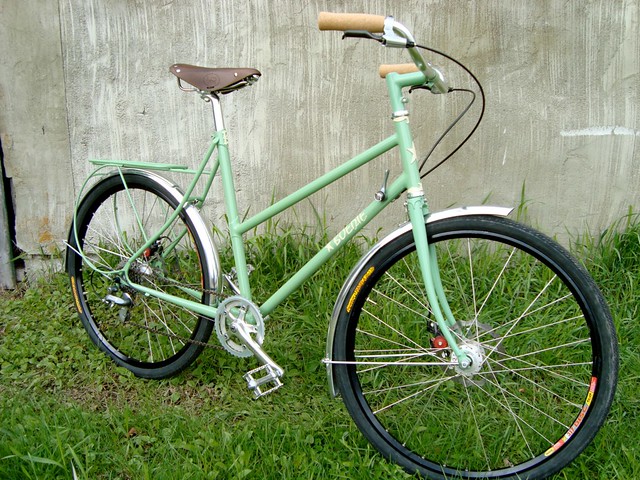
Well, not exactly. You see, when a bicycle model exists in both diamond frame and step-through designs, the latter is usually not just about lowering the standover height. It is also about taking the female anatomy into account. For example, have a look at the pictures below and see whether you notice anything interesting.
These are the Oma and Opa versions of the current production Gazelle Toer Populair bicycles. If you look closely, you will notice that the Oma on the left has a considerably higher headtube than the Opa on the right. This is done in order to set the Oma's handlebars higher, so as to accommodate the typically shorter torsos and arms of female cyclists. The bikes are named "Grandma and Grandpa," because they are, in fact, gender-specific. The expanded headtube tactic is used by many manufacturers on their step-through models, while others use the alternative tactic of shortening the virtual top tube. Either way, more often than not the step-through version of a given bicycle model is designed for the female body. This is not to say that men cannot or should not ride step through frames, but only that step-through frames are typically optimised for female proportions.
Of course, one could ask: Why confound gender-based anatomical differences with preferences for standover height? After all, some women may prefer diamond frames, while some men may prefer step-throughs. That is where statistics and market research come in. Most manufacturers cannot afford to make two versions of diamond frames and two versions of step-through frames within the same model. And statistically, women are considerably more likely to wear skirts and are thus more likely to prefer a step-through transportation bike. Therefore, it makes more sense to optimise the step-through design for the female anatomy, while optimising the diamond frame design for the male anatomy. Naturally, there will be some females who prefer the diamond frame and some males who prefer the step-through. Furthermore, not every woman has a short torso and not every man has a long torso. But when it comes to manufacturing decisions, it's all about tendencies and probabilities - not about individuals.
And speaking of statistics, perhaps we could indulge in another poll (a weekly tradition?). No purpose for this other than my own curiosity, and possibly yours:
In my own vocabulary, I use terms like "lady's bike" or "woman's frame" when I am referring specifically to the bicycle's suitability for females - be it anatomically, or in terms of their ability to accommodate skirts. On the other hand, I use terms such as "step through," "loop frame," and "mixte," when I am describing frame geometry. And while some worry that referring to bicycles as "women's bikes" makes them seem inferior or less valuable, I am not on board with that line of thinking. After all, what is considered "standard" frame geometry in the industry, is in fact optimised for the male anatomy. We are female, we are wonderful, and we need bicycles designed for us. To me, that is neither offensive nor obsolete - it's just common sense.
Monday, January 10, 2011
The Mary Poppins Effect?
Posted on 8:35 AM by dvdsvdsdv
Lately, there has been some discussion in the comments about whether drivers display more courtesy when cyclists ride upright bicycles and dress in "regular" clothing. One reader wrote that "the uprightness [is] more visible and [the clothing] maybe less offensive to your average driver... The images generated revolve around Mary Poppins. Only a monster would do anything mean to Mary Poppins" (Christopher Fotos, December 10, 2010). Do you agree?
When Bike Snob NYC poked fun at the Tweed Ride last week in his typically colourful manner, I related to the associations he made with colonialism and Civil War re-enactments: I never found Tweed Rides appealing for precisely those reasons. But I disagree with his conclusion that nice clothes on a bike are generally "not traffic calming." It's one thing to be dressed in what appears to be period costume, joined by dozens of others who have done the same while taking a joyride through the city. It's another thing entirely to be cycling to work in a suit and a wool overcoat, because that is what you normally wear to work.
Speaking solely from my own experience, I'd noticed as soon as I started cycling for transportation that drivers are nicer to me when I dress "normally." And since having begun to ride a roadbike recreationally, the difference between how I am treated on the roads when on a bike with drop bars, wearing "sporty clothing" and my hair tucked away, in comparison to how I am treated when on an upright bike in "city clothing," with my work bag in the basket and my hair visible, is noticeable. The majority of the time, when a driver is rude to me or impatient with me, I am on my roadbike - which is odd, since I am faster on a roadbike than I am on an upright bike, and thus should be less "in the way." To me, this just confirms that drivers' perceptions of how annoying a cyclist is, are entirely subjective. You can be going 10mph and this will be okay, or you can be going 25mph and they might still be annoyed.
In part, I think the idea of not wanting to harm Mary Poppins is valid - in the sense that a cyclist dressed "normally" looks more human to the driver. The way people process each other visually and emotionally is governed by a complicated system of simulation and self-recognition (this is actually my research specialty, so I've spent a lot of time thinking about it!). And from that point of view, it makes sense to speculate that the more "I am human! I am you!" signals we give off when cycling, the more empathy a driver will feel towards us. Dehumanisation, on the other hand, makes it easier to cause harm to another human being - because we fail to simulate their emotional state and relate to their suffering. And dehumanisation is facilitated by things like uniforms (one reason it is easier to kill soldiers and war prisoners, than civilians), or anything else that obscures individuality and hides signs of humanness.
But in addition to the Mary Poppins effect, I think that there are also implicit right of way rules that are present in the driver's mentality, from which "normally" dressed cyclists benefit. I am not suggesting that this is justified in any way, but I get the impression that drivers are enraged by the associations with leisure and recreation that a road cyclist's attire evokes. The cyclist is on the road because they are going for a ride. The driver, however, is on the road because they need to be somewhere. So the reasoning follows, that the person who needs to be somewhere clearly has more valid reasons to use the limited road space than the person who is going for a ride, which is why the presence of the road cyclist causes annoyance. On the other hand, when the cyclist's appearance suggests that they are also engaging in transportation and need to be somewhere just like the driver, their presence on the roads seems more justified. This is just a theory, but the fact that drivers will shout things like "Get a job!" to roadies, but will ask me "How long does it take you to get to work?" at red lights when I am dressed up, gives it some plausibility. They associate the "normal clothes" look with going to work, and they associate the sporty look with recreation.
All of this is, of course, entirely speculative and none of it is to say that cyclists should strive to dress in any particular way in order to secure the driver's compassion. Only the certainty of criminal prosecution can reliably deter a driver from causing harm to a cyclist, and I hope to see that become the norm in the US in the near future. Until then, let's hope that drivers can find a way to see Mary Poppins in all of us, whether we are dressed in lycra, tweed, or something in between.
When Bike Snob NYC poked fun at the Tweed Ride last week in his typically colourful manner, I related to the associations he made with colonialism and Civil War re-enactments: I never found Tweed Rides appealing for precisely those reasons. But I disagree with his conclusion that nice clothes on a bike are generally "not traffic calming." It's one thing to be dressed in what appears to be period costume, joined by dozens of others who have done the same while taking a joyride through the city. It's another thing entirely to be cycling to work in a suit and a wool overcoat, because that is what you normally wear to work.
Speaking solely from my own experience, I'd noticed as soon as I started cycling for transportation that drivers are nicer to me when I dress "normally." And since having begun to ride a roadbike recreationally, the difference between how I am treated on the roads when on a bike with drop bars, wearing "sporty clothing" and my hair tucked away, in comparison to how I am treated when on an upright bike in "city clothing," with my work bag in the basket and my hair visible, is noticeable. The majority of the time, when a driver is rude to me or impatient with me, I am on my roadbike - which is odd, since I am faster on a roadbike than I am on an upright bike, and thus should be less "in the way." To me, this just confirms that drivers' perceptions of how annoying a cyclist is, are entirely subjective. You can be going 10mph and this will be okay, or you can be going 25mph and they might still be annoyed.
In part, I think the idea of not wanting to harm Mary Poppins is valid - in the sense that a cyclist dressed "normally" looks more human to the driver. The way people process each other visually and emotionally is governed by a complicated system of simulation and self-recognition (this is actually my research specialty, so I've spent a lot of time thinking about it!). And from that point of view, it makes sense to speculate that the more "I am human! I am you!" signals we give off when cycling, the more empathy a driver will feel towards us. Dehumanisation, on the other hand, makes it easier to cause harm to another human being - because we fail to simulate their emotional state and relate to their suffering. And dehumanisation is facilitated by things like uniforms (one reason it is easier to kill soldiers and war prisoners, than civilians), or anything else that obscures individuality and hides signs of humanness.
But in addition to the Mary Poppins effect, I think that there are also implicit right of way rules that are present in the driver's mentality, from which "normally" dressed cyclists benefit. I am not suggesting that this is justified in any way, but I get the impression that drivers are enraged by the associations with leisure and recreation that a road cyclist's attire evokes. The cyclist is on the road because they are going for a ride. The driver, however, is on the road because they need to be somewhere. So the reasoning follows, that the person who needs to be somewhere clearly has more valid reasons to use the limited road space than the person who is going for a ride, which is why the presence of the road cyclist causes annoyance. On the other hand, when the cyclist's appearance suggests that they are also engaging in transportation and need to be somewhere just like the driver, their presence on the roads seems more justified. This is just a theory, but the fact that drivers will shout things like "Get a job!" to roadies, but will ask me "How long does it take you to get to work?" at red lights when I am dressed up, gives it some plausibility. They associate the "normal clothes" look with going to work, and they associate the sporty look with recreation.
All of this is, of course, entirely speculative and none of it is to say that cyclists should strive to dress in any particular way in order to secure the driver's compassion. Only the certainty of criminal prosecution can reliably deter a driver from causing harm to a cyclist, and I hope to see that become the norm in the US in the near future. Until then, let's hope that drivers can find a way to see Mary Poppins in all of us, whether we are dressed in lycra, tweed, or something in between.
Wednesday, December 15, 2010
User Friendly Interface
Posted on 12:21 AM by dvdsvdsdv
Now that it's winter, I find that strangers talk to me more than usual about cycling - typically when they see me locking up my bike. Over the past couple of weeks, several women have told me that they'd love to ride a bike, but find the logistics daunting: having to buy lights and figure out how to mount them; constantly getting flats (something they remember from previous cycling experiences); having to figure out how to carry their handbag, struggling to mount the bike in business attire, and other similar concerns. Their misgivings are fueled by the perception that cycling will complicate their lives - compared to walking, or taking public transportation, or driving.
What frustrates me about this, is that all of their concerns can be addressed with the right bike. As I explain about step-through frames, dynamo lighting, tires with puncture-protection, dress guards, chain cases, and panniers that attach to the bicycle's rack in seconds, I can see the ladies' faces light up as they eye these features hungrily.
One woman tried to step through my frame in her skirt-suit and squealed with delight when she was able to do it. She had never tried anything other than a mountainbike before. She said: "I knew you had a special type of bike! It's got this... user-friendly interface!" That phrase echoed in my mind for some time.
Even though I enjoy learning about bicycle design and own multiple bikes on which I constantly experiment, I am first and foremost a "transportation cyclist." My main priority is to have that one bike that is reliable, comfortable, and as low-maintenance as possible. The bicycle I use for transportation needs to make life easy for me. It needs to minimise the extent to which I think about it and tinker with it - so that I can focus on work and life itself, not on the bicycle. Skirt suit? Heavy bag? Dark outside? Raining like crazy? The "user friendly interface" on my machine accommodates all of these scenarios.
Many manufacturers are making what they are calling "transportation bicycles" nowadays, but not all of these bikes work for everyone. When a woman wearing a skirt suit walks into a bike store and says she would like to start cycling to work, my hope is that the salesperson will point to the section with the right kind of bicycle for her - rather than saying "Well, you won't be able to do it wearing that!" A user-friendly interface means that we should all be able to do it. Holiday wish: more elegant, practical, comfortable bicycle options for the women in skirt-suits who feel out of place in bike shops. It's getting better, but we aren't there yet.
What frustrates me about this, is that all of their concerns can be addressed with the right bike. As I explain about step-through frames, dynamo lighting, tires with puncture-protection, dress guards, chain cases, and panniers that attach to the bicycle's rack in seconds, I can see the ladies' faces light up as they eye these features hungrily.
One woman tried to step through my frame in her skirt-suit and squealed with delight when she was able to do it. She had never tried anything other than a mountainbike before. She said: "I knew you had a special type of bike! It's got this... user-friendly interface!" That phrase echoed in my mind for some time.
Even though I enjoy learning about bicycle design and own multiple bikes on which I constantly experiment, I am first and foremost a "transportation cyclist." My main priority is to have that one bike that is reliable, comfortable, and as low-maintenance as possible. The bicycle I use for transportation needs to make life easy for me. It needs to minimise the extent to which I think about it and tinker with it - so that I can focus on work and life itself, not on the bicycle. Skirt suit? Heavy bag? Dark outside? Raining like crazy? The "user friendly interface" on my machine accommodates all of these scenarios.
Many manufacturers are making what they are calling "transportation bicycles" nowadays, but not all of these bikes work for everyone. When a woman wearing a skirt suit walks into a bike store and says she would like to start cycling to work, my hope is that the salesperson will point to the section with the right kind of bicycle for her - rather than saying "Well, you won't be able to do it wearing that!" A user-friendly interface means that we should all be able to do it. Holiday wish: more elegant, practical, comfortable bicycle options for the women in skirt-suits who feel out of place in bike shops. It's getting better, but we aren't there yet.
Posted in comfort, dress guards, gender, loop frame, skirt, social commentary, urban cycling
|
No comments
Monday, December 6, 2010
Bicycles and the Human Figure: Do We Look Better on a Bike?
Posted on 4:00 AM by dvdsvdsdv
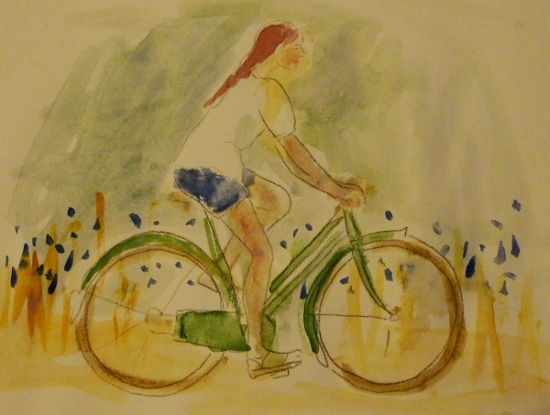
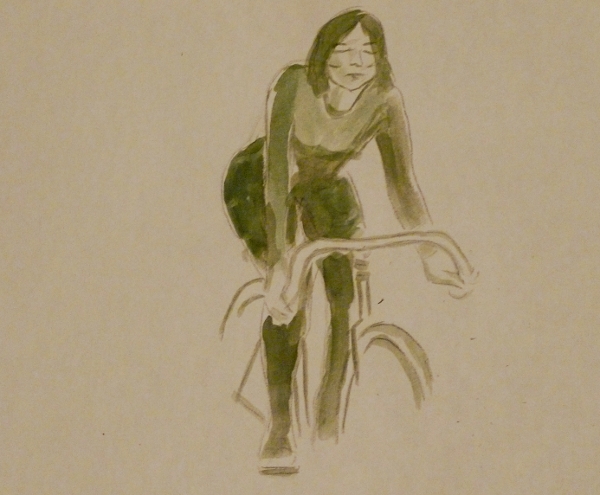
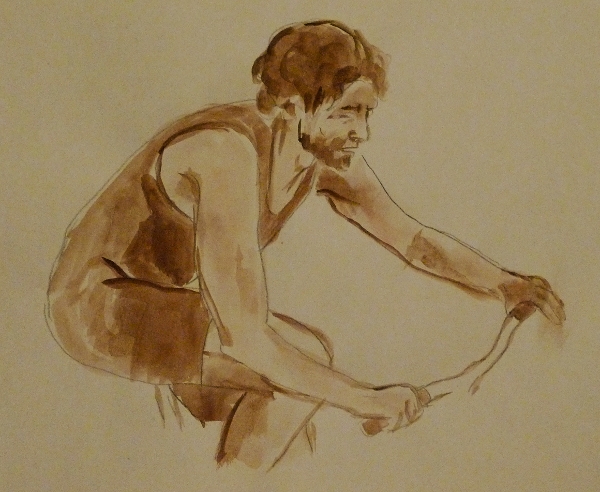
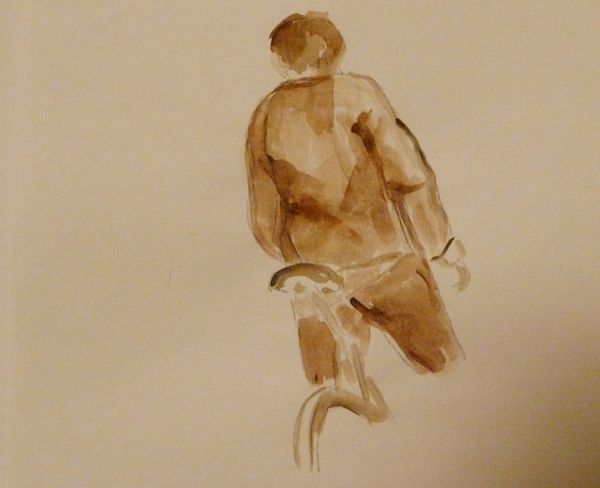
I have never drawn or painted bicycles before, but am now starting a commissioned painting that will include two female cyclists - so I've been making figure drawings and sketches of people on bikes. It has been interesting to study the postures our bodies adapt while cycling - and especially interesting to note the inherent attractiveness of those postures.
Cycling also tends to make the legs look longer and leaner - another evolutionary measure of attractiveness, for both genders (researchers believe that long legs may have been indicators of hereditary longevity).
When we cycle, the muscle tone in our arms and legs is accentuated - a general sign of health. In males, this can also serve to suggest strength - which, according to evolutionary psychology once again, females are pre-disposed to respond to.
Finally, being on a bicycle raises the figure higher off the ground, literally making the cyclist seem taller - another advantage for males. The added height also makes the cyclist more noticeable, regardless of gender - placing their body on a moving pedestal of sorts.
Of course, these things aren't simple formulas and there are many factors to consider in addition to the evolutionarily built-in heterosexual responses to each other's bodies. But generally speaking, there is a great deal of evidence that our postures and body language implicitly communicate sexual appeal and social roles to others. Maybe "you look better on a bike" is not just a catch phrase!
As you may have heard, the folks at the Kickstand are having a Virtual Alleycat Race, powered by cycllelicious. If you are taking part, then you have arrived at the Lovely Bicycle checkpoint. You are probably looking for the link to the next checkpoint, but hang on - you're not getting it yet!
Here is what to do:
1. To qualify for the Best Checkpoint Comment Prize, please leave a comment on this post with your name and registration number. The comment must be left between 10am Eastern Standard Time on December 6, 2010 and the same time on December 13, 2010.
2. Lovely Bicycle is having its own mini-contest as part of the Alleycat, and the winner will receive a Mystery Prize. What the mystery prize is I cannot tell you, but if you like bicycles and art you might enjoy it. To take part, tell me what you like best about the way you - or others - look on a bicycle (this does not have to be physical - be as creative or abstract as you like). Please include your name and race number, so that I can identify you! The most compelling comment will receive the Lovely Bicycle Mystery Prize. Only Alleycat racers are eligible for this contest.
3. You would like the link to the next checkpoint now, yes? You shall have it just as soon as you answer a few questions [link disabled - the Alleycat is over, thank you for taking part!].
If you haven't registered for the 2010 Kickstand Cyclery Virtual Alleycat Race yet, register here now!
Saturday, November 27, 2010
Musings on MUSA Knickers
Posted on 12:17 AM by dvdsvdsdv
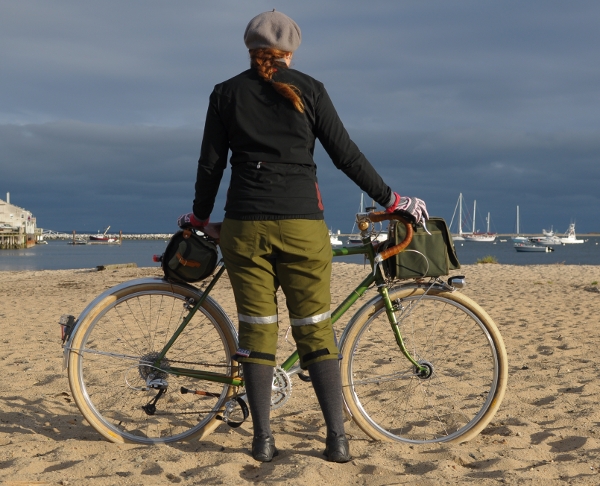
Musa is a Rivendell house brand that stands for "made in USA." Under this label, Rivendell produces a line of clothing and accessories, including the knickers and pants that are designed specifically for cycling, but are described as being wearable "anywhere when formal wear isn't called for." The Co-Habitant ordered both the knickers and the long pants over the summer, because he was wearing out all his regular pants on long rides, and he thought these would be more durable. He immediately loved them and kept recommending them to me - until I finally bought a pair of knickers myself a couple of months later. Our impressions of this product are somewhat different, and put together they will hopefully be informative for both genders.
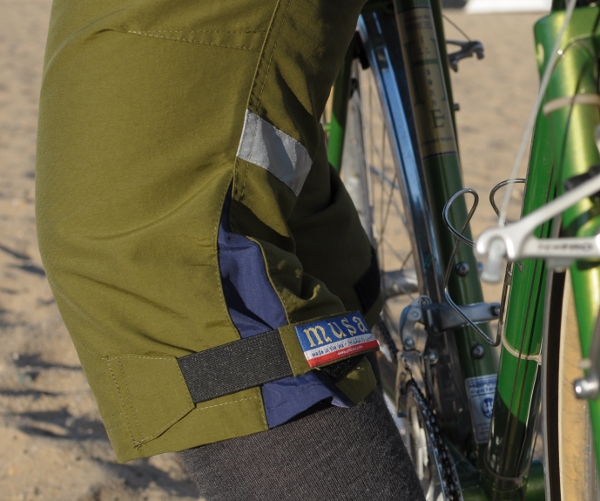
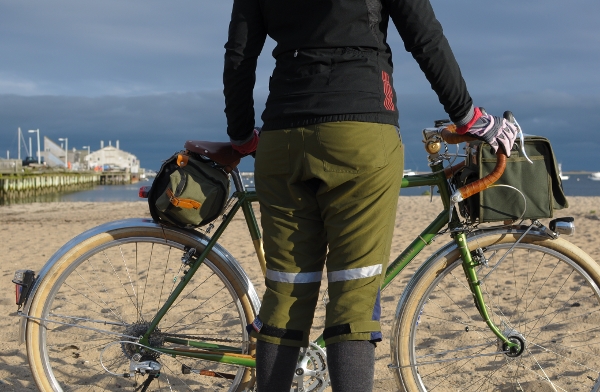
Made of lightweight, breathable, and durable nylon, the Musa knickers work well for cycling, because they feature a roomy gusset in the crotch area, adjustable-width cuffs with velcro straps, and reflective strips.
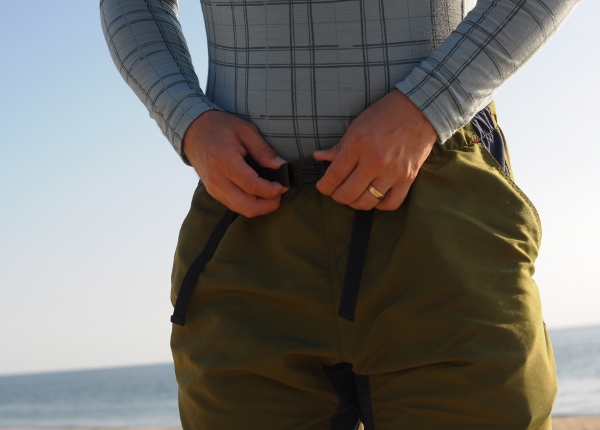
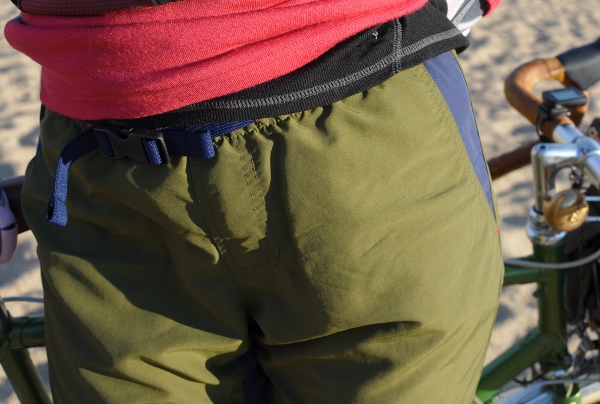
The adjustable waist closes via one of those nylon belts and plastic buckles you see on hiking pants.
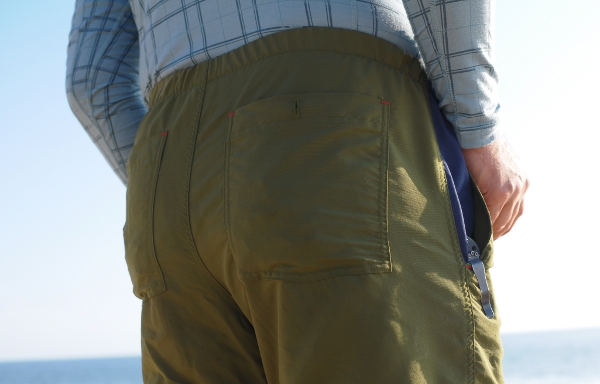
The pockets are deep and cut in a way that stuff doesn't spill out of them while cycling - a useful feature for those who like to keep small items on their person while on the bike.
The Co-Habitant normally wears pants with a 34" waist, and the XL Musas fit him well. They are relaxed, but with a tailored look to them. The cut is flattering to the male body.
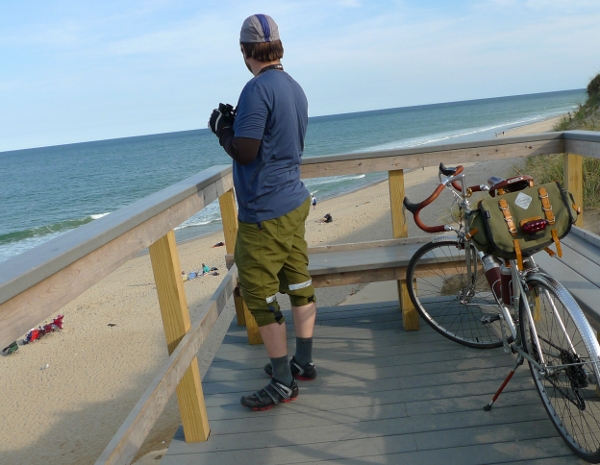
The pants and knickers are currently available in olive, gray, black and blue. The Co-Habitant has the olive knickers (pictured) and the gray long pants. The knickers he wore mostly over the Summer and early Fall; the pants he continues to wear now, including off the bike. His feedback is that his Musas are extremely comfortable and useful. Not only does the seamless gusset protect from chafing during long trips, but the pants regulate temperature well in both hot and cold weather, and are a lot more durable than the trousers he wears off the bike (one problem with cycling long distance in regular clothing, is that the clothing can get ruined from rubbing against the saddle and from sweat). For those men who do not want to wear tight, padded cycling shorts, but want something cycling-specific that looks decent off the bike, these are a good option. I do not quite agree with Rivendell's description of them looking like "normal" pants. They are definitely quirky. But I find this particular quirkiness attractive.
Moving on to my own experience with the Musa knickers (and in case you are wondering - no, we do not wear them at the same time!), my main reason for buying them was the gusset. I cannot ride a roadbike for more than 20 minutes while wearing anything with seams along the crotch, and finding pants without seams in that region is not easy. So seeing how happy the Co-Habitant was with his Musas, I finally ordered a pair for myself. Rivendell describes these knickers as unisex and has a size chart for women. Going by the waist measurements on the chart, I initially ordered an XS. However, I could not pull them on over my hips, so I exchanged them for a Small. The Small went on over my hips fine, but fit me overly loosely petty much everywhere else.
Sometimes a loose fit can be flattering, but with the Musa knickers luck was not on my side. The sagginess in the butt distorts the shape of my body in a way that just doesn't look good, and extra material bunches up around my inner thighs.
The knickers are also overly loose in the front. It is as if the fabric won't lie against my body right - bunching up in all the wrong places. This leads me to conclude that the pants were simply not tailored with a female waist-to-hip ratio in mind. While I am not the curviest woman in the world, I do have a narrow waist and comparatively wide hips - a combination that makes it difficult to get the sizing right.
But fit and sizing issues aside, the Musa knickers do have a number of features I find useful. The gusset is huge and there is not a single seam between me and any part of the saddle, which is excellent. The nylon material really is very light and breathable, as well as wind-resistant, mildly water resistant and fast-drying. The fabric does not pill or degrade after prolonged contact with the saddle - and having worn through several pairs of leggings and shorts over the past year, such durability is welcome. The pockets are staggeringly deep - though the feature is wasted on me, as I prefer to cycle without too much stuff in my pockets. The expandable width cuffs with velcro closure are clever, if a bit finicky (I had to redo mine a few times to get them to feel right). As other owners of these have noted, the pants were shiny and slippery in the beginning, but this went away after a few long rides.
All in all, the Musa pants and knickers are excellent if you want to wear something comfortable and durable on a roadbike, and if you are male. If you are female, consider the issues with fit and compare how the pants look on a male vs a female body. For me, the gusset and other positive features are worth it - but only because I found no better alternatives. And I would never wear these knickers in a context other than on a roadbike, which does diminish the value of what was meant to be a "wear them anywhere" design.
Made of lightweight, breathable, and durable nylon, the Musa knickers work well for cycling, because they feature a roomy gusset in the crotch area, adjustable-width cuffs with velcro straps, and reflective strips.
The adjustable waist closes via one of those nylon belts and plastic buckles you see on hiking pants.
The pockets are deep and cut in a way that stuff doesn't spill out of them while cycling - a useful feature for those who like to keep small items on their person while on the bike.
The Co-Habitant normally wears pants with a 34" waist, and the XL Musas fit him well. They are relaxed, but with a tailored look to them. The cut is flattering to the male body.
The pants and knickers are currently available in olive, gray, black and blue. The Co-Habitant has the olive knickers (pictured) and the gray long pants. The knickers he wore mostly over the Summer and early Fall; the pants he continues to wear now, including off the bike. His feedback is that his Musas are extremely comfortable and useful. Not only does the seamless gusset protect from chafing during long trips, but the pants regulate temperature well in both hot and cold weather, and are a lot more durable than the trousers he wears off the bike (one problem with cycling long distance in regular clothing, is that the clothing can get ruined from rubbing against the saddle and from sweat). For those men who do not want to wear tight, padded cycling shorts, but want something cycling-specific that looks decent off the bike, these are a good option. I do not quite agree with Rivendell's description of them looking like "normal" pants. They are definitely quirky. But I find this particular quirkiness attractive.
Moving on to my own experience with the Musa knickers (and in case you are wondering - no, we do not wear them at the same time!), my main reason for buying them was the gusset. I cannot ride a roadbike for more than 20 minutes while wearing anything with seams along the crotch, and finding pants without seams in that region is not easy. So seeing how happy the Co-Habitant was with his Musas, I finally ordered a pair for myself. Rivendell describes these knickers as unisex and has a size chart for women. Going by the waist measurements on the chart, I initially ordered an XS. However, I could not pull them on over my hips, so I exchanged them for a Small. The Small went on over my hips fine, but fit me overly loosely petty much everywhere else.
Sometimes a loose fit can be flattering, but with the Musa knickers luck was not on my side. The sagginess in the butt distorts the shape of my body in a way that just doesn't look good, and extra material bunches up around my inner thighs.
The knickers are also overly loose in the front. It is as if the fabric won't lie against my body right - bunching up in all the wrong places. This leads me to conclude that the pants were simply not tailored with a female waist-to-hip ratio in mind. While I am not the curviest woman in the world, I do have a narrow waist and comparatively wide hips - a combination that makes it difficult to get the sizing right.
But fit and sizing issues aside, the Musa knickers do have a number of features I find useful. The gusset is huge and there is not a single seam between me and any part of the saddle, which is excellent. The nylon material really is very light and breathable, as well as wind-resistant, mildly water resistant and fast-drying. The fabric does not pill or degrade after prolonged contact with the saddle - and having worn through several pairs of leggings and shorts over the past year, such durability is welcome. The pockets are staggeringly deep - though the feature is wasted on me, as I prefer to cycle without too much stuff in my pockets. The expandable width cuffs with velcro closure are clever, if a bit finicky (I had to redo mine a few times to get them to feel right). As other owners of these have noted, the pants were shiny and slippery in the beginning, but this went away after a few long rides.
All in all, the Musa pants and knickers are excellent if you want to wear something comfortable and durable on a roadbike, and if you are male. If you are female, consider the issues with fit and compare how the pants look on a male vs a female body. For me, the gusset and other positive features are worth it - but only because I found no better alternatives. And I would never wear these knickers in a context other than on a roadbike, which does diminish the value of what was meant to be a "wear them anywhere" design.
Thursday, October 14, 2010
Do Women Want Custom Bicycles?
Posted on 9:08 PM by dvdsvdsdv
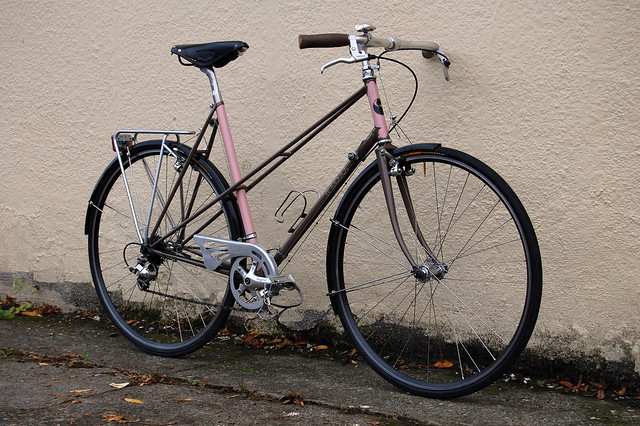
Not surprisingly, my beautiful mixte by Royal H. Cycles has been making quite a splash. People ask about the bicycle, and when I say that it was custom built the reactions are interesting. Several men (including framebuilders) have asked whether it was a gift from my husband or boyfriend - meaning, whether he was the one who ordered the frame for me, interacted with the builder, etc. Others have asked whether the framebuilder is my boyfriend. And others still have noted the amazing amount of detail for a women's frame and asked whether it was built as a NAHBS bike (show bike) - which is mostly where one would see such a mixte. When I explain that I was the one who ordered the frame, thought up the criteria for it, specified the design features, etc., all without a male intermediary, this is met with amazement. And having thought about it, I doubt this has anything to do with sexism. Rather, I think it is about statistics: According to the framebuilders I have talked with, women do not typically take the initiative to order custom hand-built bicycle frames. The more common scenario, is that a male framebuilder builds the bicycle for his female significant other, or a male bicycle lover orders it for his spouse.
Thinking about that has made me wonder how women feel about handbuilt bicycles. Do they want them? Or do they perceive the process as either too daunting, or not worth the money or time it takes?
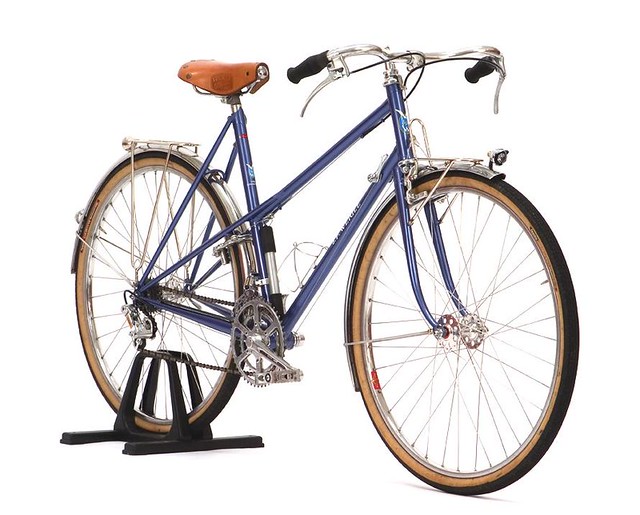
At NAHBS and other handmade bicycle shows, mixtes and step throughs have become increasingly popular over the past several years. One might even say that it is now almost de rigueur for classic framebuilders to include a mixte in their portfolio. Does this not mean that there has been an increase in demand for ladies' bikes?
To an extent, I am sure there has been some increase in demand (and here again we must differentiate between women ordering the bicycles versus their spouses ordering for them). But for the most part, I believe the appearance of women's bicycles at handbuilt shows is mainly symbolic - reflecting the increasing number of women cycling for transportation in American cities.
Additionally, a mixte frame is more challenging to build than a diamond frame. It involves more elaborate brazing and lugwork - giving the framebuilder the opportunity to truly show off the extent of their skills. When done right, a mixte can embody elegant design at its most stunning.
So what about the ladies? Do they ever call up a framebuilder and order a bike for themselves? I am not saying that it never happens, and a few builders in particular (ANT, for example) seem to attract female customers. There is also the "lady framebuilder" Sweetpea, which caters specifically to women. But overall, it isn't typical. If you browse framebuilders' websites and flickr accounts that include narratives about recently made bicycles, you are more likely to find descriptions such as "this mixte was commissioned by Joe for his lovely wife Mary" than "this mixte was commissioned by Mary". Will this change as the number of female cyclists grows? I hope so! It would be fun to argue with another female about seat tube angles and lugwork.
Monday, June 28, 2010
Do We Care If They See Our Underwear?
Posted on 5:55 PM by dvdsvdsdv
Ah, the topic of underpant visibility whilst cycling in a skirt! It is truly one of which we lady cyclists never seem to tire. Some enthusiastically discuss methods of tying down the skirt so as to curb its treacherous revelations. Others advocate wearing leggings. But as I cycled to various meetings in different parts of Vienna today in insane mid-day heat, I suddenly simply did not care. And neither, I noticed, did any of the Viennese ladies on bicycles around me. And, more importantly still, neither did the men.
Noticing this made me think about why it is that we tend to be so concerned about whether our underpants are showing as we cycle. Is it a personal sense of modesty? Or is it because of how men look at us? For me, I have to say it is the latter. In the US, if I am not wearing leggings under a skirt while cycling, it is almost inevitable that a man will shout something at me or meaningfully look at me in a way that I find unpleasant. That is why I wear leggings, and not because I am inherently ashamed to show my underwear. Despite the theoretical progress in gender relations, I think it is unsafe to evoke a curiosity about my anatomy in strange men.
By comparison, in Vienna the men don't seem too interested in examining women cycling in skirts. Perhaps it is a deep-rooted cultural difference when it comes to gender relations, or perhaps it has something to do with the fact that there is a nudist beach just down the river. Whatever the reason, it is a welcome relief. If they don't care, then honestly - I don't either. If only that sense of liberation were enough to deal with this horrible heatwave!
Posted in comfort, gender, skirt, social commentary, summer cycling, sun and heat, Vienna
|
No comments
Sunday, May 16, 2010
'So My Husband Wants Me to Get a Bike...'
Posted on 7:42 PM by dvdsvdsdv
My husband/boyfriend is a cyclist and he wants me to get a bike so that we can ride together. I am not very good at cycling, or sports in general. What bike do you recommend? My husband/boyfriend sent me a link to your blog and said that you would know.
Nice. Notice that the phrasing is not "I would like to get a bicycle so that I can accompany my husband/boyfriend on rides," but that the desire and intent are attributed entirely to him. This is something he has probably been convincing her to do for a while, and finally he sent her to my website, as if to say "See? Other women can do it!" (Great way to make her hate me, fellows!)
Of course if he does succeed in convincing her to buy a bike and join him, I can already see how that will go. He: the man dressed like a professional racer on a $2,500 road bike. She: the woman in ill-fitting bike shorts, cotton tank-top and sneakers, on a $600 hybrid. He: stern and professorial, explaining the importance of proper cadence and posture in a tireless monologue. She: red in the face and panting, sneaking longing glances at the families picnicking on the grass. Eventually it ends in bickering and tears - or worse, a fall. I see this on the local trails all the time. Please, don't be that couple.
If you are a cyclist and want to share your favourite pastime with your spouse, that's fantastic. But please understand that in order for someone to enjoy cycling as much as you do, the interest must come from within - and that you are essentially killing any chance of that happening by pushing too strongly or making the person's first cycling experience too difficult and stressful.
So what should you do instead? Well, for starters don't try to be your spouse's teacher or mentor. Unless she has absolutely never pedaled a bike before, there is no need to "instruct" her, as tempting as that may be. Even if you think she is "doing it wrong", leave it. She did not sign up for a bicycle course; she just wants to have fun with you out in nature. Give her that, and she will associate cycling with the nice time she had - and therefore will want to do it again.
In general, I think that getting your spouse to cycle is not about what she should do to keep up with you, but about what you should do to make her comfortable with her current level of skill. If it's going to work, that's the only way. Only if she enjoys cycling, will she become motivated to improve her skills, and perhaps will even start asking you for advice - giving you plenty of opportunity to play "coach" when the time comes for it. But that initial enjoyment is key, and it is up to you to set things up in a way to make it happen. Think about it from that perspective, start slow, let her figure things out for herself... And perhaps before you know it, your special lady might delight you by becoming a bona fide obsessed cyclist, entirely on her own accord. She may even start a blog.
Subscribe to:
Posts (Atom)