lindaikeji35

  • Subscribe to our RSS feed.
  • Twitter
  • StumbleUpon
  • Reddit
  • Facebook
  • Digg
Showing posts with label comfort. Show all posts

Monday, August 15, 2011

Selle AnAtomica: My Impressions

Posted on 12:47 PM by dvdsvdsdv
Seven, Fizik, Selle An-Atomica
[Edited to add: This review is of the older generation Selle Anatomica Titanico; the review of the current model can be found here.]

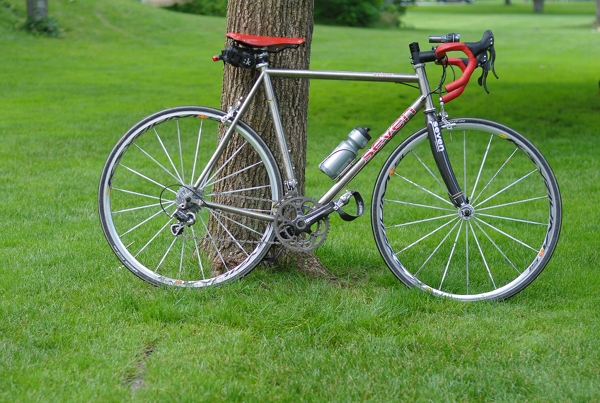
Some time ago I bought a red Selle Anatomica Titanico saddle, initially to go with a vintage bicycle I had at the time. But when I was loaned a Seven roadbike earlier this summer, the Selle Anatomica migrated onto it instead: It promised to be more comfortable than the bike's native racing saddle and was a perfect match for its red decals. This is how I had the saddle set up on the bike, and I put about 700 miles on it.

Selle An-Atomica After 400 Miles
Founded in 2007 by the now deceased avid cyclist Tom Milton, Selle Anatomica is a small American manufacturer of leather saddles. The company is now run by the founder's sister, Meredith Milton Evans. Notably different from the other leather saddles on the market, Selle Anatomica offers several potentially attractive selling points. One is the long "anatomic" cut-out, which they claim allows the two sides of the saddle to move independently, thus relieving pressure on soft tissue. The other is the "watershed leather," which refers to the saddle's treatment with a waterproof top layer. The saddles are available in a variety of colours, and there are separate versions rated for heavier and lighter riders. You can read more about the design and specs here.

Selle An-Atomica After 400 Miles
I purchased my saddle in Spring 2011 and since then a couple of changes have been made that I find somewhat confusing but will try to summarise. Selle Anatomica now advertises being made with cro-moly rails, so I am not sure what the rails on my saddle are made of. They also changed the weight criteria, so that what were formerly called the "Clydesdale" saddles and recommended for persons weighting over 180 lb have now become their regular saddles and are recommended for persons over 140 lb. If I understand these changes correctly, then what is now called the "Titanico" model is a slightly different product from the saddle I own, and the version I own is more comparable to what is now called the "Titanico Legacy." However, based on my conversations with the manufacturer I am not entirely certain of this, and I hope that she might clarify in the comments.

Selle An-Atomica After 400 Miles
My impressions of the Selle Anatomica underwent several stages. Initially, the saddle felt so comfortable that I could hardly believe it. The tension of the leather was just right, there was no pressure anywhere, and the cut-out slot worked as advertised. The leather was softer, more pliable and more "hammock-like" than other leather saddles I'd tried and I could feel it moving with me, as opposed to my body moving against it. There was no chafing or soreness what so ever, and there was no breaking in period. It was almost too good to be true.

This Fits Everything Needed to Fix a Flat??
Then, after about 100 miles, I began to feel a sharp pinching pain in my "soft tissue." The pain would come and go, seemingly at random, and felt as if someone took a pair of pliers to a fold of skin along my crotch. Eventually I realised that the slot somehow began to close in at its narrowest part, pinching my skin right through the padded bicycle shorts. Soon after that I also noticed that (after only 150 miles), the saddle had sagged dramatically. At the time we were unable to determine whether it was the actual leather that sagged, or whether the bolt controlling the tension had unscrewed. But in retrospect it seems to have been the latter, because once we increased the tension and screwed the bolt in tightly, it did not sag again nearly as much.

We assumed that tensioning the saddle would also solve the pinching problem, but the occasional pinching persisted. We tried bending the leather inward in the part of the slot where it pinched, but that did not help. After some investigation, it turned out that a few others reported this same problem with Selle Anatomica saddles, and the recommended solution was to use a knife to enlarge the slot in the spot where it pinched. Just as we were debating whether to do this, the pinching suddenly stopped on its own around mile 400. I kept waiting for it to return, knife at the ready, but it did not. With no explanation, the saddle suddenly felt as good again as on the day I got it. For the remaining 300 miles I rode on the saddle, there has been a gradual and slight loss of tension, but no further problems.

Selle An-Atomica After 400 Miles
Having ridden with this saddle in the rain multiple times on a bike with no fenders, I can confirm Selle Anatomica's claim that the saddle is absolutely waterproof. The rain just rolled right off without getting absorbed into the leather. However, the "watershed" layer eventually began to wear off - not from the rain, but from my contact with the saddle. You can see this in this picture, which was taken after 400 miles. On the manufacturer's website, it is suggested that the top layer could wear off over time as part of everyday use, and that eventually the owner may need to send the saddle back for re-waterproofing (which is done for an extra fee, as far as I understand). It is not specifed for how many miles the "watershed" leather is designed to last before the top layer needs to be reapplied.

Overall, my impression of Selle Anatomica is a positive, but somewhat frustrated one. If the tension remains as it should and the slot does not pinch, it is the most comfortable saddle I have ridden on. If the watershed layer remains intact, it is the most maintenance-free leather saddle I have experienced. However, neither of these factors has been stable for me, and so I would describe the saddle as high maintenance and rather unpredictable. With its price on par with mid-range Brooks and less than Berthoud, personally I would buy Selle Anatomica again and would be willing to fuss with it just to achieve the level of comfort I know it is capable of giving me. But be aware that this is an unusual saddle, and that user experiences tend to be varied - even more so than with the other leather saddle manufacturers. I hope that Selle Anatomica remains in business and continues to streamline its product. With its unique design, it is a welcome alternative to the other saddles currently on the market.
Read More
Posted in comfort, product reviews, saddles | No comments

Monday, August 1, 2011

Adventures with Padded Cycling Shorts

Posted on 12:07 PM by dvdsvdsdv
"Should I wear padded bicycle shorts?" is one question I get asked a lot by women, especially since photos occasionally reveal my wearing them. As with most comfort issues, there is no straight answer here. Everybody is different, and the best I can do is provide feedback about my own experience.

When I cycle casually or for transportation I do not wear cycling shorts. It is crucial to me that my transportation bikes be comfortable and upright enough to ride in regular clothing, and I do not ride them strenuously. I also do not find that padded shorts are a solution for saddle discomfort. If a saddle causes me pain, the shorts can at best mask it for a brief time, but the saddle itself will still need to be addressed.
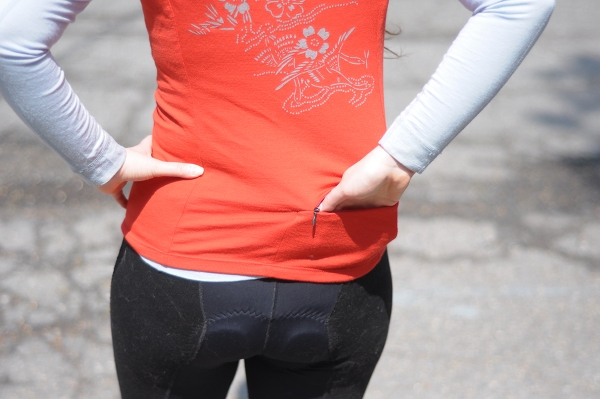
I began wearing bicycle shorts when I got into roadcycling. In that context, I find them beneficial, in that they provide just the right amount of compression and cushioning. It is difficult to explain why this is necessary, until you yourself get to the point where it makes sense. For a while I rode wearing non-cycling-specific leggings, but ultimately did not find them sufficient. The tight, stretchy fabric of bicycle shorts - unflattering as it may be - makes the muscles in my legs feel better when I pedal vigorously. The slight padding (and minimalism is key here) creates just enough of a buffer zone between me and the saddle during active rides.

T-Warf, Rockport MA
I have owned several pairs of cycling shorts so far. The first one I bought was by Pearl Izumi. Everyone kept saying to me "But how do you know that you can't wear synthetics? These high-tech fabrics have come so far!" And so I tried. You won't see a picture of the Pearl Izumi shorts here, because they made my legs look like overstuffed sausages and it's just too traumatic for me to share that. But the bigger problem is that I really do have a sensitivity to polyester and wearing these things gave me a disgusting rash along the back of my legs. Also, despite Pearl Izumi's promises of being wicking and temperature regulating, they were nothing of the sort. Sweat pooled in every skin fold, and words can't describe what an unpleasant experience it was to wear this garment. I got rid of them a month later, struggled with my cotton leggings again for a bit, and then finally bit the bullet and bought a pair of wool Ibex cycling knickers.

Wellfleet, Sept 2010
I have been happily wearing the Ibex El Fito wool cycling knickers since last August, and have since also bought a pair of their Seree shorts. I think the version of the knickers I have is last year's model or older (I bought it from a discount retailer), because the currently produced version features a new pad design that is less noticeable from the back.  In both the new and the older design, the padding is minimalistic and feels comfortable. Overall, I am happy with the Ibex shorts and knickers, and I alternate between them depending on the weather and on which pair is clean.

1st Randonneur Test Ride
Now let's be honest: no cycling shorts are flattering unless you are super-slender with sinewy thigh muscles. But all in all, these are not nearly as horrific as other cycling shorts I've tried and the "sausaging" effect is very slight. At least I am willing to post pictures. A wider and softer waistband would make them more comfortable around the middle, but that is my only real complaint. The wool does not feel especially thin to the touch, but I can wear these things in 95F heat and they feel wonderful. No skin sensitivity, no pooled sweat.

Seven Axiom S, Lexington MA
More recently, I got a pair of Harlot Scarlet X Tech knickers via a trade with the manufacturer. These knickers are stretchy nylon and spandex (to which I am not sensitive), and are meant mostly for mountain biking. I thought they could work nicely for touring because of all the pockets and the relaxed tailoring.

Harlot Scarlet-X Knicker
The elasticised waistband is soft and comfortable and the styling is that of casual capri pants. They are formfitting throughout the hips and upper thighs and loose around the knees.

Harlot Scarlet-X Knicker
The padding is not visible. There is a meshy panel that runs along the inseam, providing ventilation. Decorative white piping runs along the outside seam (more pictures here).

While the Harlot knickers are well-made, flattering, and do a good job disguising the padding, I have not been wearing them much after the initial "Oh, neat" reaction. I think the reason is that I have no need for this particular style of cycling shorts. If I am going to wear something padded, then I am going to be roadcycling and I want the shorts to be tighter, more stretchy, less constricting, and without any extras such as pockets. Likewise, if I am commuting or just cycling with a friend in the park, then I don't need cycling-specific attire at all. But if you can use cycling shorts that are made like regular capri pants, only with padding, knickers such as these and the ones by Chrome I wrote about earlier, could work nicely.

Wellfleet, Sept 2010
As I see it, padded cycling shorts and knickers are one of those "If you need them, you'll know it" things. If you are comfortable without them, I think that's just fine and there is no need to question yourself just because other cyclists are wearing them. And while cycling shorts can look silly, they are designed that way (tight, padded) for a reason, and changing that design in order to make them look like regular pants can also reduce their functionality. That's my take on it at least, for the time being.

Do you wear padded cycling shorts? What kind and for what type of cycling? I am especially curious about any experiences with Smartwool, Icebreaker, and other wool cycling shorts - particularly for women.
Read More
Posted in clothing, comfort, product reviews | No comments

Friday, July 22, 2011

Drinking and Cycling

Posted on 9:59 AM by dvdsvdsdv
Vita Coco
Yesterday I did a 40 mile ride in 97 degree heat and high humidity. As someone who is sensitive to hot weather, normally I would not go outdoors on such a day at all. But when the temperature is like this on a daily basis, the choice is either to stop riding or find a way to deal with it. One experienced cyclist I know suggested drinking large amounts of water starting early in the morning, and then a dose of coconut water right before the ride itself. I did just that, and it helped: I  was able to do the ride without feeling faint or headachy. Earlier in the week I tried to do the same ride and turned back 15 minutes later, nursing a migraine for the remainder of the day. I don't know how much the hydration regimen had to do with the improvement, but it made me curious about the relationship between drinking and cycling. 

Take, for example, water: I've always been one of those weird people who doesn't like the taste of water and does not usually feel thirsty, so drinking so much of it was an entirely new concept when I began cycling. At first I had to practically force myself to do it, but at some point it started to become more natural and I developed the thirst mechanism I hitherto lacked. Those who've known me for a while are surprised that I now actually crave water, even when off the bike. 

On the other hand, juice and energy drinks make me feel sick when I cycle. They are too sweet and I only feel more thirsty afterward. Things like Gatorade and weird chemical energy powders I just can't take at all - it goes straight to my head and makes me feel dizzy, as well as leaves a disgusting taste in my mouth. So in order to regain electrolytes, I've been eating bananas and putting a tiny bit of salt in my water. Coconut water was suggested as an alternative, and I was surprised to read about its electrolyte content: It is basically a natural sportsdrink. I still find it slightly too sweet and the aftertaste a little weird, but manageable - and it seems to work.

Then there is the question of coffee. I am addicted and drink more cups per day than I care to count. I like to drink coffee before a ride, because it makes me feel more energetic. However, some warn against doing this - claiming that it's bad for the heart to have coffee right before exercise. Are cyclists who caffeinate dooming themselves to early heart attacks? Seems unlikely to me, but I do wonder sometimes as I drink my nth cup.

And finally, alcohol. I am not a big drinker by any means, but I like an occasional white wine or martini. Sadly, I've discovered that I can't drink if I plan to go on strenuous rides, not even a little bit. Maybe I am worse at processing alcohol than most people, but if I have a martini in the evening and then try to go cycling the next morning, I can smell the gin coming out of my pores and just don't feel 100% on the bike. That's after just one drink. I cannot imagine how some cyclists manage to guzzle beer during races, or stop for lunch with wine in the middle of long ride; I can't do it.

What's your practice with regard to water, energy drinks, coffee and alcohol when cycling?
Read More
Posted in comfort, sun and heat | No comments

Wednesday, July 20, 2011

Everyone Wants Stability

Posted on 10:27 AM by dvdsvdsdv
Blue and Green
In discussions of a bicycle's ride quality, one thing that always comes up is stability. We want a bike that is stable and we complain when it is not. Of course the problem with "stability" is that the concept is largely dependent on our skill level and cycling background. Those who are unaccustomed to riding roadbikes will often find them unstable at first, while those who ride roadbikes exclusively will often find upright bikes unstable. This does not mean that either is actually unstable, but rather that the two cyclists are used to radically different means of weight distribution. Similarly, what's "unstable" to one cyclist can be "responsive" to another. It seems that perception of stability has at least as much to do with the person riding the bicycle as it does with the bicycle itself. How useful is it, then, to tell a salesperson or a framebuilder that we want a bicycle that is stable? And how useful is that term in reviews? Clearly we need further qualification.

When I talk to new cyclists who are uncomfortable operating their bikes, instability is often cited as the problem: It can make a bicycle difficult or scary to ride, making the cyclist feel not entirely in control. In the process of teasing out what exactly is meant by this elusive concept, I've identified a number of distinct points that I would like to share, and see what others think: 

Pilen, Balance
Starting from a stop
Some bicycles are described as shaky when starting from a stop, as if the front wheel is wobbly and wants to turn just as the cyclist is trying to get the bike rolling forward. This is a complaint I hear a lot from women about vintage mixtes that came with dropbars, but have been converted to upright bikes and also, interestingly, about classic Dutch bikes. The feeling is sometimes referred to as "light steering" or a "light front end," and has to do with a complicated combination of the bicycle's geometry and the height of the handlebars. With some bikes, I have found that lowering the handlebars helps - in particular when it comes to the mixte conversions - but ultimately it is a matter of getting used to it. Some cyclists do get used to it, but others can't and feel inherently uncomfortable with the bike. 

Cycling at slow speeds
Similar to the above, only extended to cycling at slow speeds: The bike wants to weave (i.e. feels "squirrely" or "twitchy") when the cyclist attempts to ride slowly, making it difficult to control. Aggressive roadbikes are known for this quality, but cyclists report the feeling about some upright bikes as well (albeit often they are upright bikes that are roadbike conversions). One thing I have found useful when riding bicycles like this at slow speeds, is to pedal in slow motion while feathering the brake, instead of coasting. I would be interested to know whether this works for others. 

Pilen Bicycle, Castle Island
Cycling at fast speeds, downhill
When riding at fast speeds, and particularly downhill, some cyclists are alarmed to notice that the font end of their bicycle will begin to vibrate in the region of the stem and handlebars. Assuming that nothing is loose on the bike or mechanically wrong with it, this is known as "shimmy" and there are ongoing debates regarding what causes it, whether it's a problem, and whether it is even a real phenomenon. This is something that a cyclist either gets used to, learns to avoid by abstaining from high speeds on that particular bike, or deals with by getting a different bike. 

Turning
When cyclists describe a bicycle as unstable on turns, they can mean a number of things by this. One type of complaint is that the bike turns too aggressively or, "too much," overreacting to the turn. Another type of complaint is the opposite: that the bike keeps trying to straighten itself while the cyclist is still continuing the turn. Either of these qualities can make turning stressful, with the cyclist struggling to make the bicycle follow the course they would like it to follow. How to deal with this, other than developing handling skills in line with the bicycle's tendencies (or getting a different bike) I cannot say.

Tire and Rock
Rough surfaces
To some cyclists it is important how stable a bicycle feels when going over rough or uneven surfaces. While wide tires play a role, at least to some extent this seems to be also about the bicycle itself - with some bikes seemingly "unfellable" off road or over potholes, while others relatively easy to wipe out on, especially for novices. In the realm of upright city bikes,  there is an increasing number of manufacturers (Pilen, Retrovelo, Urbana) infusing classic transportation bicycles with mountain bike characteristics in a way that works well in this context. Converting an old hardtail mountain bike to an upright bike can work as well. Upright roadbike conversions on the other hand, tend to be problematic in this respect - particularly for beginners. 

Tire width
Whether on smooth or rough surfaces, I have noticed that tire width can have a lot to do with a novice cyclist's perception of a bicycle's stability: Narrow tires are simply more difficult to balance on across a wide range of circumstances. If the bicycle's clearances allow for wider tires, this is an easy way to improve the feeling of a bicycle's stability. 

Mixte with Camera Bag, Pannier and Packages
Cycling with a load
Finally, whereas a bicycle might feel perfectly stable unloaded, some notice that introducing weight in the front basket or on the rear rack can disrupt that stability. Most of the time, this happens with a front rather than rear load: the bicycle begins to weave or wobble if the front is overloaded. There can be a myriad of causes for this, and subsequently a myriad of ways to deal with them. Generally speaking, carrying weight lower on the bike (i.e. not mounting a basket on the handlebars) is said to improve stability. But some bicycles are just not intended for a front load no matter what.

Pilen Bicycle, Castle Island
While it might be difficult to express what we mean by stability, breaking it down into specifics can be helpful - both in communicating with others and in gaining more insight into our own preferences. In attempting to understand the nuances of ride quality, it continues to amaze me how the same idea can be echoed by so many people, yet mean something slightly (or even not so slightly) different to each. Does a novice who finds their bicycle unstable need a different bike, or merely wider tires? Could be either.
Read More
Posted in beginners, comfort, mixte, pilen | No comments

Wednesday, July 13, 2011

Shifter Placement on a Mixte: an Aesthetic and Functional Challenge

Posted on 5:58 PM by dvdsvdsdv
Porteur Bars, Elkhide Grips, Inverse Levers, Silver Shifters
I've been asked to describe how the shifters are set up on my mixte, but I hesitate to write about it, because I don't necessarily recommend this method. My handlebar setup consists of inverse brake levers, elk hide grips covering the entire handlebar, and bar-end friction shifters mounted upon "thumbies" up toward the front. The rationale here was to leave as much of the handlebar area uninterrupted as possible, allowing for a variety of hand positions. It works nicely in that context, but it is not for everyone - which brings me to the issue so many have written to me about: There seem to be few options for mounting gear shifters on a mixte with upright handlebars that are both elegant and convenient. Personally, I find my own setup not entirely elegant: Too many cables up front. And it's not entirely convenient either: The levers can only be reached when the hands are in the aggressive forward position on the bars. But what other possibilities are there?

Shimano Shifters and Paul Thumbies on Betty Foy
One alternative is to move the shifters closer to the edges of the handlebars, so that they are near the brake levers. This placement is more convenient if that is the position where you tend to hold your hands the most, and since I've been using my own mixte more and more as a city bike I am considering switching to something like this. The problem, however, is that placing the shifters here interrupts the handlebars and limits potential hand positions: It will not be possible to slide my hands back and forth along the bars the way it's possible on my current mixte set-up. Also, it's essential to get the angle of the shifters just right, and doing so does not always result in attractive placement. Finally, both with my current set-up and with the set-up pictured above, there is something messy-looking to my eye in having so many cables sprouting from the handlebars. I have not been able to find a way to make handlebar-mounted shifters look attractive.

Royal H Handlebars, Take 1: Porteur, Guidonnet, Bar-Ends
A potential way to clean up the handlebar setup from the "messy cables" look while keeping the shifters within reach is to opt for bar-ends. I tried this prior to my current setup, but quickly discovered that this works well only with the wide Nitto Albatross bars used by Rivendell, and ideally on a bike with a long virtual top tube and/or with the handlebars raised high. Otherwise, you may discover that the bar-end shifters will poke you in the knees to the point where it could interfere with pedaling on turns. That is exactly what happened when I tried them on my small sized mixte with narrow Porteur bars.

Mercier Updates
If none of these methods appeal to you, you can go the vintage route - one possibility being to mount the shifters on the stem. However, generally this is not recommended for a number of reasons. Some claim that mounting the shifters in this spot is dangerous, because they could potentially "impale" you if you fall forward on your bike. To me this seems rather far-fetched: After all, it's common to have bruises on your thighs from bumping into bar-end shifters, yet no one claims they are dangerous. I think the real reason stem shifters are disliked is that they are considered to be a symbol of lower-end bikes: In the '70s, stem shifters meant that a bike was marketed for amateurs who held their hands mostly on top of the handlebars and were unable to reach downtube shifters.

Mercier Mixte: Headtube Lugs, Downtube Shifters
But while downtube shifters offer elegance and simplicity, removing the second set of cables from the handlebars entirely, most cyclists who are looking for an upright mixte find them difficult to use. In order to shift gears, you have to remove you hand from the handlebars are reach quite a ways down. Particularly if you are sitting upright, this is inconvenient - not to mention beyond the skill level of some cyclists.

Belleville Handlebars, Dia Compe Levers
As far as aesthetics go, a mixte frame is a challenge to set up, because the twin lateral stays already add a degree of visual complexity to the looks. If you add a cluttered handlebar set-up to that, it can get pretty messy. In vintage photos and in handmade bicycle shows, the cleanest looking mixtes tend to be set up either as single speeds, with hub gearing, or with single chinrings - ensuring that there is, at most, only one shifter to deal with. But in practice, most mixtes today are set up with derailleur gearing and either double or triple chainrings - presenting an aesthetic and functional challenge. 

While I cannot offer a solution that would suit everyone's tastes, I wanted to share the methods I know of and the pros and cons of each, as I see them. How have you set up the shifters on your mixte, and are you happy with them in terms of user-friendliness and looks?
Read More
Posted in comfort, handlebars, mixte | No comments

Tuesday, July 12, 2011

Leveling the Playing Field

Posted on 11:01 AM by dvdsvdsdv
Rivendell, Longer Stem
File this under "duh" if you will, but I need to acknowledge this out of fairness to Rivendell, and as a means of providing information to others wondering just how much of an effect one's positioning on a bike can have on pedaling effort and speed. Earlier I described being considerably faster, particularly uphill, on the Seven bicycle I have on loan in comparison to my Rivendell Sam Hillborne. It was widely agreed that there were many factors involved in this difference - from frame geometry, to weight, to positioning. For some time now I'd been considering making changes to my Rivendell, and finally it's been done - thus somewhat leveling the playing field between the two bikes, with interesting results.

You may spot a number of other alterations in these pictures, but for now I will talk just about the difference in positioning. Namely, the bike now has a longer stem (8 cm, instead of 6 cm as previously). The handlebars have been positioned slightly lower as well.

Rivendell, Less Setback
We've also reduced the amount of setback on the saddle by about 2 cm (not just by moving the saddle forward, but by replacing the seatpost). The overall effect is that my lean has increased by a small amount, my weight on the bike has shifted forward, and my hips are move directly above the cranks.

It's important to stress that I would not have found this position comfortable a year ago, so making these changes is not so much "admitting a mistake," as altering the bicycle's set-up to reflect my changing skill level and preferences. I very much find this position comfortable now - comfortable and fast.

Altered Rivendell
We rode to Lexington, MA to try some hill intervals. I did not attach a saddlebag, so that I could get a sense of how the bike itself performs. And it performed well - albeit differently from the Seven.

Here is my amateur description of what happens on the two bikes when I cycle uphill: The Seven allows me to very easily "attack" a hill - to cycle up it at a fairly high speed, until I run out of steam toward the end and am forced to slow down. In comparison, the Rivendell does not like to "attack" and forces me to slow down earlier. In its previous state, this slowing down happened almost immediately and drastically. Now it happens half way up, and the speed drop is considerably smaller. Cycling on flats, the new positioning makes the Rivendell faster to accelerate than previously. Not as fast as a racing bike of course, but I no longer feel as if I am sitting "behind the bike" unable use my weight efficiently.

Once I attach bags, that will no doubt slow it down some. But I have a strong feeling that the change in performance is due to the forward placement of my weight more than anything else - when I ride the bike now it feels inherently different - more responsive and more efficient. I am not trying to convert the Rivendell to a Seven and I am not considering taking it on paceline rides. I want to keep the wide tires, the fenders, the rack, the bags, the lighting - there is no compromise possible on that end, as these features are extremely useful to me. But the Seven's positioning (and my enjoyment of that positioning) has most definitely affected my expectations in terms of performance, and I don't think I can go back to short stems and seatposts with generous setback. Not that there is any reason I should - It's all about what you are comfortable with at any given point in time.
Read More
Posted in comfort, Rivendell, roadcycling | No comments

Friday, July 8, 2011

Adjustable Stem!

Posted on 10:00 PM by dvdsvdsdv
Randonneur, Adjustable Stem
When I wrote about wanting a longer stem on one of my bikes, several people suggested I get ahold of a vintage adjustable stem. I did not know that such a thing existed, but clearly there is much I don't know.

Long story short, I am now in the temporary possession of a 3ttt Record Regolabile adjustable stem, on loan courtesy of Jan Heine of the Bicycle Quarterly. I decided to use it not on my own bike, but on the Royal H. randonneur collaboration - it just looked so appropriate.

Produced in the 1970s by Tecno Tubo Torino of Italy, this elegant stem adjusts from (I think) 6 cm to 12 cm. Here is more information about it and some close-up pictures. The beauty of this system is that it combines the vertical adjustability of the quill stem with the horizontal adjustability of the threadless stem (with the latter you can swap out stems without redoing your handlebar set-up). Why are things like this not being made anymore? Those of us who constantly change our minds about handlebar positions would find it extremely useful. Right now I have it adjusted for 8 cm, but who knows what the future holds - I am looking forward to playing around with this! 
Read More
Posted in comfort, handlebars, Randonneur, Royal H, vintage | No comments

Thursday, July 7, 2011

Chrome Pasha Hoodie: Wool That Feels Like a Real Sweatshirt?

Posted on 10:43 AM by dvdsvdsdv
Hooded sweatshirts are the comfort food of clothing: There is something so snuggly and relaxing about them, that just putting one on at the end of a long day can improve my mood. Before I started cycling I was a fan of this garment and wore it frequently when not in my dressy attire. But I soon discovered that I can't really wear hoodies on a bicycle: I sweat too much and the thick cotton eventually turns into a heavy wet rag. Comfort food no more. Wool manufacturers have attempted to address this issue by making their own versions of the hoodie. I've tried these from Ibex, Icebreaker and one other company I can't recall, hoping to find a replacement for my beloved cotton sweatshirts.  But the wool versions only vaguely resemble the real thing; something is off about the texture and feel. Thus jaded, when Chrome offered me to review their "Pasha" hoodie I expected more of the same. But I am glad to report that I was wrong.

Chrome Pasha Hoodie
Whatever else might be said about the Pasha, I think it is crucial to recognise that Chrome did it: They made a wool sweatshirt that feels like a "real" sweatshirt and not like a wool sweater pretending to be a sweatshirt. The inside is fluffy and impeccably soft, the outside feels convincingly sweatshirt-like to the touch. The weight, the texture - everything is just like the hoodies I am used to. The asymmetrically placed zipper and structured tailoring add a contemporary touch.

The design of the Pasha is cycling-specific, in that it is semi-form fitting and is cut longer in the back than in the front. I have read some reviews complaining that the cut is too narrow around the chest and too generous around the middle, and I somewhat agree. But I have a modestly sized chest, so the narrowness in that region works well for me. The middle is indeed roomy, but I do not find the cut unflattering. I am a US women's size 4, and the "Small" hoodie is just about spot on.

The hood is tight around the head and neck without requiring pull-strings. I've worn it on a roadbike in windy thunderstorms, and it did not get blown off over the course of the ride as other hoods tend to.

54cm Frame Toptube Clearance
I admit that once I took these photos I blacked out the Chrome logo, which is just too prominent for my taste. I suggest they consider making a subdued version of it, as many don't like displaying branding on their clothing. (And yes, I realise the irony of this photo as I write this - but bicycle logos are different!)

Chrome Pasha Hoodie
My one major real complaint about the design of the Pasha is that the thumb loops are not practical when riding a roadbike; they dig into the space between my thumb and forefinger when I stretch my arms to reach the drop bars. So unless I am riding an upright bike with a short reach, I end up not using them. I will probably sew up the holes in the sides of the sleeves.

Chrome Pasha Hoodie
A lesser complaint is that I do not like the exposed metal zipper. It's cold and "unfriendly," in contrast to the overall feel of the hoodie. The zippers they use on the pockets feel much better, so I would love the central one to be replaced with something in that vein.

Yet another minor complaint is an aesthetic one. There is maroon stitching in some parts of the hoodie, apparently for decorative reasons. This is nice in itself, but it clashes with the primary-red stitching next to the pockets, as well as with the Chrome logo and with the fabric of the same colour inside the pockets. Maybe this is a personal thing, but the combination of the maroon and the primary red looks off to me.

Finally, I should note that the Pasha is made in China, unlike some of Chrome's other items.

Chrome Pasha Hoodie, Pocket
The Pasha has two zippered side pockets - one much larger than the other, due to the asymmetrical placement of the central zipper. The larger pocket easily fits a wallet, point and shoot camera, or sandwich. The smaller pocket will fit a mobile phone or keys. There is also a large zippered rear pocket that will fit the contents of both side pockets together. The pockets have meshy interiors and can also be used for added breathability.

First Spring Ride, Bianchi
As far as weather conditions, I find the Pasha best for cold weather and mild rain - which we've been having a lot of here, even in the summer. In May and June we had stretches of days with temperatures in the 40s-50s, continuous rain, and this horrible bone-piercing dampness. The Pasha kept me warm, not sweaty, and mostly dry from the rain. Being wool, it is wearable in warmer temperatures as well, certainly into the lower 70s.

I've had this hoodie since March and have washed it three times on account of getting it covered in mud while riding a fenderless bike. It is durable and takes well to being washed and dried.

The most enjoyable thing for me about the Chrome Pasha, is that it has all the properties of 100% wool while feeling like a real sweatshirt. The design could be tweaked, but I'll take it even as is. It's great to be able to wear a hoodie on a bike without the "wet rag" effect.
Read More
Posted in clothing, comfort, product reviews | No comments

Tuesday, July 5, 2011

Sagging Saddles?

Posted on 10:17 PM by dvdsvdsdv
It seems that I complain a lot about saddles, finding fault with most of the ones I try if not immediately then certainly within a year's time. This one won't break in, that one hurts my crotch. This one is too narrow, that one is too wide. This one is too soft, that one is too hard... So what now?

Okay, I've had this Brooks B72 for about a year. No complaints about the shape, size or breaking in period - it felt wonderful from the start on a semi-upright bike. I have owned several other B72 models as well - both modern and vintage - and they've all been good. This was the one saddle of all my saddles I thought was pretty darn perfect. Then a couple of months ago I started to notice that the outer edge was pressing into my derriere. At first it was subtle, but the feeling kept getting worse - until one day I looked at the saddle, and the leather was visibly sagging in the center, with the outer edge (where the rivets are) forming a sharp ridge. Regrettably I neglected to take a picture of this before we messed with the tension, but I really ought to have emailed it to Brooks. It is unexpected that a saddle should sag that much under a 125lb rider in less than a year's time. It had never gotten caught in the rain, I am not a proofide zealot, and I had ridden maybe 600 miles on it in the course of 8 months (it is installed on a city bike) when the problem began to present itself.

Though some recommend not to mess with the tension on a Brooks we went ahead and did, and the saddle felt great again... for a couple of weeks. But now, slowly but surely, I am starting to feel the rivets pressing into my behind once more as the leather continues to sag ever so gradually. Darn.

Having spoken to a few long-time Brooks owners and retailers, I do not think that this is an issue with the B72 model specifically, but rather a general issue with quality control and the natural variation in leather thickness. A couple of retailers have told me that some Brooks saddles will sag in this manner and there does not appear to be a pattern to which models are susceptible to it. Well, that's not very reassuring. I am especially disappointed since this particular saddle was my overall favourite before the sagging problem started. I guess perfection is a myth and it is best to keep that in mind to avoid disappointment. I am curious whether others have experienced the "sudden sag" syndrome on any of their leather saddles, and if so which makes and models. Is there a cure?
Read More
Posted in Brooks, comfort, product reviews, saddles | No comments

Tuesday, June 28, 2011

Shorter Cranks, Dainty Pedals, and the Ambiguity of Toe Overlap

Posted on 11:11 PM by dvdsvdsdv
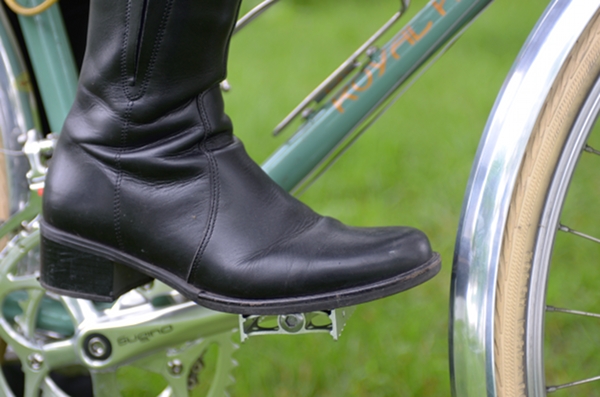
Last week I was offered the opportunity to trade the Sugino Alpina crankset on my mixte for the exact same model with shorter cranks, and I went for it. The original cranks were 170mm. The ones on it now are 165mm. A 5mm difference is very small, but can be significant. For instance, some say that shorter cranks make for a smoother pedal stroke. But my reason for the change was to reduce toe overlap. I mentioned previously that my mixte has it to a small degree, and that I'd like to get rid of it since I now use this bike mainly for transportation. In theory, that could be done either by converting to 650B or re-raking the fork. But before resorting to such drastic measures, I wanted to try something easier.

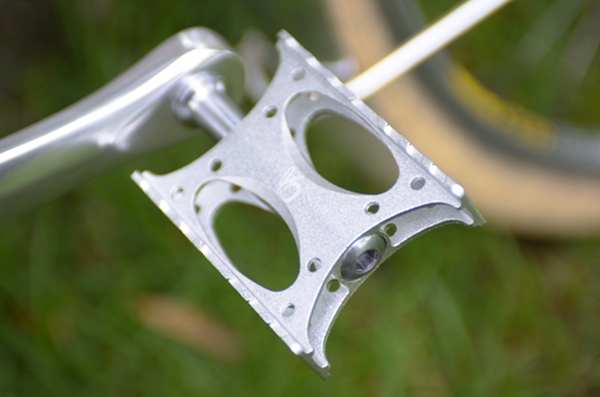
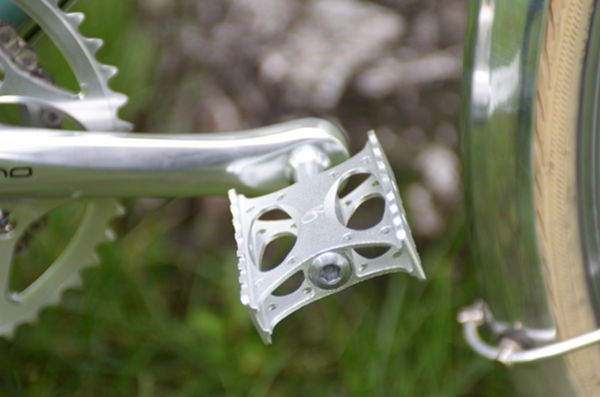
In addition to the shorter cranks, I also replaced the MKS Touring pedals with Velo Orange City Pedals. Being smaller, my assumption was that the new pedals would reduce overlap further still - though I am now told this isn't so.

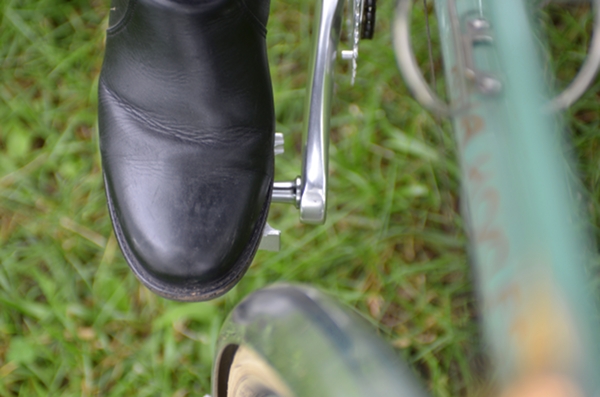
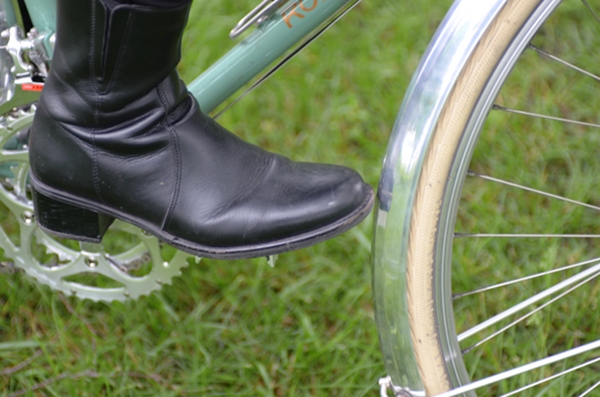
Either way, with the new set-up my toes are about 1/4" further back from the front fender than where they were previously. These are the longest-toed boots I own, and with my foot in its most typical position on the pedal there is no overlap even on the widest turn.

Aerial view.

But the thing about an upright bike that is ridden casually and with no foot retention, is that you can plant your foot on the pedal any which way. Sometimes I am sloppy, and plop it down further forward than typical when starting. In that sense, the toe overlap issue remains ambiguous. I need to ride around with this setup for a few weeks to see whether it still happens on occasion. I am not sure whether I notice any difference between the old cranks and the new ones, but it's possible that my pedaling feels a little "rounder." Or I could be imagining it, because that's what I've been told is supposed to happen. (Crank length placebo effect?)

As for the VO City Pedals, I absolutely love them so far. Ever since having tried them on the Rainbow Bike, I wanted them for myself. They don't stab my bare legs and toes the way MKS Touring pedals do, they are grippy, and they are extremely light (228gr per pair). It also does not hurt that they are pretty - though this, of course, is in the eyes of the beholder.

One caveat though, is that these pedals are very narrow (82mm across) and I have heard from a couple of people who find them uncomfortable for that reason. If you have large feet or tend to wear bulky workboots on your city bike, these are probably not the best choice.

So far I am happy with the changes I've made here, and together with the new basket the mixte has definitely turned into a transportation bike. The toe overlap was minor to begin with, so hopefully this will render it insignificant - but we'll see.

If you've ever played around with crank length on your bikes, did you notice a tangible difference? I have bicycles with cranks ranging from 165mm to 175mm, and they all feel fine, so I tend to use things like bottom bracket height and wheel size to determine what cranks a bike should have. But what do I know! Maybe with time I'll be able to tell the crank length of the bike I am riding just by the way it feels to pedal... though I remain skeptical.
Read More
Posted in comfort, mixte, product reviews | No comments

Tuesday, June 21, 2011

Back and Forth: Lessons in Positioning

Posted on 10:58 AM by dvdsvdsdv
Last week I rode my Rivendell Sam Hillborne for the first time in three weeks after riding exclusively the loaner Seven on a close to daily basis. It's hard to believe that the body can adapt to one position so quickly as to find other positions unnatural. I confidently got on my bike, expecting that old familiar feeling of riding it to welcome me back. But I was in for a surprise. The ride was as comfortable as I remembered, but everything felt off. It took me a while to understand what was wrong. Initially it was just a vague sense of not feeling as connected to the road and as much in control of the bike, which was disconcerting. As I kept cycling, I became aware that it was really two specific things: I felt that I was seated too far back, and that I wasn't out far enough over the front wheel. I kept wanting to shove my weight forward, and it was frustrating to feel almost as if I were sitting "behind" the bike. 

Looking at the way the two bicycles are set up, the difference makes sense. On the Seven, the saddle sits further forward and the handlebars are further out. I was aware of this difference before, but assumed that I would find the Seven's set-up aggressive and uncomfortable, while the Rivendell's set-up a welcome relief. Instead the Seven's set-up now feels "right" and anything deviating from it feels "wrong" - as if I don't have sufficient control of the bike. That feeling is hard to shake. I think my Rivendell needs a little make-over. 

While moving the saddle forward is easy enough, changing the handlebar set-up will be messy, because I will have to replace the fairly short (6cm) stem with a longer one. When I fist began trying to ride with drop bars, I found it extremely difficult and a short stem was recommended to make the transition easier. I cannot say that it was a poor recommendation, because it worked. I rode with this set-up for a year, gradually becoming more comfortable with the whole idea of a roadbike, and feeling increasingly natural in a forward-leaning position. Some would look at my bikes and point out that my stems are too short, and I was perfectly aware that by most standards they are. But these things are highly personal, and last year I was concerned not so much with speed and agility, as with just being able to ride the bike. The way a bike balanced with a shorter stem felt better to me at the time. For what it's worth, I see many roadbikes from the 1970s-80s that were ridden by women set up with short stems. My previously owned vintage Trek had an even shorter stem than this bike, and that was the original owner's doing.

Going back and forth between the Seven and the Rivendell has been educational; each has what the other lacks. It is fairly clear to me that I "need" a lightweight, purely-roadish roadbike like the Seven and that I also "need" a wide-tired, befendered, dynamo-hub, luggage-bearing long distance bike like the Rivendell. I would not want to turn one into the other, or to combine them into something in-between. If I could make changes to the Seven, it would be to magically decrease its size. If I could make changes to the Rivendell, it would be to alter its positioning and to make it lighter. The former we will be doing shortly. The latter is not really possible without getting rid of the very things that make this bike practical. But I am very curious now whether it is the positioning, more than anything else that accounts for the difference in speed between the two bicycles. I am also wondering what the "ideal" stem length for this bike would be. The top tube is unusually long, so it would have to be 8-9cm tops. It's frustrating that experimenting with stems is not easy, but I will report the results of my trial-and-error fumblings. 
Read More
Posted in comfort, Rivendell, roadcycling, Seven | No comments
Older Posts Home
Subscribe to: Posts (Atom)

Popular Posts

  • Upside Down!
    Fate has been kind to Marianne! Rather than being torn apart for donor components , she has been spared, and fitted with new handlebars. Wha...
  • Computer Games
    I have never liked computer games, but with the influence of the Co-Habitant I am finally starting to get into them. Here he is, taking a br...
  • Matters of Identity
    Well... I thought that I could quietly change my blogspot username without anybody noticing or caring, but it's caused some confusion. S...
  • Rediscovering Familiar Places... and the Hills You Never Knew Were There
    Yesterday was a special occasion for us, and we wanted to do something special to celebrate. We decided to visit an area of Seacoast New Ham...
  • Celestial Beings
    [image via Spernicelli ] Depending on who you speak to, it is either the most over-rated vintage bicycle in existence, or the Holy Grail: Th...
  • The Pashley Roadster Sovereign: Review After Two New England Winters
    If you are a regular reader, you probably know that the Co-Habitant owns a Pashley Roadster Sovereign. We bought a pair of Pashleys  when I...
  • Crime vs. Accident?
    I was cycling across town with a friend today, who suggested that we take the side streets instead of my usual route along the major roads. ...
  • Putting Your Foot Down
    Enough people have asked me about this now that I thought it worth writing about: How do I put a toe down in traffic while remaining on the ...
  • Urbana: Review of a True Transport Bike
    A month ago, I received a bicycle from the Canadian manufacturer Urbana , to test ride and review.  When the offer was initially made, I vis...
  • About a Year
    Looking through the pictures I took of a recent ride along the cherry-blossoming Charles River, I realised that it has been just about a yea...

Categories

  • ANT
  • art
  • bags
  • basket
  • beginners
  • Bella Ciao
  • bicycle events
  • bicycle industry
  • bicycle reviews
  • bike friends
  • bike shopping
  • blog development
  • blogiversary
  • books
  • Boston
  • Brompton
  • Brooks
  • Cape Cod
  • cargo bikes
  • cars
  • cats
  • children
  • clipless
  • clothing
  • Co-Habitant
  • coaster brake
  • comfort
  • Constance
  • countryside
  • diamond frame
  • DIY
  • DL-1
  • dress guards
  • drop bars
  • Eustacia Vye
  • fashion industry
  • fenders
  • films
  • fixed gear
  • flowers
  • food
  • framebuilding
  • Gazelle
  • Geekhouse
  • gender
  • give-away
  • grips
  • handlebars
  • handmade
  • holidays
  • Interbike
  • Italian bicycles
  • Jacqueline
  • knitting
  • lights
  • local bike shops
  • locking up
  • loop frame
  • lugs
  • Maine
  • Marianne
  • mercian
  • Mercier
  • mixte
  • Moser
  • Motobecane
  • Myles
  • night time cycling
  • North Shore
  • paceline
  • Pashley
  • pilen
  • poll
  • product reviews
  • racks
  • rain
  • Raleigh
  • Randonneur
  • randonneuring
  • restoration
  • Rivendell
  • roadcycling
  • rod brakes
  • Rodney
  • Romania
  • Royal H
  • Royal H. Mixte
  • saddles
  • safety
  • Seven
  • shop visits
  • silliness
  • skirt
  • social commentary
  • Soma
  • somervillain
  • stories
  • summer cycling
  • sun and heat
  • Surly
  • tandem
  • technique
  • test rides
  • tires
  • tools
  • traffic
  • trails
  • transportation options
  • travel
  • unpaved
  • urban cycling
  • Urbana
  • Velo Orange
  • Velouria
  • Vienna
  • vintage
  • winter cycling

Blog Archive

  • ▼  2011 (236)
    • ▼  September (17)
      • Frills or Basics?
      • European City Bikes and the North American Market
      • Thoughts on Fixed Gear Cranksets?
      • From Holsters to Corsets: The Cycling Accessory Fe...
      • Yeah Baby! Transportational Elegance Reigns at Int...
      • Handmade Bicycles at Interbike
      • Bleak Prognosis for the Dutch Bicycle?
      • GB Components Are Back! ...And You Can Have Their ...
      • Song, Dance and Bicycle Romance: The Interbike Fas...
      • On Bicycle Reviews
      • What's the Difference?
      • In the Raw
      • Frames of Mind: Why Did We Not Cycle?
      • Embracing Wrinkles
      • Reunited
      • The Art of the Ride Report: a Touring Bicycle Give...
      • If a Branch Falls in a Forest...
    • ►  August (22)
    • ►  July (26)
    • ►  June (27)
    • ►  May (27)
    • ►  April (26)
    • ►  March (30)
    • ►  February (30)
    • ►  January (31)
  • ►  2010 (262)
    • ►  December (28)
    • ►  November (29)
    • ►  October (24)
    • ►  September (23)
    • ►  August (25)
    • ►  July (25)
    • ►  June (20)
    • ►  May (19)
    • ►  April (20)
    • ►  March (17)
    • ►  February (18)
    • ►  January (14)
Powered by Blogger.

About Me

dvdsvdsdv
View my complete profile