lindaikeji35

  • Subscribe to our RSS feed.
  • Twitter
  • StumbleUpon
  • Reddit
  • Facebook
  • Digg
Showing posts with label Motobecane. Show all posts

Monday, May 23, 2011

On Sentimentality and Retiring Old Bikes

Posted on 10:34 AM by dvdsvdsdv
When we got the Co-Habitant's Surly Cross-Check frame, it was supposed to be an off-road-capable supplement to his vintage roadbike, not a replacement. But after he built up the Surly and took it on several rides, the old Motobecane was soon put away. We had expected that the modern cross bike with wide tires would be more comfortable, but slower and less agile than the vintage roadbike. Instead, it is more comfortable in addition to being just as agile and also faster - not to mention more stable and entirely lacking in shimmy on descents. 

The Co-Habitant is a wee bit disillusioned in vintage bikes at the moment. All the lugs and "patina" in the world are not worth it to him, if a reasonably priced, good quality new TIG-welded frame fitted with decent components offers a better ride. That is not to say that a mass produced mid-tier Motobecane from 1976 represents all vintage bikes. But sometimes experimenting with vintage until you find a good frame can be more expensive than buying new.

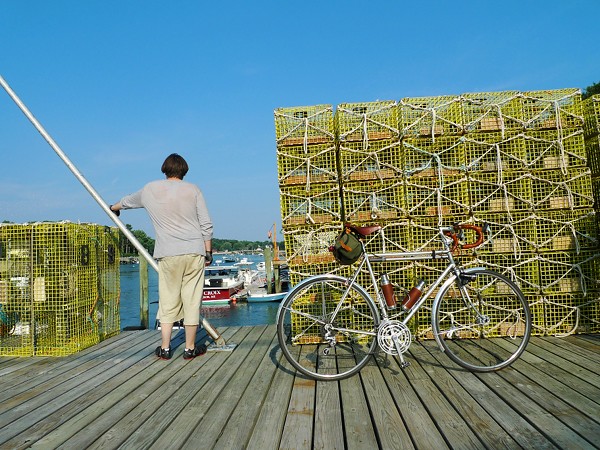
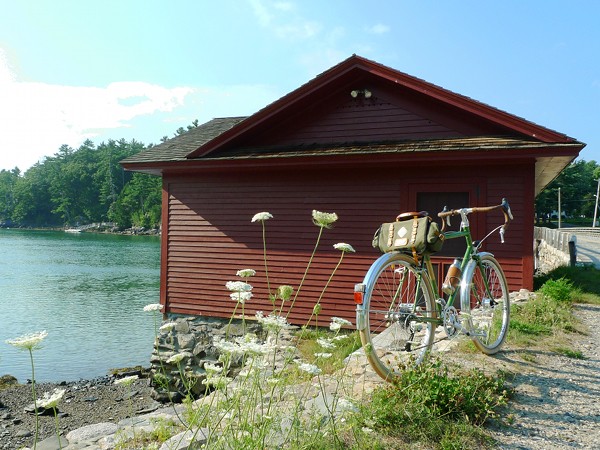
Nonetheless, "Myles" the Motobecane was the first roadbike he'd ridden as an adult, and the one and only roadbike he's been riding for the past two years. It was old and crusty and we made it beautiful. It was rickety and we updated it with nicer components. That bike got him through multiple trips to Maine and Cape Cod just fine, before he knew that "just fine" could feel even better. It seems almost a betrayal to get rid of it so unceremoniously.

We've considered turning the Motobecane into a beater city bike, but that idea was eventually dismissed. Ultimately, he likes wide tires and stable handling for city riding, and a twitchy 1970s French roadbike is just not his idea of a good time in our pothole-ridden neighbourhood. Fair enough.

So, what to do with a retired bike? One option is to sell it as a complete bicycle. The other option is to strip all the good components, keep them for future projects or trades, and sell just the frame. In the past, we've always gone with the former, even though financially it makes less sense. This time we are considering the latter, but ultimately still leaning toward the former out of sheer sentimentality - if Myles is kept intact, at least he would still be "alive." But of course that's ridiculous.

Later in the summer I will face a similar dilemma with my vintage Moser fixed gear conversion. It feels too small. But more importantly, despite having been reassured about the low bottom bracket issue I've now actually experienced pedal strike on this bike and that's enough to convince me that I need a fixed-gear specific road frame. In the case of the Moser, I plan to move its wheelset and some of the other components to the new frame when I get it, and just hang on to the Moser frame as a keepsake. I got in in Austria and the memories associated with it are worth more to me than whatever money I could get for the frame. Maybe some time later I will give it away to a friend as a gift, but I just don't feel that it's sellable.

What do you do with bicycles that you replace or retire? Does sentimental attachment get in the way of reason?
Read More
Posted in Co-Habitant, Motobecane, Myles, vintage | No comments

Tuesday, November 2, 2010

Location, Lock-ation...

Posted on 11:47 PM by dvdsvdsdv
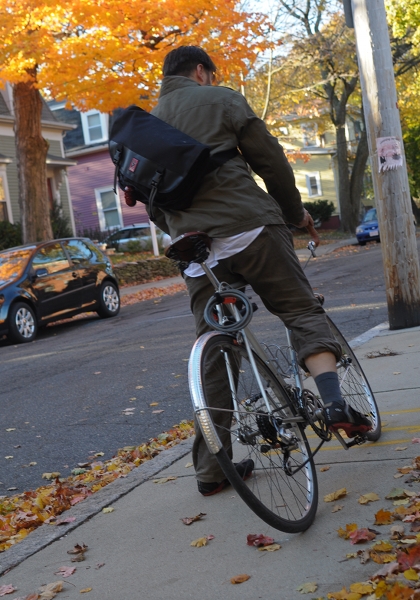
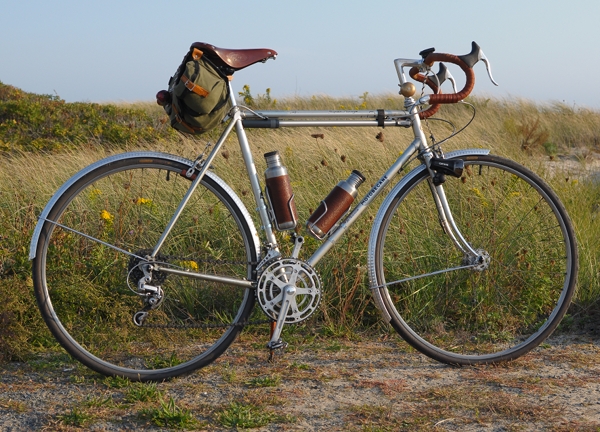
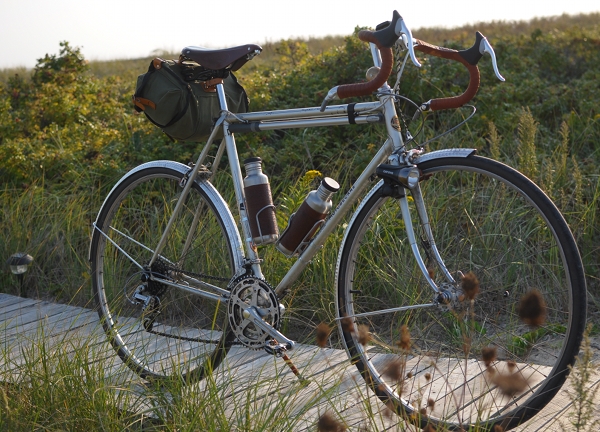
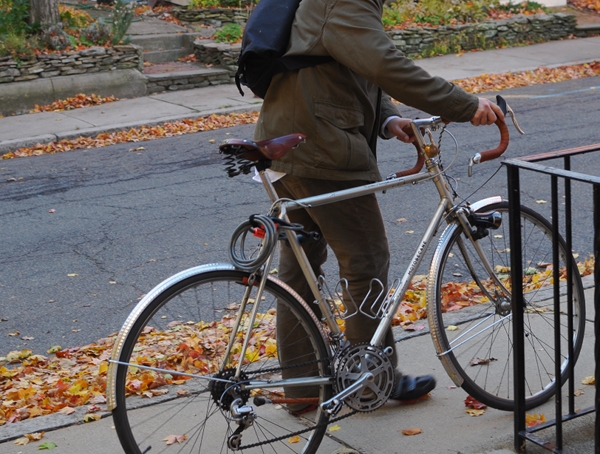
The Co-Habitant started a new job this week, and with it a new commute. The trip is about the same distance as before, but his cycling ritual is much changed. Previously, he rode to work on his fully loaded Pashley Roadster, which he would lock up in the secure bicycle cage inside the building's parking garage. The new job's parking facilities are less secure, and it is in an area where he does not feel comfortable leaving his Pashley on the street all day. So he will now be commuting on his old Motobecane roadbike, which he has stripped down to the bare bones.  This is what Myles looks like in his normal role as touring bike. And above is the new pared-down version: No saddlebag, no twined water bottles, no pump under the top tube. A U-Lock and an extra long cable lock are wrapped around the seat cluster. The battery headlight on the fork is detachable, and the tail light will now be attached to the messenger bag he plans to carry.

The Co-Habitant's response to his new commute underscores the differences in our attitudes toward bicycle security.  His Pashley is a comfortable, upright bicycle and if it were me, I would continue to ride it despite the change of location and the less than ideal parking situation. I would remove the Pashley's luggage, get a detachable pannier for the rear rack, use a U-lock plus long cable combination, lock it up outside and stop worrying about it. But then again, some would say that my own lock-up methods are scandalously lax, because I typically just use a cable lock. In short, the Co-Habitant and I are separate people and often our views on things differ. I respect that he does not want his "nice" bicycle to get stolen, but it just seems like such a shame to ride an aggressive roadbike (with clipless pedals!) to work and carry all his stuff in a messenger bag, when he owns the perfect commuter bike. 

How much of a factor is the location of your job (or residence) in your choice of what bicycle to ride and in your lock-up methods? 
Read More
Posted in Co-Habitant, locking up, Motobecane, Myles, urban cycling | No comments

Friday, September 24, 2010

Making an Ordinary Vintage Roadbike Extraordinary (a Review of Sorts)

Posted on 12:36 PM by dvdsvdsdv
The Co-Habitant's roadbike, Myles, is a 1976 Motobecane Super Mirage, which he acquired in Spring 2009 and has been gradually updating with modern components and personal touches. It is his only roadbike, and he has cycled somewhere between 2,000 and 2,500 miles on it through its various iterations. I wanted to write a review of it (from my perspective), because I think it poignantly illustrates some aspects of owning and customising a vintage roadbike.

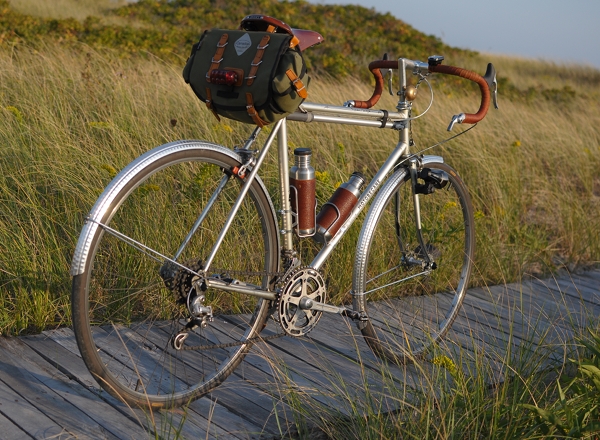
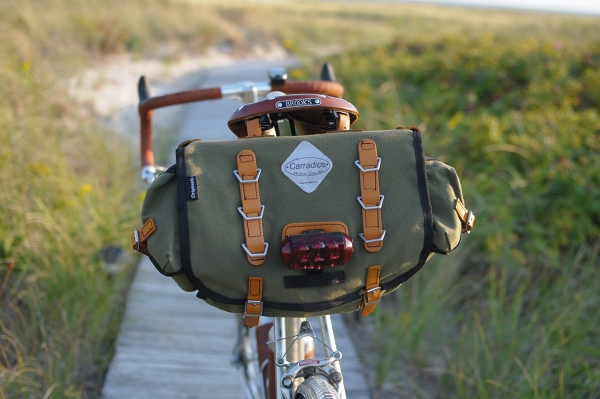
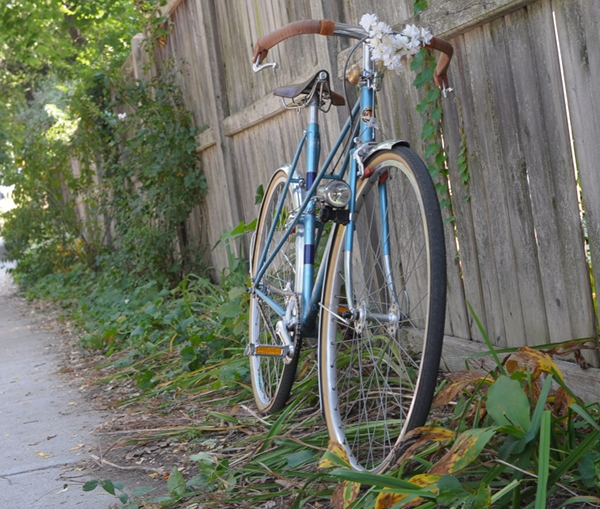
It is always interesting to observe people's reaction to Myles, for he is a real head turner - even more so than my Rivendell. The silver frame, the hammered fenders, the wealth of brown tones in the leather and twine, the frame pump looking almost like a double top tube, and the classic Carradice bag, somehow combine to create a whole that is more magnificent and eye-catching than the sum of its parts.

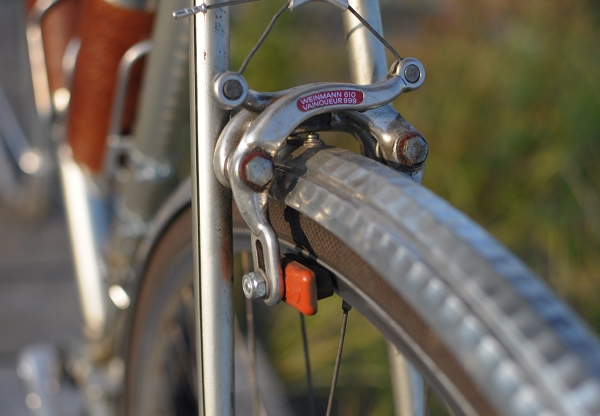
On closer inspection, those who know bicycles typically exhibit one of two reactions. Some are delighted to see a good, ordinary vintage bicycle salvaged and turned into a thing of beauty. Others are bewildered that we bothered to so elaborately refurbish something so commonplace, rather than searching for a frame with a more impressive pedigree. While the Motobecane Super Mirage was a good, solid bicycle in its time, it was decidedly middle-tier and for that reason unremarkable. The frame is hi-ten steel, the lugs are fairly basic, and the original components (Suntour, Weinmann) are pretty good, but not excellent.

We do not disagree with the point of view that a better frame would have been more deserving of all the DIY lavished on Myles. But sometimes a bicycle just evolves organically, and such was the case here.

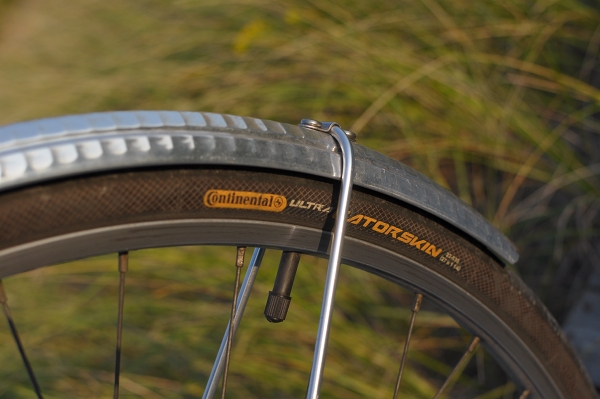
When the Co-Habitant found the bike, used and somewhat abused, the plan was simply to ride it after a few minor changes. He first replaced the tires, after the original ones blew up on his very first ride.  He has ridden these Continental Gatorskins (27" x 32mm) the entire time without incident.

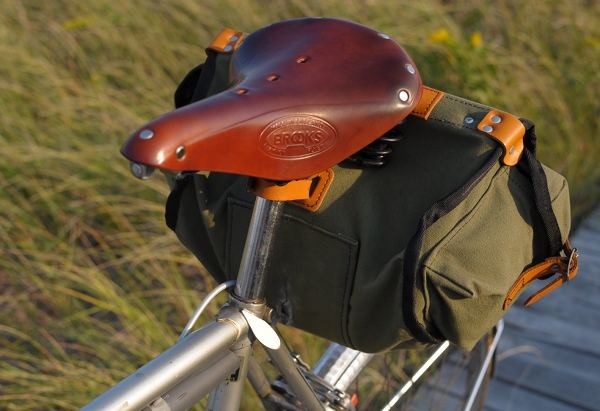
He then replaced the original vinyl saddle with a Brooks Flyer. Early on, he was caught in the rain and the Flyer got wet - which hastened its breaking-in process nicely.

The brakes on the bicycle worked fine after some adjustment, but he did replace the pads with the salmon Kool-Stops.

As he began riding the bicycle more and more, he added fenders and a saddle bag. Although I am normally not a fan of hammered Honjos, I think they do look good on silver bikes - providing textural variation where the colour is similar.  Hammered fenders are also a good investment in terms of hiding dents or scratches.

The Carradice Barley bag has been sufficient for carrying anything he needed on this bike, up to our current trip. For the future, he will consider getting a larger bag that can fit laptops, and a rack to support it. Having a saddlebag is also handy for installing a battery-operated tail light, such as his CatEye.

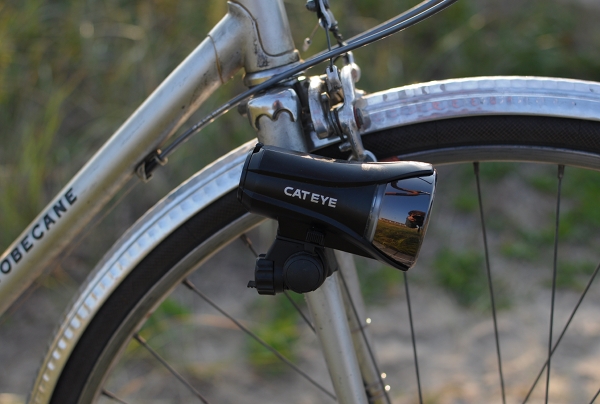
His headlight is mounted on the fork, using a Minoura light mount. While he prefers generator lighting, as far as battery-operated lights go, he likes this system very much.

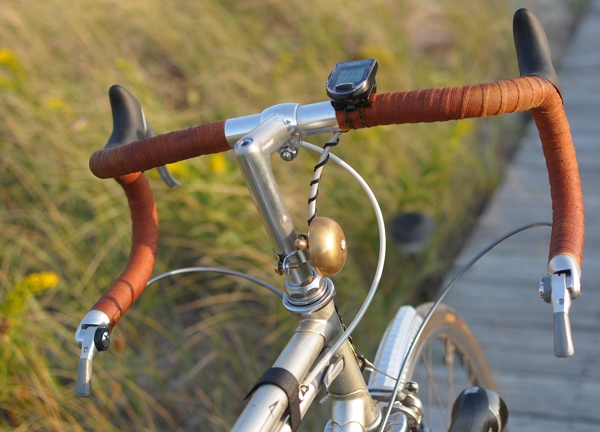
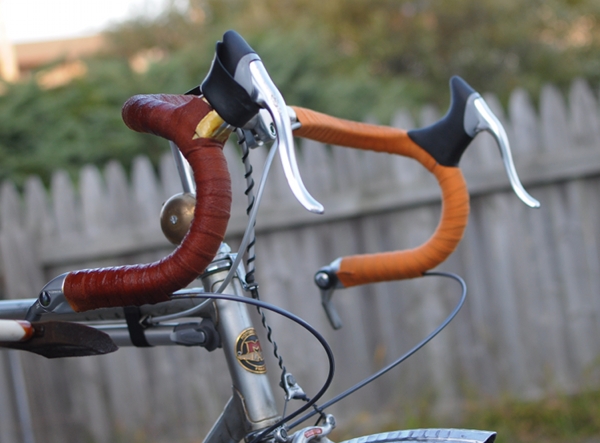
Some months later, he decided to replace the handlebar set-up, as the original one caused discomfort and difficulty operating the brake levers.  He replaced them with 42cm Nitto Noodle bars, which he loves, and the stem with a Nitto Technomic. 

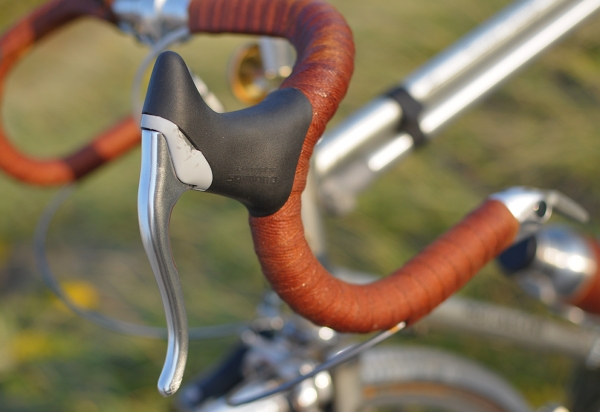
The original non-aero brake levers were replaced with modern Shimano aero brake levers. Personally, I am not a fan of these brake levers, as the hoods have a rather harsh surface and there is a plastic insert that is very easy to damage. The Co-Habitant has dropped and crashed this bike several times, and you can see that the levers look battered.

Almost a year later, a few more changes were made. After complaining that his feet always slipped on the touring pedals at high speeds and that toe clips were a bother, he installed these SPD clipless pedals - much to my shock at the time.  He loves them and now says that he would not go back to non-clipless on a roadbike, vintage or not.

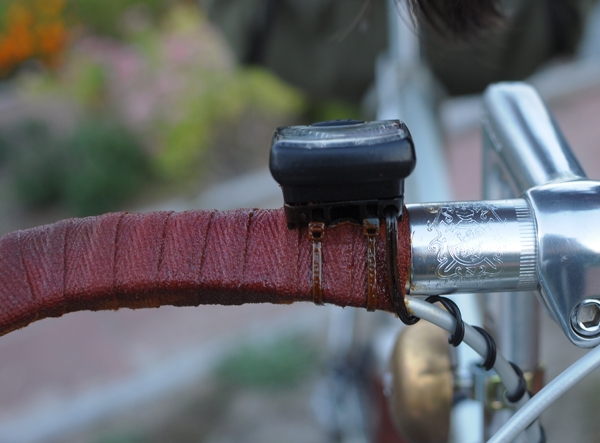
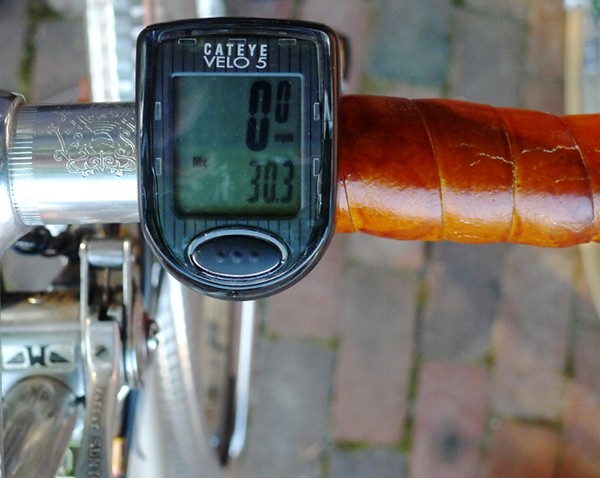
Around the same time, he also installed a CatEye computer to keep track of his speed and mileage,

a Topeak frame pump,

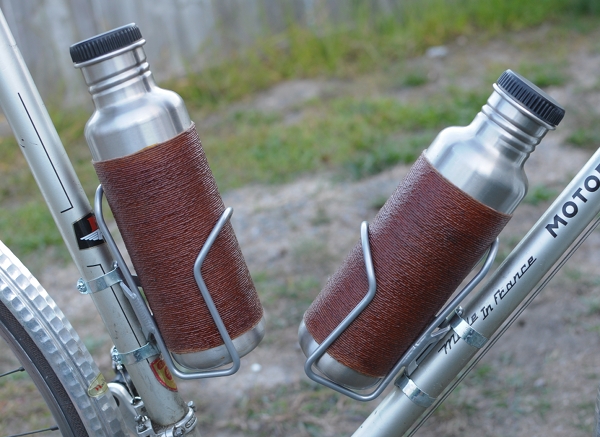
and two bottle cages, bolted onto the frame - into which he places his twined and shellacked Klean Kanteen bottles.

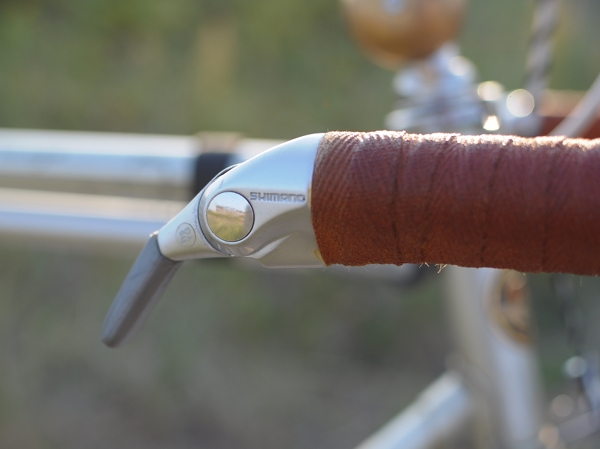
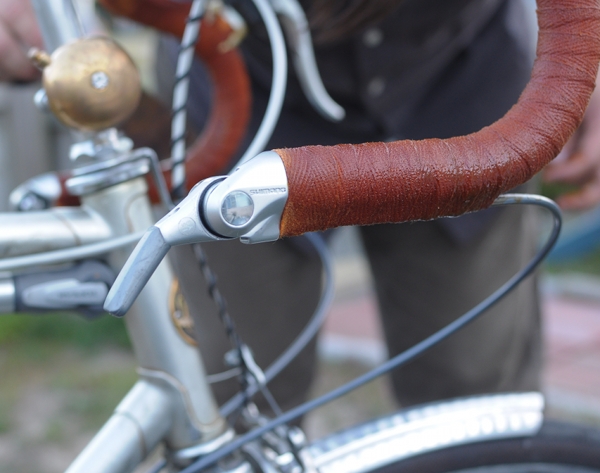
And the final update - completed just a couple of weeks ago in our yard  - was the replacement of the original stem shifters with these Shimano bar-ends. Since the bike is a 10-speed, it isn't possible to get indexed shifting, but these work just as well in friction mode. After having used a shifting method that sounded like a tractor for over a year, the Co-Habitant is absolutely delighted with these - they are fast and quiet, and he is convinced that they are superior even to my Silver shifters (although I disagree).

And so that is the story of Myles's slow but steady transformation from a plain '70s French 10-speed to a glorious and shamelessly eccentric dandy. Was it worth it? It certainly helped the Co-Habitant learn about classic roadbikes - both riding them and working on them. It is difficult to get a straight answer from him about how comfortable the bike is, especially as he is more tolerant of discomfort and pain than I am and to some degree even thinks these are "normal" to experience on a roadbike. But from what I can surmise, the bike is more or less comfortable in its current state, except that it places a bit too much weight on the hands and is over-responsive to the point of being "squirrely". Also, the frame size would ideally be larger, and he could do with better gearing.

All of these comments, however, are made only in response to my direct questioning; he never complains about the bike on his own accord. On the contrary, he is extremely fond of Myles, smiling and shaking his head quietly at any suggestion that such components ought to be placed on a new frame instead.
Read More
Posted in Brooks, Co-Habitant, fenders, Motobecane, Myles, vintage | No comments

Thursday, September 23, 2010

His and Hers Bicycles: Matching Looks vs Matching Performance

Posted on 6:08 AM by dvdsvdsdv
I love the idea of "His and Hers" bicycles: an elegant pair of lady's and gentleman's bikes from the same manufacturer. When we first decided to ride bicycles, the Co-Habitant and I envisioned ourselves exclusively on such matched pairs. We acquired a Pashley Princess and Roadster as our transport bikes. We acquired a Motobecane Super Mirage and Mirage Mixte as our roadbikes. And we acquired a Raleigh DL-1 Tourist and Lady Tourist as our vintage 3-speeds.

It was all so perfect!... except that it wasn't.  I could never keep up when we were both on the Pashleys, which was a constant source of discontent (I am now convinced that the female model is just inherently different from the male one). With the Motobecanes things were even worse, as my semi-upright mixte was no match for his racy Super Mirage roadbike. Despite being perfectly matched in looks, our beautiful velo couples were plagued by a disparity in performance. 

Having finally decided that the illusion of perfection was not the same as perfection itself, I shattered the symmetry - first by replacing my Pashley Princess with a vintage Gazelle, and then by selling my Motobecane mixte.  Interestingly, the Gazelle is a better match for the Pashley Roadster performance-wise, and we no longer experience the same problem with discrepancies in speed when cycling together on our commuter bikes.

As for roadbikes, it is difficult to keep up with somebody on drop bars, while yourself riding with upright bars - especially if you are a weaker cyclist to begin with. My Rivendell and Trek roadbikes may not look as sexy next to the Co-Habitant's Motobecane as my vintage mixte did, but they are a better match when it comes to actually cycling together.

This particular discrepancy in "his and hers" bikes is something I wonder about when I see a man and a woman cycling together, where he is on an aggressive roadbike and she is on an upright hybrid from the same manufacturer (usually Trek, Cannondale or Specialized). While I understand that the idea is for the woman (who is presumably less skilled) to ride an "easier bike," surely it must make the difference in their skill levels all the more acutely felt?

Of the three "His and Hers" pairs we started with, only our vintage Raleigh DL-1s remain. These are actually matched pretty nicely in terms of performance, so apparently "back in the day" Raleigh got it right whereas today's Pashley did not. Although we do not ride these as often as we ride our main transport bikes, it is nice to have at least one pair of bicycles that matches both in looks and performance. Who knows, maybe in the future there will be more - but the performance aspect is a must. After all, a couple's chemistry is about more than just looks.
Read More
Posted in Motobecane, Pashley, Raleigh | No comments

Wednesday, September 15, 2010

Shellac: Why and How?

Posted on 9:18 AM by dvdsvdsdv
With the rise of the "classic bicycle aesthetic" it is becoming increasingly popular again to shellac handlebar tape, cork grips and twine. Obviously I love the trend. But I also think that people ought to be aware that the purpose of shellacking is predominantly practical, not aesthetic.

Shellac is an all-natural natural sealant (derived from the secretions of a Thai insect), which makes it perfect for waterproofing wood and cloth. When you cover your handlebars in cloth tape, two things will happen to them over a surprisingly short time period:  They will get dirty from your hands rubbing road dust into them, and they will get soggy from rain and sweat - which can cause the tape to distend, discolour, and even rot eventually. Shellac will form a protective layer that will prevent this from happening.

At this point, we have applied shellac so often and to so many bicycles, that we have gone through 3 cans of the stuff in a year and a half. For those interested, here is how I like to do it:

. I use a 1" foam brush, rather than a real paintbrush. A paintbrush can leave visible brush strokes, whereas a foam brush makes it easy to quickly put down an even coat. Also, because shellac is difficult to wash out, it is pretty much a given that you will ruin paintbrushes with it. Ruining a foam brush is less costly.

. I like to apply shellac in thin layers, rather than oversaturating. This way it dries faster, and I have better control over the thickness.

. Because I like to feel the texture of my bar tape, I am careful not to go overboard with the shellac application. If you apply so much that your bars feel glassy and hard as a rock, they might not be so comfortable to hold. If you find that you've accidentally done this, try going over it with steel wool or fine grade sandpaper to restore some of the texture.

. Since I ride my bike often and in bad weather, I re-shellac on a fairly regular basis. The shellac tends to wear off first in the spots where I keep my hands the most. When I notice this, I know it is time to add another thin layer.

. Shellacking the night before I plan to ride the bike usually leaves sufficient drying time - but doing it at least 24 hours beforehand is safer. Once or twice, I've ended up holding my hands on the hoods during an entire ride, because the bars were still not 100% dry.

Twine requires shellacking for similar reasons as bar tape: If left in its natural state, it will unravel over a short time period from friction and moisture.

Because of their distinct look, it is understandable that shellacked tape or twine on a bicycle can be seen as a fashion statement. But while I am happy it looks nice, for me the practical benefits far outweigh this aspect. If it were not for shellac, I would destroy my cloth tape on a regular basis. And in case you are wondering - Yes, of course we brought shellac to the Cape! The Co-Habitant has finally replaced his Motobecane's stem shifters with Shimano bar-ends, and we re-did his tape as the sun was setting over the beach next to our house.
Read More
Posted in DIY, handlebars, Motobecane, Myles | No comments

Thursday, September 2, 2010

French Experiments Continue: Belleville Handlebars and Inverse Brake Levers

Posted on 10:18 PM by dvdsvdsdv
Spare bicycle parts, a restless spirit, and a willing "guinea pig" can make for a dangerous combination. In her latest reincarnation, Marianne sports VO Belleville handlebars and Dia Compe inverse brake levers - a practice run to determine how a similar set-up would feel on the Royal H. mixte.

Here are the bars and levers in all of their French glory - on a Motobecane mixte with an Ideale saddle.

The Belleville handlebars are similar to the Porteur handlebars shown here. Both are a classic style of upright bars found on vintage French city bicycles. These bars are narrow, with long gripping areas that are nearly parallel to each other - placing the rider's hands in a position similar to holding a tray.  The Bellevilles are 5cm narrower than the Porteurs (43cm vs 48cm) and are completely straight across the front (whereas the Porteurs have a slight forward sweep).

It is typical to see handlebars like this fitted with inverse brake levers. My assumption is that this is done to maximise the gripping area of the bars. Because the levers are installed at the ends, there are no interruptions along the handlebar's surface and the cyclist is free to move their hands pretty much along the entire bar.

The inverse brake levers you will find today are most likely either Tektro or Dia Compe. Here I have installed the latter, and you can see that their brown rubbery tips go nicely with twined handlebars. It surprised me to learn that some dislike the Dia Compes because of the brown tips and prefer the Tektro levers instead - which are all-metal. To me, the rubbery surface felt nice, but I suppose it is a matter of personal preference. If you have used either of these levers, I'd like to hear your thoughts.

Braking with inverse levers.  I have found that I am able to get pretty good leverage almost no matter where I hold my hand along the bar, with the exception of the very front.

Can't brake from here, near the corners. But if I move my hands 1-2 inches back, it will work. This set-up is amazingly versatile in terms of the hand positions it allows.

The inverse levers are set back from the bars far enough so that they do not interfere with the grip. You can see in the pictures that they are nowhere near my knuckles. Truly a neat design.

If you are curious about this type of French set up, both the bars and the levers are surprisingly inexpensive. You will like them if you are a fan of narrow handlebars, and if you prefer to hold your hands to the sides rather than flared out or straight in front of you. I certainly fit that description, so both the Belleville and the Porteur handlebars feel as if they were made just for me. The super-wide Albatross bars were comfortable enough, but with the Bellevilles and the Porteurs I get that "spot on!" feeling. I also think that they are better match for French bicycles - especially for the Motobecane's aggressive handling.

I will pause and confess here, that this is the last change I will be making to Marianne... because she no longer belongs to me. Yes, I did sell her after all - to a lovely local woman whose acquaintance I had the pleasure of making this morning. Riding the Motobecane with the French handlebars and inverse levers yesterday, I finally felt that this bicycle was "perfect" and experienced a calm sense of satisfaction - not dissimilar to how I feel when a painting is finally "finished" or when a photograph looks just right. And after that, it finally felt appropriate to let her go. I hope the new owner enjoys her as much as I hope to enjoy my Royal H. mixte - which I will most definitely fit with a similar handlebar set-up.

Oh - and if anybody wants some Nitto Albatross bars (the alloy version) or VO Milan bars, drop me a line. Thankfully, I have no more "spare" bicycles to put them on.
Read More
Posted in DIY, grips, handlebars, Marianne, mixte, Motobecane, product reviews | No comments

Sunday, August 29, 2010

Cycling and the Beach

Posted on 12:42 PM by dvdsvdsdv
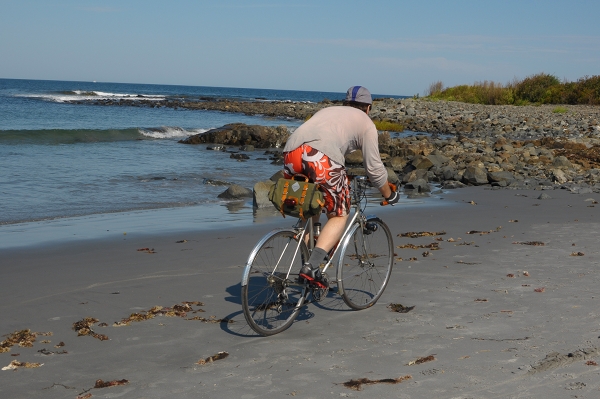
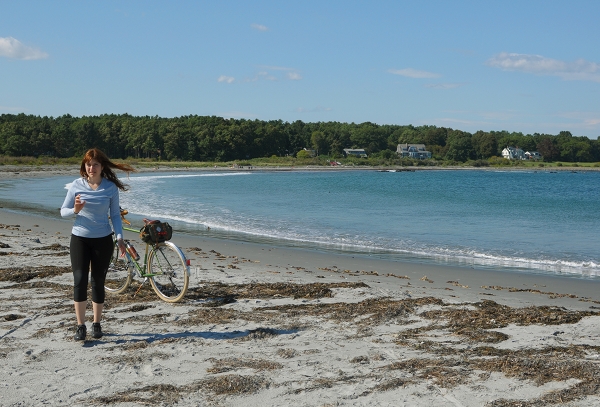
If you live in a beach town, it is easy to hop on a cruiser and pedal to the shore, have a swim, more or less dry off, and pedal home. But what about incorporating the beach into long, strenuous and hilly touring style-rides? This has been our dilemma when taking trips to Maine this summer. In the absence of folding bikes (and frankly, I don't think folding bikes would be appropriate for the terrain here), we strap our roadbikes to the car, and get around entirely by bike once we arrive to our "base" location. In rural Maine, everything is far away from everything else - at least by Boston standards - and it is normal for us to cycle 5-10 hilly miles from one destination to another, multiple times in a day. We often pass our favourite beach in the area, but swimming can seem like such a project when your bicycle bags are already stuffed with photo equipment and other things, and the beach has no changing rooms. 

Plus, when a 10 mile ride with plenty of uphill lies between the beach and the nearest town where you could freshen up, believe me that you don't want any sand to be stuck in your body's crevices, and neither do you want to pedal in a bathing suit. The Co-Habitant has tried wearing his swim trunks on the bike, and regretted it. 

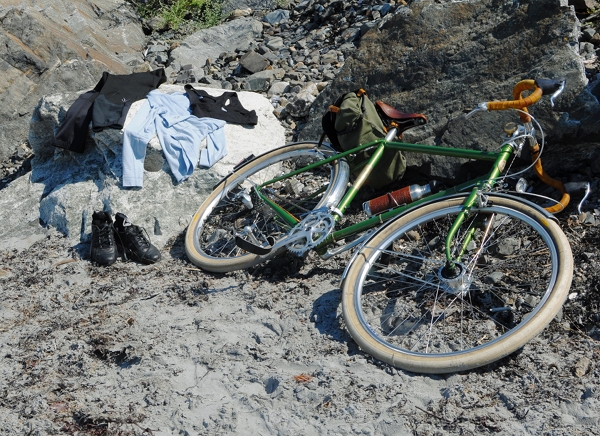
So here is my solution: I bring a bathing suit and a thin Pashmina or wrap instead of a towel. These take up almost no extra space in my saddle bag. Once at the beach, I remove my shoes and socks, wrap myself in the pashmina, and change into my bathing suit underneath it. If you don't have a pashmina or wrap, a long oversized t-shirt can work as a "changing tent" as well. After swimming, I "air dry" while either walking around or sitting on rocks (rather than sitting on sand); then I reverse the "changing tent" process. After this, the bathing suit can be wrung out, placed on a rock to dry off a bit, then placed in a plastic bag and packed away into the saddle bag together with the pashmina. After de-sanding my feet and putting my socks and shoes back on, I am ready to keep cycling. All this is a surprisingly low-hassle process. 

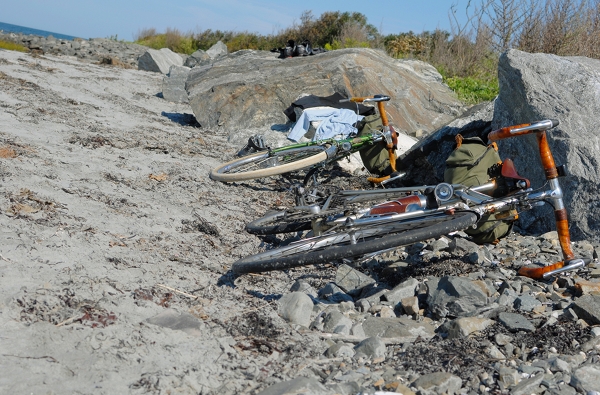
Of course, one thing to make sure of before you stop at a beach like this, is that your water bottles are full. Also, never try to prop up your bike on the sand using a kickstand; carefully lay it down instead (drivetrain side up). Even if it seems as if the bike is stable on the kickstand, the sand's consistency changes with the wind and the tide, and the bike can easily fall. Oh, and if you go swimming, leave your bike as far from the water as possible - the tide can come in faster than you think!

Swimming in the ocean and cycling are two of my favourite activities, and it feels wonderful to combine them. Interestingly, the ocean water seems to be a great complement to high-intensity cycling - relaxing the muscles and giving me extra energy to go on. Anybody else have this experience?  
Read More
Posted in Co-Habitant, Motobecane, Rivendell, roadcycling, travel | No comments

Thursday, July 29, 2010

Computer Games

Posted on 9:20 AM by dvdsvdsdv
I have never liked computer games, but with the influence of the Co-Habitant I am finally starting to get into them.

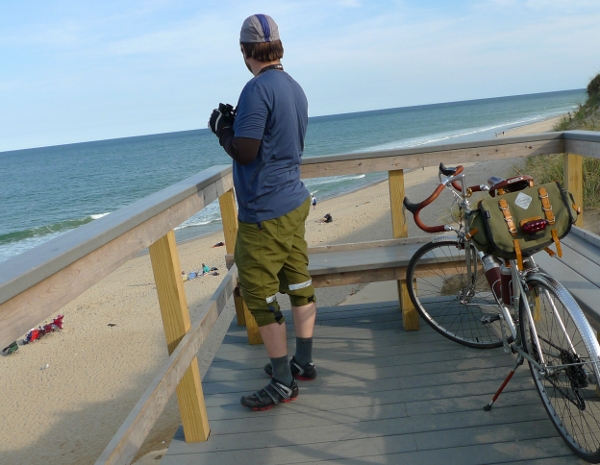
Here he is, taking a break after a particularly heated round.

What you need to play: an open road and a fast bicycle. Challenging hills can be introduced after you pass Level 1. Oh yes, and of course you'll need a computer.

After I mocked the Co-Habitant for putting one of these on his own bike, he decided that I was just jealous and got me one for Graham (my Rivendell Sam Hillborne). I reluctantly agreed to try it, and quickly grew to love it - much to my dismay, as there is really no attractive way to attach these things to a bike.

For those not familiar with it, a bicycle computer is basically a speedometer with some extra features. Mine tells me: distance covered during a trip, current speed, maximum speed during a trip, average speed, and total distance covered so far (since installing the computer). There is also a clock, which is handy since I don't wear a watch and extracting my mobile phone requires stopping the bike. If you are training yourself for touring, the bicycle computer helps you measure your progress in terms of how fast you are able to cycle. Keeping track of the distance you have covered is also useful. My top speed so far is 27.4 mph (44.1 km/h), which I reached the other day on the hills in Maine. I know that to the roadies out there, this is far from impressive. But for me, it was shocking to learn that I was capable of cycling this fast. 27.4 mph is of course a downhill speed, but on flattish ground I was consistently cycling at 16-19 mph.

The Co-Habitant is faster, so I guess he won the computer games - and probably will continue to win for a while. But who knows, maybe someday I will catch up.

The main thing that makes me lose speed, is fiddling around with my shifters. I don't shift gears on my usual rides outside Boston, so whenever we go to an area with real hills it takes me a while just to get comfortable with shifting. The Co-Habitant thinks that my friction shifters are an affectation, and if I got "brifters" (brake levers that contain indexed shifters within them) it would solve all of my problems. I feel attached to my wonderful silver bar-end shifters, but I do see his point.

For those interested in touring or in cycling for sport, the bicycle computer can be useful and fun. But beware: Once you have one, it can also get addictive! I know some people who have one on every single bicycle they own and are incapable of cycling without knowing their exact speed or distance covered.  I am not likely to suffer this fate, but I am glad to have a computer on Graham.  And a question for the randonneurs and roadies out there: What speed should I be working toward for touring and for club rides? It would be great to know where I stand.
Read More
Posted in Co-Habitant, drop bars, Maine, Motobecane, Rivendell, roadcycling, technique, travel | No comments
Older Posts Home
Subscribe to: Posts (Atom)

Popular Posts

  • Computer Games
    I have never liked computer games, but with the influence of the Co-Habitant I am finally starting to get into them. Here he is, taking a br...
  • Upside Down!
    Fate has been kind to Marianne! Rather than being torn apart for donor components , she has been spared, and fitted with new handlebars. Wha...
  • Matters of Identity
    Well... I thought that I could quietly change my blogspot username without anybody noticing or caring, but it's caused some confusion. S...
  • Celestial Beings
    [image via Spernicelli ] Depending on who you speak to, it is either the most over-rated vintage bicycle in existence, or the Holy Grail: Th...
  • The Pashley Roadster Sovereign: Review After Two New England Winters
    If you are a regular reader, you probably know that the Co-Habitant owns a Pashley Roadster Sovereign. We bought a pair of Pashleys  when I...
  • Crime vs. Accident?
    I was cycling across town with a friend today, who suggested that we take the side streets instead of my usual route along the major roads. ...
  • Putting Your Foot Down
    Enough people have asked me about this now that I thought it worth writing about: How do I put a toe down in traffic while remaining on the ...
  • Pulling the Trigger vs Doing the Twist: Thoughts on 3-Speed Gear Shifters
    On bicycles with internally geared hubs, we typically see two types of gear shifters. The trigger shifter (pictured above) is a small gadget...
  • Manufacturers with 'History': Does Continuity Matter?
    What does it mean, when we say that a bicycle manufacturer has a long history? There are manufacturers out there, whose names are legendary ...
  • An Igleheart and a 'Sex Hub'
    At the New England Bicycle Expo  a couple of weekends ago, I had the pleasure of meeting legendary New England framebuilder Christopher Igle...

Categories

  • ANT
  • art
  • bags
  • basket
  • beginners
  • Bella Ciao
  • bicycle events
  • bicycle industry
  • bicycle reviews
  • bike friends
  • bike shopping
  • blog development
  • blogiversary
  • books
  • Boston
  • Brompton
  • Brooks
  • Cape Cod
  • cargo bikes
  • cars
  • cats
  • children
  • clipless
  • clothing
  • Co-Habitant
  • coaster brake
  • comfort
  • Constance
  • countryside
  • diamond frame
  • DIY
  • DL-1
  • dress guards
  • drop bars
  • Eustacia Vye
  • fashion industry
  • fenders
  • films
  • fixed gear
  • flowers
  • food
  • framebuilding
  • Gazelle
  • Geekhouse
  • gender
  • give-away
  • grips
  • handlebars
  • handmade
  • holidays
  • Interbike
  • Italian bicycles
  • Jacqueline
  • knitting
  • lights
  • local bike shops
  • locking up
  • loop frame
  • lugs
  • Maine
  • Marianne
  • mercian
  • Mercier
  • mixte
  • Moser
  • Motobecane
  • Myles
  • night time cycling
  • North Shore
  • paceline
  • Pashley
  • pilen
  • poll
  • product reviews
  • racks
  • rain
  • Raleigh
  • Randonneur
  • randonneuring
  • restoration
  • Rivendell
  • roadcycling
  • rod brakes
  • Rodney
  • Romania
  • Royal H
  • Royal H. Mixte
  • saddles
  • safety
  • Seven
  • shop visits
  • silliness
  • skirt
  • social commentary
  • Soma
  • somervillain
  • stories
  • summer cycling
  • sun and heat
  • Surly
  • tandem
  • technique
  • test rides
  • tires
  • tools
  • traffic
  • trails
  • transportation options
  • travel
  • unpaved
  • urban cycling
  • Urbana
  • Velo Orange
  • Velouria
  • Vienna
  • vintage
  • winter cycling

Blog Archive

  • ▼  2011 (236)
    • ▼  September (17)
      • Frills or Basics?
      • European City Bikes and the North American Market
      • Thoughts on Fixed Gear Cranksets?
      • From Holsters to Corsets: The Cycling Accessory Fe...
      • Yeah Baby! Transportational Elegance Reigns at Int...
      • Handmade Bicycles at Interbike
      • Bleak Prognosis for the Dutch Bicycle?
      • GB Components Are Back! ...And You Can Have Their ...
      • Song, Dance and Bicycle Romance: The Interbike Fas...
      • On Bicycle Reviews
      • What's the Difference?
      • In the Raw
      • Frames of Mind: Why Did We Not Cycle?
      • Embracing Wrinkles
      • Reunited
      • The Art of the Ride Report: a Touring Bicycle Give...
      • If a Branch Falls in a Forest...
    • ►  August (22)
    • ►  July (26)
    • ►  June (27)
    • ►  May (27)
    • ►  April (26)
    • ►  March (30)
    • ►  February (30)
    • ►  January (31)
  • ►  2010 (262)
    • ►  December (28)
    • ►  November (29)
    • ►  October (24)
    • ►  September (23)
    • ►  August (25)
    • ►  July (25)
    • ►  June (20)
    • ►  May (19)
    • ►  April (20)
    • ►  March (17)
    • ►  February (18)
    • ►  January (14)
Powered by Blogger.

About Me

dvdsvdsdv
View my complete profile