lindaikeji35

  • Subscribe to our RSS feed.
  • Twitter
  • StumbleUpon
  • Reddit
  • Facebook
  • Digg

Friday, November 12, 2010

Heavyweights, Middleweights, and Lightweights: a Loop Frame Taxonomy

Posted on 4:02 AM by dvdsvdsdv
The "Manufacturer Profiles" page linked in the upper left corner lists popular manufacturers that produce quality ladies' bicycles which I believe to meet the urban commuting criteria described here. Fairly often, I am asked about the differences between the bicycles featured on this page - particularly in terms of weight, speed, and their ability to handle hills. Happily, I have now ridden almost all of these bikes, and am able to provide this type of feedback. If I had to classify the higher-end loop-frame bicycles currently available on the market, I would say there are three main categories: the heavyweights, the middleweights, and the lightweights. Each category has its strengths and weaknesses, its benefits and its drawbacks. I will try to describe my experience of them here.
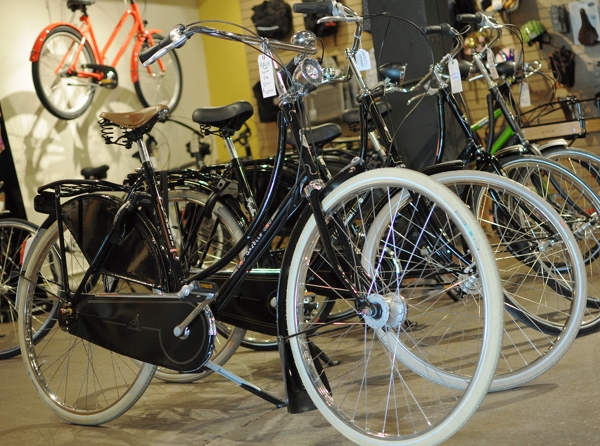
The Heavyweights

In this category I place the traditional Dutch bikes: the classic models produced by Gazelle, Azor/Workcycles, Achielle, and Batavus. They have long, super-relaxed frames, high handlebars and 28" wheels. They are very heavy. They have heavy-duty racks and are designed to haul serious weight. They place the cyclist in a bolt-upright position. And their basic design has remained unaltered for nearly a century.

The benefit of the "heavyweights" is that they are supremely comfortable and stable.  On a proper Dutch bicycle, you can expect to glide along even the most treacherous urban surfaces: You will not feel potholes, bumps, or cobblestones to nearly the same extent as you do on other bikes. You can load your rear or front rack with as much weight as you like without feeling the difference. You can give your friends rides on the rear rack while transporting your toddler on a handlebar-mounted childseat if you like - these bicycles were designed to handle that.

The drawbacks that come with these wonders are the weight (over 50lb - with the Workcycles/Azor being heavier than Gazelle and Batavus) and the wide turning radius. The weight of bicycles is not a problem for the Dutch, because they keep them parked outdoors. If you are not willing to do that and live in a 2nd floor apartment, consider whether you will be able to drag that much weight up and down the stairs every day. As for the handling, it is natural to expect that a long, relaxed bike will make fairly wide turns and will not want to weave aggressively though traffic. To some, this means that Dutch bikes are not sufficiently "maneuverable." Some also complain that because of their weight and relaxed position, it is difficult to cycle uphill on a Dutch bike - especially a prolonged hill.

Conclusion:  These bicycles will give you unparalleled comfort and stability at the expense of weight and maneuverability.
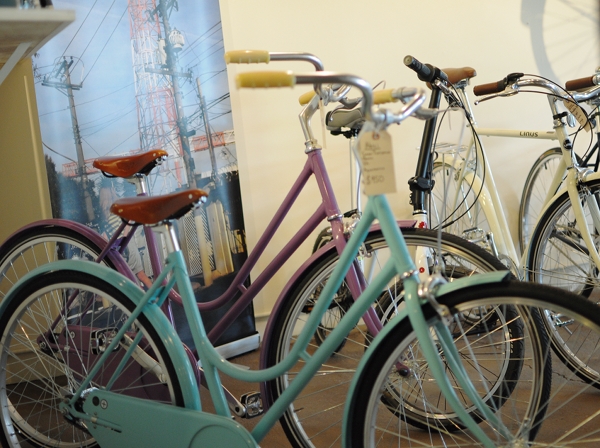
The Lightweights

At the moment, the only loop frame bicycles in this category are the Italians: Abici and Bella Ciao. They are more nimble and sporty than their heftier cousins, with smaller frames and large-ish 700C wheels (a size typical of roadbikes). With their distinct curvature and clean lines, these bicycles are elegant, coltish and fast.

The benefit of the Italian lightweights, is that they are as light and zippy as you can possibly get on this type of city bicycle. Typical weight is 30-35 lb depending on gearing and lights. They do well on hills, they are easy to lift and carry, they are maneuverable.

On the downside, the ride quality is not quite as smooth as on the Dutch bikes. You will feel the road to a greater extent and you will not be as oblivious to the potholes and bumps. Because of their light weight and sportier geometry, these bicycles also have a limited load-carrying capacity. You can carry your bag and panniers, but you probably won't be able to wheel around your boyfriend and your toddler as you would on a Dutch bike.  I am not even sure about the toddler alone.

Conclusion: These bicycles will give you lightweight speed and agility, at the expense of extra cushioning and hauling capacity.
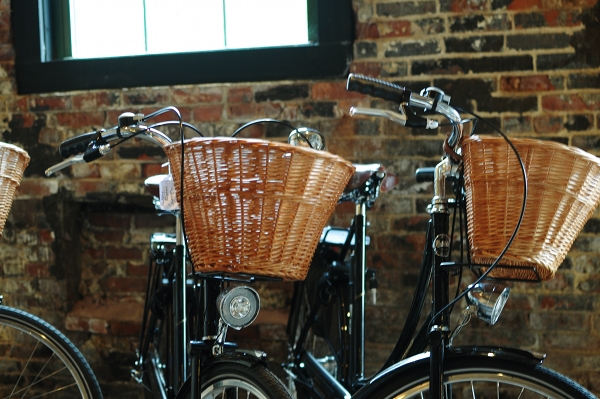
The Middleweights

As you may have guessed, bicycles in this category are somewhere in between. They include the English Pashley, the Danish Velorbis, the Swedish Skeppshult and the German Retrovelo.  Their frames are not as relaxed as the Dutch bicycles, but not as sporty as the Italians. They are typically fitted with 26" wheels. Sometimes these bicycles are specifically marketed as lighter-weight "improvements" compared to Dutch bikes or classic Roadsters.

I am going to combine the benefits and drawbacks of this category into one narrative, because they are not quite so clear-cut.  In a very general sense, the benefit of these bicycles is that they are somewhat lighter than the Dutch bikes (40-45lb+), while also being somewhat sturdier than the Italian bikes. As for smoothness and cushiness of the ride, there is variability. I have found the Pashley and the (non-balloon tire) Velorbis to be about the same in terms of cushioning as Bella Ciao, while also being nearly as heavy and just as difficult on uphills as some of the Dutch bikes. So in the case of these two, I do not feel as if the decrease in cushiness (in comparison to Dutch bikes) is adequately balanced by an equally significant decrease in weight. On the other hand, in the Retrovelo this problem seems to have been solved with the Fat Frank balloon tires  - the ride is almost as cushy as on a Dutch bike, with some of the weight shaved off and some maneuverability added.  I have not tried the Velorbis balloon-tire bikes and cannot say how they compare. And I have not tried the Skeppshult at all.

Conclusion: Overall I am not sure what to make of these bicycles. Having ridden the Pashley, the Velorbis, and the Retrovelo, I would say that Retrovelo has the nicest ride quality of the three and Pashley the second nicest. But to me the bikes in this category do not feel that much lighter than Gazelle or Batavus.
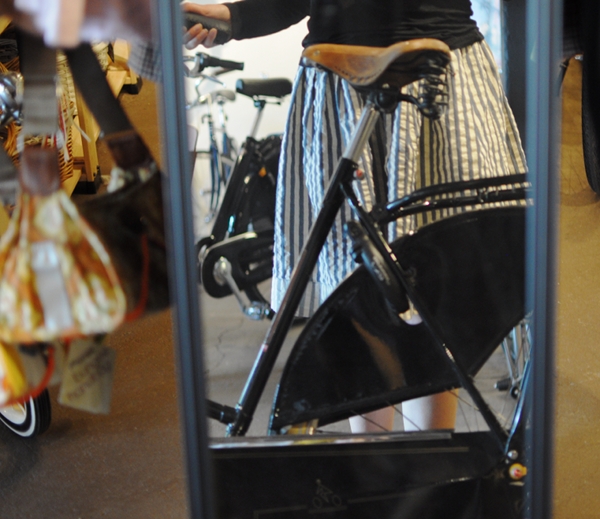
While this method of classification cannot begin to compete with the benefit of firsthand experience, I hope that it at least very generally suggests what to expect. The Dutch bicycles are obscenely comfortable, but cumbersome. The Italian bicycles are light and nimble, but do not offer the same sprawling sense of luxury. And the bicycles in between are a mixed bag. When considering which bicycle is right for you, the closest to "advice" I can give is to take very seriously your priorities and your limitations. It's not just about the weight and handling of the bicycle - but about what you need those factors to be like. We all need something different, and each of these bicycles is perfect for the right owner.
Email ThisBlogThis!Share to XShare to FacebookShare to Pinterest
Posted in bicycle industry, loop frame | No comments
Newer Post Older Post Home

0 comments:

Post a Comment

Subscribe to: Post Comments (Atom)

Popular Posts

  • Computer Games
    I have never liked computer games, but with the influence of the Co-Habitant I am finally starting to get into them. Here he is, taking a br...
  • Upside Down!
    Fate has been kind to Marianne! Rather than being torn apart for donor components , she has been spared, and fitted with new handlebars. Wha...
  • Matters of Identity
    Well... I thought that I could quietly change my blogspot username without anybody noticing or caring, but it's caused some confusion. S...
  • The Pashley Roadster Sovereign: Review After Two New England Winters
    If you are a regular reader, you probably know that the Co-Habitant owns a Pashley Roadster Sovereign. We bought a pair of Pashleys  when I...
  • Crime vs. Accident?
    I was cycling across town with a friend today, who suggested that we take the side streets instead of my usual route along the major roads. ...
  • 'Off Label' Use
    In pharmacological jargon, there is a term, "off label use," that refers to a treatment being used successfully for something othe...
  • Celestial Beings
    [image via Spernicelli ] Depending on who you speak to, it is either the most over-rated vintage bicycle in existence, or the Holy Grail: Th...
  • Handlebar Hoopla, What Now?
    My  Royal H Mixte  is almost built up, save for the fenders, racks and lights. I don't want to post glamour shots before the bike is com...
  • Putting Your Foot Down
    Enough people have asked me about this now that I thought it worth writing about: How do I put a toe down in traffic while remaining on the ...
  • Thoughts on Public Transport
    While I avoid public transportation in Boston, I love it in Vienna. The Wiener Linien system consists of: the U-Bahn (subway), the Straßen...

Categories

  • ANT
  • art
  • bags
  • basket
  • beginners
  • Bella Ciao
  • bicycle events
  • bicycle industry
  • bicycle reviews
  • bike friends
  • bike shopping
  • blog development
  • blogiversary
  • books
  • Boston
  • Brompton
  • Brooks
  • Cape Cod
  • cargo bikes
  • cars
  • cats
  • children
  • clipless
  • clothing
  • Co-Habitant
  • coaster brake
  • comfort
  • Constance
  • countryside
  • diamond frame
  • DIY
  • DL-1
  • dress guards
  • drop bars
  • Eustacia Vye
  • fashion industry
  • fenders
  • films
  • fixed gear
  • flowers
  • food
  • framebuilding
  • Gazelle
  • Geekhouse
  • gender
  • give-away
  • grips
  • handlebars
  • handmade
  • holidays
  • Interbike
  • Italian bicycles
  • Jacqueline
  • knitting
  • lights
  • local bike shops
  • locking up
  • loop frame
  • lugs
  • Maine
  • Marianne
  • mercian
  • Mercier
  • mixte
  • Moser
  • Motobecane
  • Myles
  • night time cycling
  • North Shore
  • paceline
  • Pashley
  • pilen
  • poll
  • product reviews
  • racks
  • rain
  • Raleigh
  • Randonneur
  • randonneuring
  • restoration
  • Rivendell
  • roadcycling
  • rod brakes
  • Rodney
  • Romania
  • Royal H
  • Royal H. Mixte
  • saddles
  • safety
  • Seven
  • shop visits
  • silliness
  • skirt
  • social commentary
  • Soma
  • somervillain
  • stories
  • summer cycling
  • sun and heat
  • Surly
  • tandem
  • technique
  • test rides
  • tires
  • tools
  • traffic
  • trails
  • transportation options
  • travel
  • unpaved
  • urban cycling
  • Urbana
  • Velo Orange
  • Velouria
  • Vienna
  • vintage
  • winter cycling

Blog Archive

  • ►  2011 (236)
    • ►  September (17)
    • ►  August (22)
    • ►  July (26)
    • ►  June (27)
    • ►  May (27)
    • ►  April (26)
    • ►  March (30)
    • ►  February (30)
    • ►  January (31)
  • ▼  2010 (262)
    • ►  December (28)
    • ▼  November (29)
      • What Our Hands Can Do
      • OYB Pannier: a Modified Swiss Army Bag for Your Bike
      • Winter Hibernators
      • Announcing Hat Recipient!
      • Musings on MUSA Knickers
      • Fade to Black
      • The 'Thanking Your Bicycle' Give-Away!
      • Advice from Fixed Gear Experts? And a Look at MKS ...
      • Colour Theory for Bikes
      • Fondness for the Bottle
      • Over the River and Through the Wood: the Season of...
      • Winter Project: a Roadbike for the Ladies Who Fear...
      • Mixte vs Mixte: What's the Difference?
      • Got Skills? Riding a Bicycle without Knowing How
      • The Popular Girl: Test Riding the Rivendell Betty Foy
      • Hats and Scarves for Cold Weather Cycling: What to...
      • Pulling the Trigger vs Doing the Twist: Thoughts o...
      • Heavyweights, Middleweights, and Lightweights: a L...
      • Reaching a Non-Cycling Audience
      • A Cruel Transition
      • Choosing an Upright Saddle: Brooks B72 vs Brooks B66
      • Up-lifting Experiences
      • Born for the Hills! A Review of the Rivendell Sam ...
      • Cross-Cultural Relationships
      • Water, Water Everywhere
      • On Bias, Ethics, and Moving Forward
      • Location, Lock-ation...
      • Lugged Non-Steel?
      • Mixed Impressions: a Look at the Trek Belleville W...
    • ►  October (24)
    • ►  September (23)
    • ►  August (25)
    • ►  July (25)
    • ►  June (20)
    • ►  May (19)
    • ►  April (20)
    • ►  March (17)
    • ►  February (18)
    • ►  January (14)
Powered by Blogger.

About Me

dvdsvdsdv
View my complete profile