lindaikeji35

  • Subscribe to our RSS feed.
  • Twitter
  • StumbleUpon
  • Reddit
  • Facebook
  • Digg

Saturday, June 25, 2011

We All Fall Down?

Posted on 12:43 AM by dvdsvdsdv
[image via Nationaal Archief]

Girl on Roadbike: So you've never worn clipless shoes?
Me: Nope.
GOR: Oh you should just do it! It's really easy, honest.
Me: Really?
GOR: Oh totally!
Me: So how did you get the hang of it?
GOR: Well, I fell down all the time at first!
Me: [horrified silence]
GOR: Yeah, it was pretty funny. I'd come to a stop and just go plop!
Me: Oh my God...
GOR: But don't worry, after a couple of weeks you'll be fine!

You see, that right there is what separates me from "normal people" who've grown up playing sports: I see being guaranteed to fall and being told not to worry as completely incompatible notions.

Hopefully I won't jinx myself by writing this here, but I've never fallen off my bike as an adult. When I tell this to experienced cyclists, their reaction is usually "Oh, that's not good. You need to get used to falling." The idea being that, if I have no concept of falling - and more importantly, of how to fall "correctly" - then when it actually happens (the use of "when" instead of "if" is in itself alarming), it's going to be bad. I've been given advice such as to go out and practice falling on some grass, but honestly I cannot imagine doing that unless someone holds a gun to my head... and even then, I'd probably be trying to talk my way out of it!

What exactly scares me about falling I don't know. I don't have a fear of pain, so that's not it (I sat though an emergency root canal without novocaine yesterday, which was honestly not so bad!). Maybe I have a strong self-preservation instinct, and the physical sensation of the fall triggers it. Either way, when I am told that a specific behaviour - like learning to ride clipless - is pretty much guaranteed to make me fall multiple times, I am highly motivated to avoid that behaviour.

How do you feel about the idea of falling off your bike? Is it something you view as an inherent part of cycling (be it for sport, recreation or transportation), or do you believe that it can (and should) be avoided?
Read More
Posted in clipless, technique | No comments

Thursday, June 23, 2011

Po Campo Loop Pannier: a Ladylike Briefcase to Fit Any Bike

Posted on 1:05 PM by dvdsvdsdv
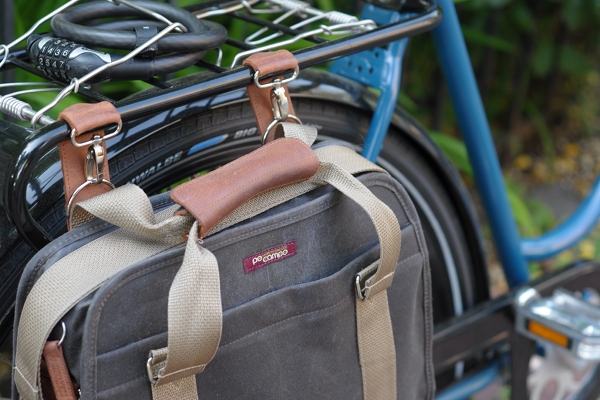
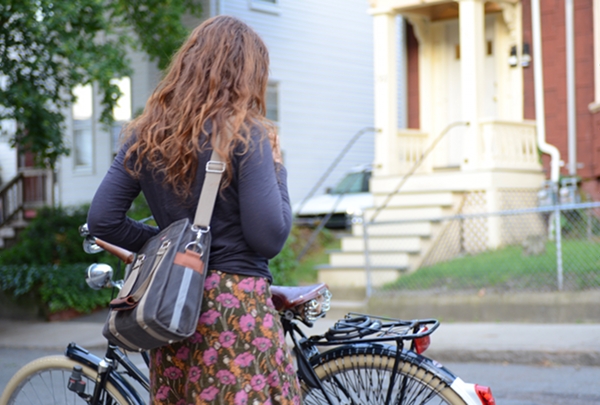
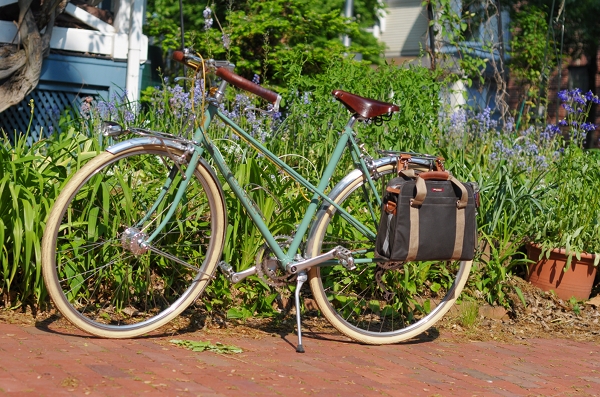
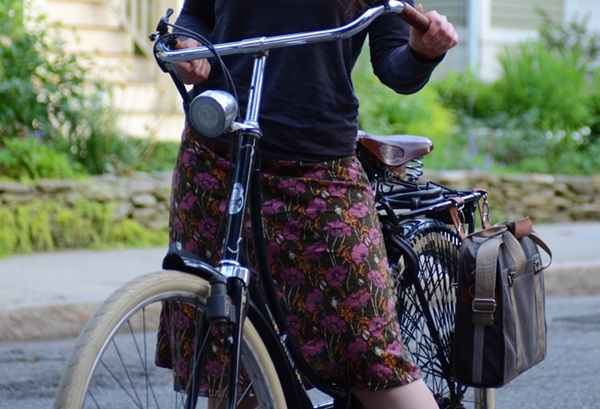
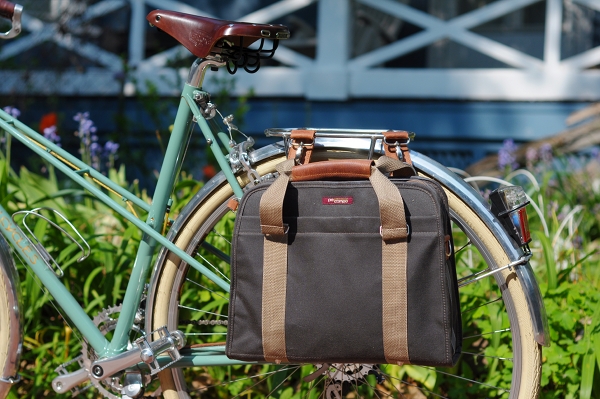
Po Campo is a small Chicago-based company that has been making a variety of bicycle-compatible women's handbags since 2009. This year they introduced a larger, briefcase-like pannier to their lineup and I acquired one in trade a couple of months ago. The Loop Pannier is available in several floral patterns, but I opted for the more subdued waxed canvas version. It is umber with tan straps, metal buckles, and honey leather trim. At 14"x10"x3.5" the size is small enough so that there is no heel strike on bikes with short chainstays, but large enough so as to fit some laptops. These bags are designed to be used on the bike as panniers, off the bike as shoulder bags, and as luggage attachments while traveling.

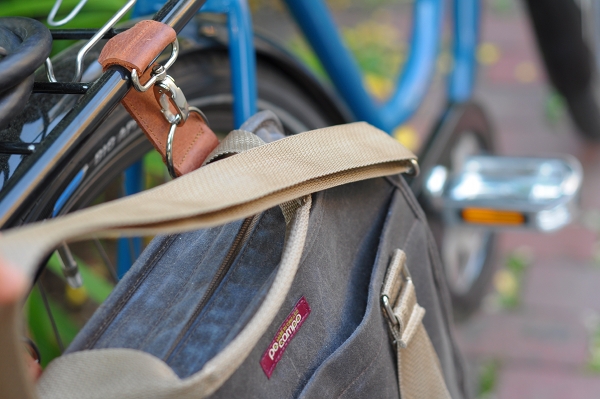
The Po Campo attachment system consists of leather straps with sturdy metal clasps. When I saw this, it was one of those "why did no one else think of this earlier?" moments. The benefit of this design is that it can fit bicycle racks with any tubing diameter. Other quick-release systems max out at 16mm tops, which means that they will not fit some heavy-duty Dutch and Roadster racks. None of our other panniers are compatible with the monstrous tubing on this Pilen rack - but the Po Campo straps have plenty of room to spare.

While using the clasps is not quite as instantaneous as the sort of quick release where you lift up the handle and the hooks open up, it is still easy and quick.

Since the straps are soft and flexible, they also offer the benefit of being adaptable to the rack's layout. Some racks have complicated rat-trap setups that can interfere with typical pannier hooks. The Po Campo straps can simply be looped around them. The more I used this system, the more I began to appreciate the design. Those who dislike plastic hooks will also rejoice at the complete lack of plastic here; it's all metal.

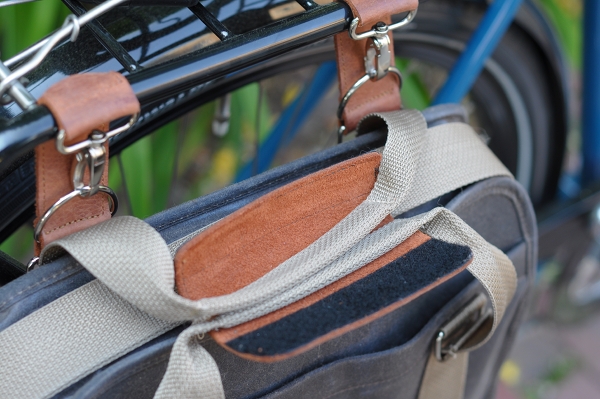
There are two short straps integrated into the pannier, and a longer detachable shoulder strap. While initially managing the system of straps seems complicated, it ends up being very intuitive.

The long shoulder strap folds over the top of the bag. Then, the second of the short straps gets tucked into the leather handle attached to the first, which closes with velcro. This keeps all three straps neatly tucked in and away from the spokes.

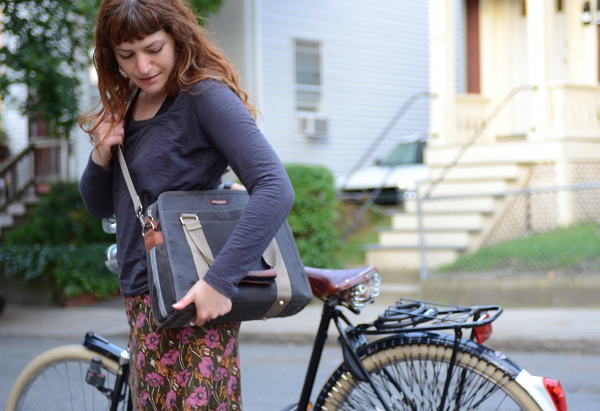
When the bag is off the bike, it can either be handheld, or used as a shoulder or messenger bag. I prefer the latter, especially since adjusting the shoulder strap on the go is very easy - the adjustment buckle slides freely.

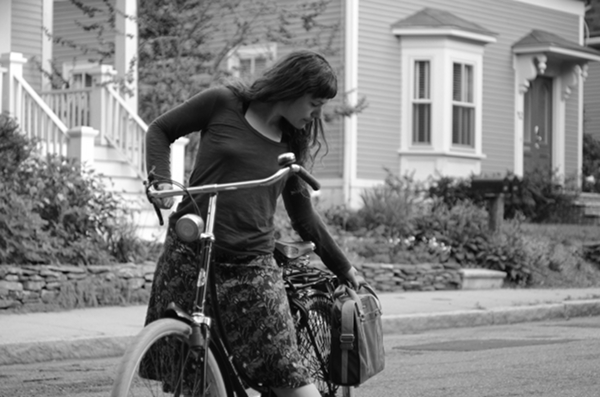
I have walked around with the bag as pictured for a couple of miles and it felt fine. I've also shortened the strap and have worn it over one shoulder, like a handbag. Either way is pretty comfortable and the clasps absolutely do not catch on my clothing. It basically feels like a normal bag to carry, not like a bicycle-specific pannier.

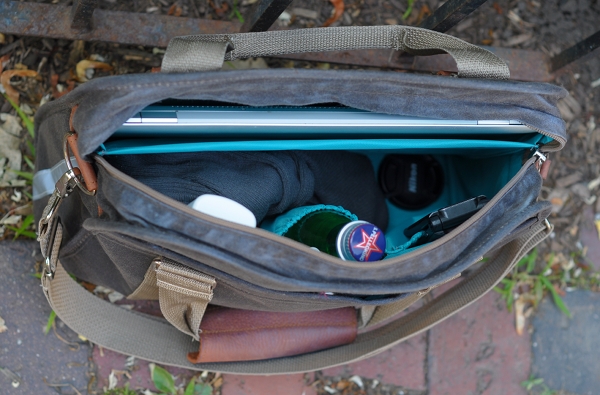
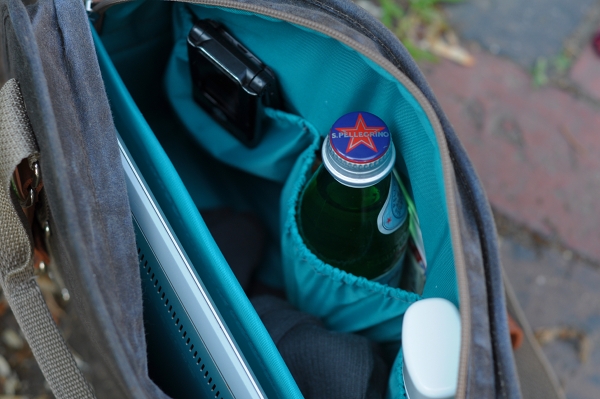
Another feature of the Po Campo I appreciate is the way it is organised inside. There is a large main compartment, and a side compartment that they refer to as a "file/lock pocket." However, I use it for my laptop, which is a MacBook Air and is the perfect size for it. I use the main compartment for clothing, books, notebooks and my DSLR camera.

There are also three elasticised interior pockets that will each fit a wallet, phone, writing instruments, or even a small bottle of water.

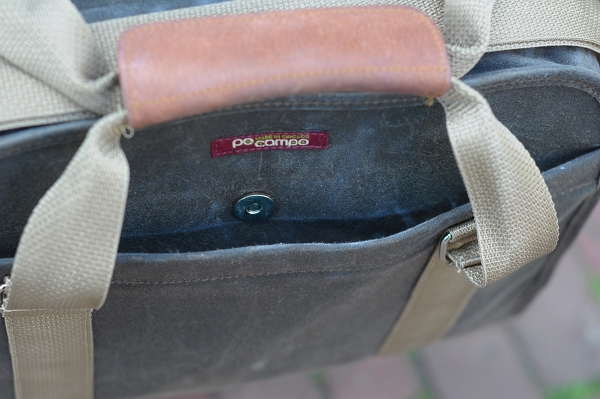
The exterior pocket is quite roomy. It is especially useful for those times you need to remove a sweater or grab some water in traffic.

I tend to overpack whenever I leave the house, so this pannier is always bulging with stuff when I use it. Still, the structured design keeps it all looking neat and presentable.

The reflective strip along the back is nice for extra visibility.

I have tried the Po Campo pannier on five different bikes with different types of racks, and it works well on all of them. I cannot imagine a rack design with which this bag will be incompatible, and in my view that is one of its most valuable features. Other strong points include the durable construction, the professional look, and the ease with which the bag can be used off the bike. This is a small pannier and you will not be able to fit groceries in it; it is really meant as a briefcase/ professional bag and will accommodate only the smaller laptop models. But the compact size has the added benefit of preventing heel strike on bicycles with shorter chainstays.

All things considered, I only have one critical suggestion for Po Campo: Think about making a version for men. When I ordered the waxed canvas finish, I was hoping that the Co-Habitant could use it too. He was delighted that the bag fit the unusually fat tubing of his Pashley Roadster rack (no other quick-release pannier we've tried will fit it), but he thinks its shape is too feminine. While Po Campo designs their products with women in mind, I think the versatile attachment system and the elegant briefcase construction of this pannier is too good not to share with the menfolk.
Read More
Posted in bags, product reviews | No comments

Wednesday, June 22, 2011

The Morning After: Post-Sport Transport

Posted on 10:32 AM by dvdsvdsdv
Today is a day like any other. I unlocked my bike from our outdoor storage area, clipped my pannier onto its rear rack and took off for the day, wearing my regular clothing. If I get home after dark, I will give my dynamo bottle a little push and the lights will come on - sustained by my pedaling. I cycle carefully in traffic. I sit upright. Drivers and pedestrians see my old-fashioned loop frame bike and they often wave to me and smile. I have been doing this more or less every day for over two years. As a mode of transportation it is perfect for me; I have truly found something that works. And I enjoy helping others who feel that it could work for them.

But cycling in traffic this morning, I am also remembering what happened last night - and it's like a fuzzy memory of a drunken party in its sheer unreal-ness. I went on another paceline ride, starting off in a faster group this time. Five miles in I dropped my chain accelerating uphill, which was mortifying and had never happened to me before. But disaster was averted ("Chain off!! Slowing!"), the chain was soon back on, and we (the woman who stayed behind to help and I) caught up with the group in no time. The chase was a nice warm-up. Toward the middle of the ride, we ended up splitting in two again, with myself and a couple of others in the front. We received minimal instruction in this slightly more advanced group, and I took frequent turns rotating. I was on a high from the sheer excitement of it, not even feeling my legs - only the speed. As the end of the ride neared, the leader asked who wanted to go on an extra climb instead of straight back, and I was among those who came along. We were allowed to pass each other uphill, and I did - passing the others, then waiting at the bottom of the hill for a good few minutes. Next time, I am told I can join the next group up. There was also discussion of joining the team. Then I cycled home for 10 miles, elated but not particularly tired. Even as I write this, it sounds like I am making it all up. My mind is swirling.

Riding my bike for transportation, I feel at ease and familiar with the city where I used to resent living just a couple of years ago. Everything seems friendlier now, more accessible, more connected to my life. I have a personal map of the city in my mind, where every area includes the sensory experience of riding my bike there. I continue to discover new neighborhoods that surprise me, feeling like an explorer every time I need to venture somewhere new. It's wonderful, and I don't write about it daily only because it has become so incorporated into my everyday routine as to become mundane.

I wonder whether I will ever experience this sense of familiarity and belonging with cycling as a sport. I feel wildly different from the other women doing the paceline rides, who seem so comfortable with the very notion of it all.  They've been running, going to the gym and playing other sports all of their lives, while I've stayed as far away from such activities as possible. And it's not just a matter of being intimidated. The non-athletic have prejudices against the athletic, whether they want to admit it or not. I grew up with perceptions of athletes as shallow, aggressive, cliquish and bullying - nothing us artsy kids wanted to be a part of. It's hard to get away from that mentality, even as an adult, and it's hard to get comfortable with the idea of being something I am not. Hearing things like "put the hammer down, girl!" followed by appreciative cheering, makes me feel conspicuously out of place.

Cycling to the training ride in my shorts, jersey, gloves, styrofoam bonnet and sunglasses yesterday, I got a "Hey, slow down!!" shouted at me by a woman strolling on the wrong side of the bike path, accompanied by a look of pure hatred. I glanced at my computer and confirmed that I was in fact going very slowly. But she saw me as fast, aggressive, and dangerous nonetheless. Would this same woman have waved to me and smiled had I been riding my loop frame bike wearing a dress?
Since I began writing about paceline rides, some readers have told me they feel I am sending "the wrong message" by getting involved in roadcycling and publicising this involvement: My "turning into a roadie" only confirms the stereotype of cycling as an extreme sport. At the same time, the supportive emails I've gotten from the pro-roadcycling camp border on pressure - from suggestions for which local team to join, to being told that I am in a unique position to advance the cause of getting more women into racing. For the most part, I am just confused by it all. I admit that I am now addicted to the paceline rides, and that joining a local cycling team is appealing. At the same time, I am socially uncomfortable both within a group of roadies, and also with being perceived as one. Call it a mild cycling-identity crisis.

I cannot take seriously the idea that to take part in paceline rides is to "betray" transportation cycling. I see the two as completely independent activities that can be pursued in parallel. Am I being unrealistic? Today I am cycling for transport while daydreaming of sport, and it seems completely natural.
Read More
Posted in Gazelle, paceline, roadcycling, traffic, transportation options | No comments

Tuesday, June 21, 2011

Back and Forth: Lessons in Positioning

Posted on 10:58 AM by dvdsvdsdv
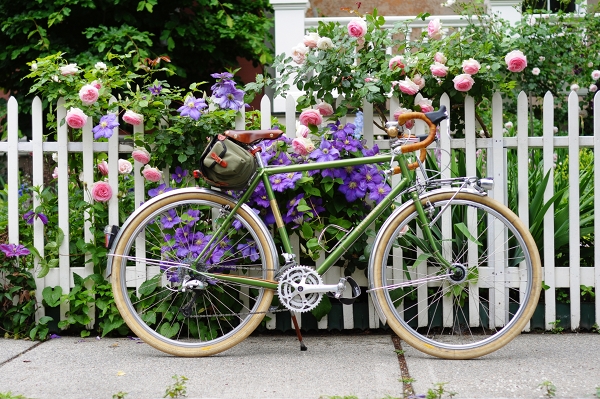
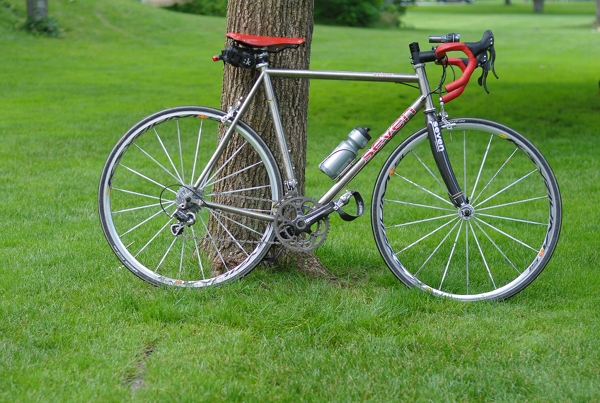
Last week I rode my Rivendell Sam Hillborne for the first time in three weeks after riding exclusively the loaner Seven on a close to daily basis. It's hard to believe that the body can adapt to one position so quickly as to find other positions unnatural. I confidently got on my bike, expecting that old familiar feeling of riding it to welcome me back. But I was in for a surprise. The ride was as comfortable as I remembered, but everything felt off. It took me a while to understand what was wrong. Initially it was just a vague sense of not feeling as connected to the road and as much in control of the bike, which was disconcerting. As I kept cycling, I became aware that it was really two specific things: I felt that I was seated too far back, and that I wasn't out far enough over the front wheel. I kept wanting to shove my weight forward, and it was frustrating to feel almost as if I were sitting "behind" the bike. 

Looking at the way the two bicycles are set up, the difference makes sense. On the Seven, the saddle sits further forward and the handlebars are further out. I was aware of this difference before, but assumed that I would find the Seven's set-up aggressive and uncomfortable, while the Rivendell's set-up a welcome relief. Instead the Seven's set-up now feels "right" and anything deviating from it feels "wrong" - as if I don't have sufficient control of the bike. That feeling is hard to shake. I think my Rivendell needs a little make-over. 

While moving the saddle forward is easy enough, changing the handlebar set-up will be messy, because I will have to replace the fairly short (6cm) stem with a longer one. When I fist began trying to ride with drop bars, I found it extremely difficult and a short stem was recommended to make the transition easier. I cannot say that it was a poor recommendation, because it worked. I rode with this set-up for a year, gradually becoming more comfortable with the whole idea of a roadbike, and feeling increasingly natural in a forward-leaning position. Some would look at my bikes and point out that my stems are too short, and I was perfectly aware that by most standards they are. But these things are highly personal, and last year I was concerned not so much with speed and agility, as with just being able to ride the bike. The way a bike balanced with a shorter stem felt better to me at the time. For what it's worth, I see many roadbikes from the 1970s-80s that were ridden by women set up with short stems. My previously owned vintage Trek had an even shorter stem than this bike, and that was the original owner's doing.

Going back and forth between the Seven and the Rivendell has been educational; each has what the other lacks. It is fairly clear to me that I "need" a lightweight, purely-roadish roadbike like the Seven and that I also "need" a wide-tired, befendered, dynamo-hub, luggage-bearing long distance bike like the Rivendell. I would not want to turn one into the other, or to combine them into something in-between. If I could make changes to the Seven, it would be to magically decrease its size. If I could make changes to the Rivendell, it would be to alter its positioning and to make it lighter. The former we will be doing shortly. The latter is not really possible without getting rid of the very things that make this bike practical. But I am very curious now whether it is the positioning, more than anything else that accounts for the difference in speed between the two bicycles. I am also wondering what the "ideal" stem length for this bike would be. The top tube is unusually long, so it would have to be 8-9cm tops. It's frustrating that experimenting with stems is not easy, but I will report the results of my trial-and-error fumblings. 
Read More
Posted in comfort, Rivendell, roadcycling, Seven | No comments

Monday, June 20, 2011

Vehicles of Equality

Posted on 11:38 AM by dvdsvdsdv
[image via cnn]

Last week many of us were following the #women2drive campaign in Saudi Arabia - a move organised via social media, where about 40 Saudi women drove cars in protest of their country's ban on female drivers. Saudi Arabia is the only country where it is currently prohibited for a woman to drive. The ban has become a symbol of gender inequality, while driving has become a symbol of freedom and women's liberation. It is unclear as of yet what effect the protest will have on Saudi policy toward women drivers. Meanwhile I've received an email from a cycling activist, asking whether I thought bicycles would at any point be incorporated into the movement.

[image via wn]

To clarify, women in Saudi Arabia are not permitted to cycle just as they're not permitted to drive. That is, they are allowed to be passengers on a bicycle, but not operators. The point of the ban is to prevent women from going off on their own, and so it applies to any vehicle that facilitates travel. However, I doubt that Saudi women will be getting on bicycles and staging a #women2ride movement any time soon. While in some cultures there is now a trend to associate cycling will freedom (freedom from dependence on fuel, from being stuck in traffic, from having to find parking, from hour-long commutes, from financial strain, etc.), the bicycle does not symbolise any of those things in Saudi Arabia. Neither does it symbolise travel, in the contemporary sense: A car can travel further and more efficiently if fuel is not an issue. In order for a group to protest not being able to engage in an activity, that activity has to be perceived as desirable. And I just don't think cycling has that status in Saudi Arabia.

[image via rfe/rl]

There are other issues to consider as well. Operating a bicycle is deemed "too sexy" by some government and religious figures in conservative Middle Eastern countries. In Iran there is technically no travel ban in effect for women, but the Iranian Women's Cycling Team was stopped by the police while training last October and told that the activity is not permitted in public, as it is too provocative.

There is also the question of safety. Driving in protest is safer than cycling in protest, as on a bicycle a person is more vulnerable to recognition, apprehension, and potential attack.

[image via bikehugger]

While in Western cultures the bicycle became a symbol of gender equality in the Edwardian era, I don't think that this can be applied to today's situation in countries where basic women's rights are being debated - particularly in the Middle East. The circumstances are too different. Should cycling activists feel threatened by the #women2drive initiative? I think that would be highly misguided. But the question of how to make bicycling more accessible to women in this region is worth considering.
Read More
Posted in cars, gender, social commentary | No comments

Saturday, June 18, 2011

The Surly Cross Check: a Colourful Build

Posted on 10:49 PM by dvdsvdsdv
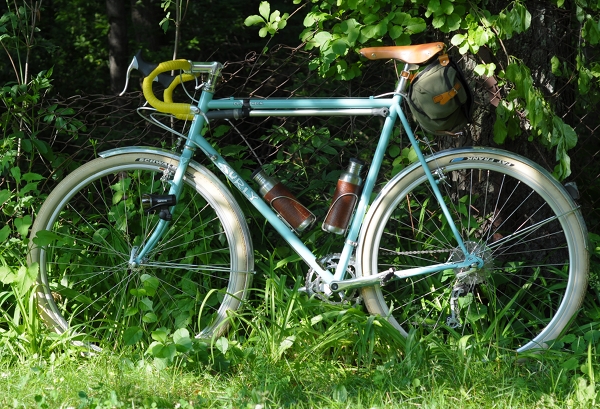
Two months ago, the Co-Habitant got a Surly Cross Check frame that he wanted to build up as a fun on/off road bike around a touring wheelset with fat tires that we already had in our possession. He is getting a nice roadbike later this summer (waiting for the frame to be finished!), and the Surly was meant to be "the other bike" - a playful, go-anywhere bike built around an inexpensive frame, mostly using components we already had. He swiftly put the bike together and has now cycled about 500 miles on it. The Cross Check is technically a cyclocross frame, but it is versatile and can also be used for touring and commuting. Given its unusual build, we've had many questions about this bike and so I offer a review on the Co-Habitant's behalf.

The most noteworthy aspect of the build, is that we were able to fit the frame with Schwalbe Fat Frank tires and metal fenders. This looks great, and the tires feel awesome, but to tell the truth the whole thing was a pain. The Cross Check is described as being able to fit tires up to 45mm with fenders, but the Fat Franks are 50mm. It was a tight fit that required some DIY. Initially we wanted to use Berthoud steel fenders, which are available in 700Cx60mm, but the Co-Habitant was not impressed with their quality upon seeing them in person. He also dislikes plastic fenders and did not want to use SKS. In the end he decided to get the Velo Orange Zeppelin 700c x 52mm fenders (which are rated for 42mm tire), and "massage" them to fit.

Out of the box, the fenders were too tight: The edges touched the sides of the tires and there was not enough space under the brake bridge and behind the seat tube to mount them high. So, the fenders had to be opened up. But when you open up a fender that's 52mm, it no longer follows the line of a 700C tire, instead making the opening much smaller. So while opening the fender, it had to also be stretched out -  taking care not to crimp the edges. To do this, he used a flat low table holding the fender upside down against its surface and pressing down gently, rolling it end to end - opening and pressing down. Pressing down would close the fender and opening it would alter the curvature, so the back and forth balanced out the opposing forces.

For the front fender there was sufficient clearance underneath the fork crown, but in the rear there was less clearance - the brake bridge is quite low and the chainstays are short. He had to dent the top of the rear fender (which isn't visible) in order to get it closer to the brake bridge, then fabricate a custom circular-L-bracket to hold the fender in place, screwed into the eyelet of the brake bridge. To dent the fender, he placed it on some clothing on the top edge of the back of a chair, then hit it with a rubberized end of a pedal wrench, creating a grooved dimple. He also had to dent the ends so that they wouldn't pinch near the bottom bracket. It was a bit of an ordeal, and if you are going to attempt this beware that it is easy to ruin the fender - it may not be a risk worth taking.

Happily, the "massaging" was a success and the Cross-Check looks great with the fat cream tires and the VO Zeppelin fenders. The ride is fast and cushy, and the Co-Habitant is discovering just how addictive wide tires are. On the downside, the clearances between the tires and fenders are so tight, that the set-up is not really practical for serious off-road cycling: stuff can get caught in there and cause problems. But for fire trails and gravel paths it is fine, and if he decides to do anything more serious (like the D2R2!), he will remove the fenders.

The rest of the build for this bicycle has mostly already been described here, but a few changes have been made since then. The original shortish stem has been replaced with a 9cm stem, flipped upside down. The original yellow cloth tape got filthy and tattered fairly quickly, so we replaced it with Fizik tape. Initially, the cloth tape was supposed to be shellacked to a warm caramel - but the bright yellow looked so "right" on this bike, that it began to seem like an inherent part of its personality and he decided to keep it that way. He also added a frame pump, lamenting the lack of pump peg and using a strap to hold it in place.

After two years in a lukewarm relationship with his Brooks Flyer saddle, he decided to sell it and replace it with a Berthoud touring saddle - the male version of the one I now have on my Rivendell. So far he loves it.

He fitted the bike with the Carradice bag that used to be on his old bike.

It now has a patch on it, to cover the tear that happened as a result of the bag rubbing over the brake cable on his old bike.

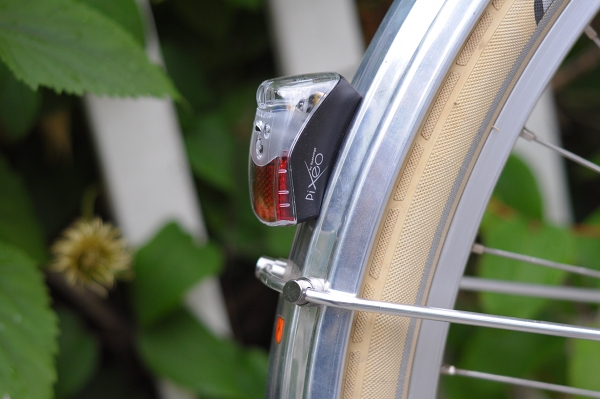
He affixed a CatEye headlight to a braze-on on the front fork, and a Spanninga Pixeo tail light to the rear fender.

He tried to liberate himself from clipless pedals and rode the bike with touring pedals for a few weeks, but ultimately could not take it anymore and put his old clipless pedals back on. Fair enough, but this does limit the versatility he originally had in mind for the bike.

After riding the Surly Cross Check for two months, his main feedback is that the bike is faster than he expected - even with the wide tires and a bunch of weight in the saddlebag. While initially he intended to use the Cross Check in conjunction with his old Motobecane until he got his new roadbike, the Motobecane was retired as soon as he started riding the Surly - no need for it, since the Cross Check did everything it could do and more. He does not find the bike sluggish, and it seems that the tubing is just right for someone of his stature (6ft/ 200lb+). Overall, he is pretty happy. Though he likes lugs, he also likes a nicely done TIG-welded frame and the Surly suits him just fine.

My take on his Cross Check... I think it is a well-made, attractive frame for the price and I am glad that he finds it comfortable and fast. To be honest, I think that at least to some extent this build was not so much about practicality, as about doing a fun and challenging project using a bunch of components that we had acquired but had no use for. If the original purpose of the bike was off-road, then the tire+fender combo with such tight clearances does not really make sense. I have a feeling that he will end up using it mainly on the road, because I can't imagine him bothering to remove and reinstall the fenders every time he wants to take it on serious trails. And this means that when he gets his long-awaited road frame later this summer, the functionalities of the two bikes will overlap considerably. Not that there's anything wrong with that. But given how much he likes the Surly I am almost worried that he might be disappointed with the special bike he's waiting for. Well, hopefully not.

On a more general note, while the Cross Check is clearly versatile enough for commuting and touring, I wonder whether many cyclists actually use it for cyclocross racing. I have a hard time imagining that, given how relatively heavy it is - even the floor models with narrower tires and sportier components. But maybe I'm just biased from having handled too many lightweight bikes recently.

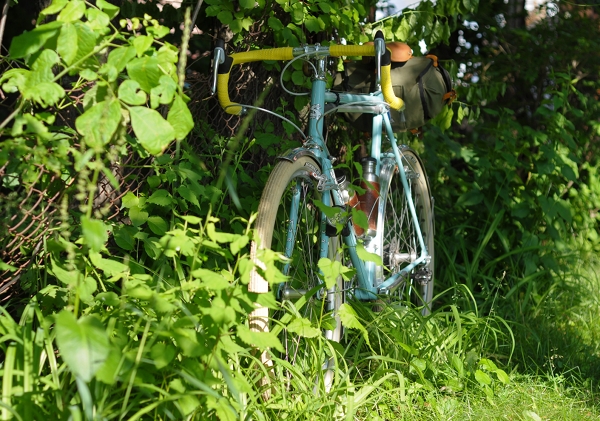
The Surly Cross Check is a fun bike with a cult following, and it is particularly impressive how customisable the frame is. With its happy colours, fat cream tires, elegant fenders and classic touring accessories, the Co-habitant's Cross Check is distinctly his own.
Read More
Posted in bicycle reviews, Co-Habitant, diamond frame, DIY, Surly | No comments

Friday, June 17, 2011

A Handful of Rust: Bicycles As Waste

Posted on 3:25 PM by dvdsvdsdv
One argument made in favour of the bicycle, is that it is a machine that is timeless. With proper maintenance and care, a bicycle can last for many generations. And those of us who own functional bicycles from as far back as the 1930s know that to be true - at least in theory. However, in practice garbage dumps throughout the country are full of discarded bikes. Countless abandoned bicycles rust away locked to urban fixtures until the city removes them. New bicycles are churned out by factories every day as old ones become junk. The bicycle's resistance to obsolescence is a heavily stressed selling point in today's green-hued marketing... and yet reality does not reflect that. When I am asked how I feel about that contradiction, it is not easy to respond without ruffling feathers.

Looking at bicycles that are rusting away abandoned, I notice a trend: It is not the oldest bicycles that are being treated as junk. In fact most of the bikes are relatively modern. The factors they have in common are awkward construction, crude workmanship, low-quality components, and a certain overall genericness that just seems to make them impersonal and unloveable. These are mostly bicycles from big box stores, or lower-end models from popular manufacturers sold at dedicated bike shops. The truth is that even when new these objects do not look "timeless" to me. They look cheap and destined for the dump within several years - seemingly by design. So when I am asked why I do not promote "more accessible" (mass-produced, lower-end, lower-priced) bicycles, that is why. I sincerely feel that the vast majority of those bikes are designed to be bought on a whim (why not? they are affordable!) and be discarded shortly thereafter.

Bicycles that are produced thoughtfully and with care cost more, because they are more costly to make, and there is just no way around this reality. But it is not such a bad thing if we perceive a bicycle as special and expensive. When an object is meaningful to us and takes time to save up for, we value it more. Even if the bicycle ultimately does not work out (or even if we lose interest in cycling altogether), we will be unlikely to discard or abandon it. Instead we will sell it or pass it on to somebody else - just as with any other valuable, well-made object that we no longer need or want. I think that I have a pretty good idea which of the bicycles marketed today will end up in the garbage dump 5 years from now, and which will be cherished and ridden, even if not by the original owner. The latter is the kind I want to promote and the former is the kind I do not.

For the same reason, I am conflicted about the bike share programs that have been popping up in major cities. My enthusiasm for the idea of bike sharing is dampened by firsthand knowledge of what happens to many of these bikes, and how quickly it happens. I have seen large municipal pickup trucks in Vienna come by the CityBike stations on a regular basis and cart away dozens of damaged bikes, replacing them with new ones. The wastefulness of the Parisian Velib system has been well documented as well. The sad truth is that people do not treat well objects that do not belong to them. And as much as I don't want to rain on the bike share parade, I find this problem difficult to side-step. There have been grassroots initiatives to use second-hand bicycles for bike share programs, but as far as I know they have been consistently rejected.

Do you feel that the current trend for all things bicycle will just generate more waste down the line, or is that a cynical view? How do you feel about bike share and the various methods of bicycle production in relation to this question?
Read More
Posted in social commentary | No comments
Newer Posts Older Posts Home
Subscribe to: Posts (Atom)

Popular Posts

  • Computer Games
    I have never liked computer games, but with the influence of the Co-Habitant I am finally starting to get into them. Here he is, taking a br...
  • Upside Down!
    Fate has been kind to Marianne! Rather than being torn apart for donor components , she has been spared, and fitted with new handlebars. Wha...
  • Matters of Identity
    Well... I thought that I could quietly change my blogspot username without anybody noticing or caring, but it's caused some confusion. S...
  • Celestial Beings
    [image via Spernicelli ] Depending on who you speak to, it is either the most over-rated vintage bicycle in existence, or the Holy Grail: Th...
  • The Pashley Roadster Sovereign: Review After Two New England Winters
    If you are a regular reader, you probably know that the Co-Habitant owns a Pashley Roadster Sovereign. We bought a pair of Pashleys  when I...
  • Crime vs. Accident?
    I was cycling across town with a friend today, who suggested that we take the side streets instead of my usual route along the major roads. ...
  • Putting Your Foot Down
    Enough people have asked me about this now that I thought it worth writing about: How do I put a toe down in traffic while remaining on the ...
  • Pulling the Trigger vs Doing the Twist: Thoughts on 3-Speed Gear Shifters
    On bicycles with internally geared hubs, we typically see two types of gear shifters. The trigger shifter (pictured above) is a small gadget...
  • Manufacturers with 'History': Does Continuity Matter?
    What does it mean, when we say that a bicycle manufacturer has a long history? There are manufacturers out there, whose names are legendary ...
  • An Igleheart and a 'Sex Hub'
    At the New England Bicycle Expo  a couple of weekends ago, I had the pleasure of meeting legendary New England framebuilder Christopher Igle...

Categories

  • ANT
  • art
  • bags
  • basket
  • beginners
  • Bella Ciao
  • bicycle events
  • bicycle industry
  • bicycle reviews
  • bike friends
  • bike shopping
  • blog development
  • blogiversary
  • books
  • Boston
  • Brompton
  • Brooks
  • Cape Cod
  • cargo bikes
  • cars
  • cats
  • children
  • clipless
  • clothing
  • Co-Habitant
  • coaster brake
  • comfort
  • Constance
  • countryside
  • diamond frame
  • DIY
  • DL-1
  • dress guards
  • drop bars
  • Eustacia Vye
  • fashion industry
  • fenders
  • films
  • fixed gear
  • flowers
  • food
  • framebuilding
  • Gazelle
  • Geekhouse
  • gender
  • give-away
  • grips
  • handlebars
  • handmade
  • holidays
  • Interbike
  • Italian bicycles
  • Jacqueline
  • knitting
  • lights
  • local bike shops
  • locking up
  • loop frame
  • lugs
  • Maine
  • Marianne
  • mercian
  • Mercier
  • mixte
  • Moser
  • Motobecane
  • Myles
  • night time cycling
  • North Shore
  • paceline
  • Pashley
  • pilen
  • poll
  • product reviews
  • racks
  • rain
  • Raleigh
  • Randonneur
  • randonneuring
  • restoration
  • Rivendell
  • roadcycling
  • rod brakes
  • Rodney
  • Romania
  • Royal H
  • Royal H. Mixte
  • saddles
  • safety
  • Seven
  • shop visits
  • silliness
  • skirt
  • social commentary
  • Soma
  • somervillain
  • stories
  • summer cycling
  • sun and heat
  • Surly
  • tandem
  • technique
  • test rides
  • tires
  • tools
  • traffic
  • trails
  • transportation options
  • travel
  • unpaved
  • urban cycling
  • Urbana
  • Velo Orange
  • Velouria
  • Vienna
  • vintage
  • winter cycling

Blog Archive

  • ▼  2011 (236)
    • ▼  September (17)
      • Frills or Basics?
      • European City Bikes and the North American Market
      • Thoughts on Fixed Gear Cranksets?
      • From Holsters to Corsets: The Cycling Accessory Fe...
      • Yeah Baby! Transportational Elegance Reigns at Int...
      • Handmade Bicycles at Interbike
      • Bleak Prognosis for the Dutch Bicycle?
      • GB Components Are Back! ...And You Can Have Their ...
      • Song, Dance and Bicycle Romance: The Interbike Fas...
      • On Bicycle Reviews
      • What's the Difference?
      • In the Raw
      • Frames of Mind: Why Did We Not Cycle?
      • Embracing Wrinkles
      • Reunited
      • The Art of the Ride Report: a Touring Bicycle Give...
      • If a Branch Falls in a Forest...
    • ►  August (22)
    • ►  July (26)
    • ►  June (27)
    • ►  May (27)
    • ►  April (26)
    • ►  March (30)
    • ►  February (30)
    • ►  January (31)
  • ►  2010 (262)
    • ►  December (28)
    • ►  November (29)
    • ►  October (24)
    • ►  September (23)
    • ►  August (25)
    • ►  July (25)
    • ►  June (20)
    • ►  May (19)
    • ►  April (20)
    • ►  March (17)
    • ►  February (18)
    • ►  January (14)
Powered by Blogger.

About Me

dvdsvdsdv
View my complete profile