lindaikeji35

  • Subscribe to our RSS feed.
  • Twitter
  • StumbleUpon
  • Reddit
  • Facebook
  • Digg

Sunday, November 21, 2010

Fondness for the Bottle

Posted on 4:21 PM by dvdsvdsdv
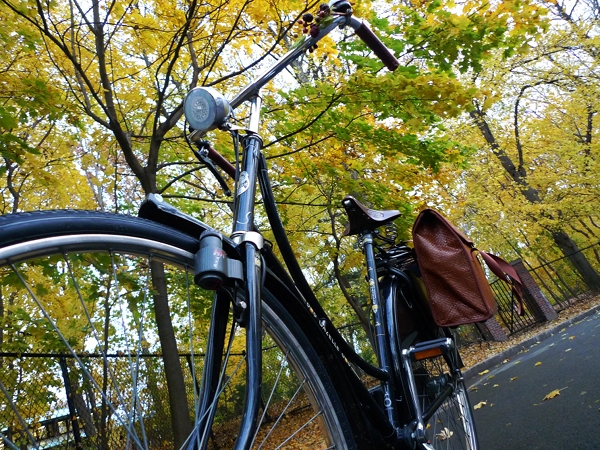
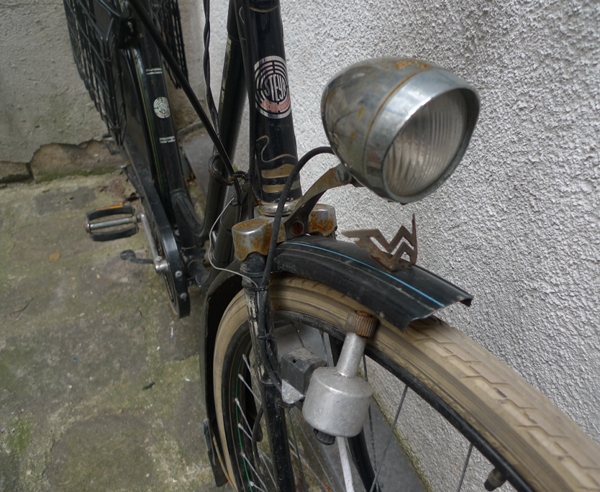
With the excellent modern dynamo hubs that are now available on the market, it might seem that using a "bottle" generator is a hopelessly outdated and clearly inferior method of powering bicycle lights. We imagine crusty old bottle dynamos making high-pitched hissing noises, powering feeble halogen lamps. Surely such a system cannot provide sufficient illumination. At least that was my thinking, until I actually used a bike with a bottle dynamo to get around in Vienna earlier this year. It was not a totally ancient bottle, but a couple of decades old and definitely crusty from use. And to my surprise, it powered my bike lights just as well as the dynamo hub on the modern Pashley I had back in the States at the time.

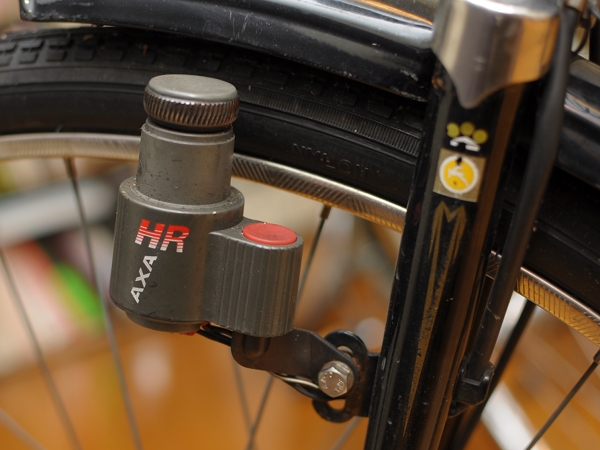
The vintage Gazelle I now ride as my main transportation bike has a bottle generator as well - this one from the 1990s. It is well-used and worn out, but works fine - both before and after we converted the lights on this bike to LED.

While I am not suggesting that a bottle dynamo is "better" than a hub, I think that it does have some underrated virtues, and that in some cases it can make sense to use it. Consider, for example, that...

Bottle-powered lights are just as bright.  Most modern bottles can handle the exact same voltage as most modern hubs (6 volts / 3 watts).  This means that I can use the same LED lighting set-up with a bottle as I would with a hub. There are differences in efficiency and a few other factors, but when using a bicycle for transportation at urban speeds, I have never felt this difference. 

The bottle is easy to install.  If you don't yet have generator lighting on your bicycle, installing a bottle is a matter of clipping it to the fork, or to one of the rear stays, using a bracket. Installing a generator hub is considerably more difficult: You must either rebuild the front wheel around the hub, or buy a new wheel with the hub pre-installed. 

The bottle is less costly. A good dynamo hub costs around $80 on average, plus the wheelbuilding fee (or the price of a new wheel) - which can run rather high. In the EU, a decent bottle can be had for under $30, with no additional fees involved.

The bottle is independent of hub/wheel functionality.  If your bottle dynamo breaks, it is not a big deal: buy another one. If your hub dynamo breaks, you will have to not only buy another one, but also rebuild the wheel or buy a new wheel.

The bottle weighs less! Surely that's an important factor for all of you out there counting grams on your roadsters and Dutch bikes?

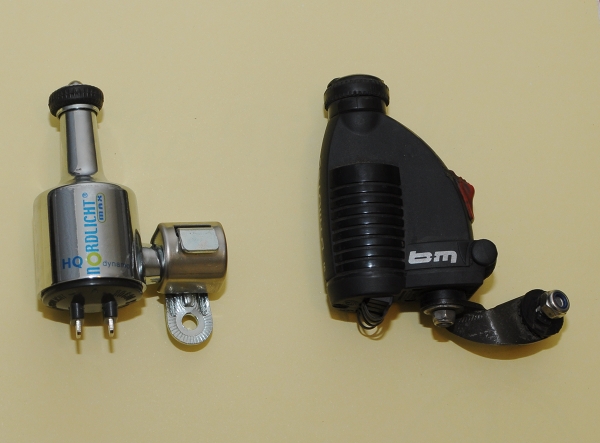
Because my vintage Gazelle's bottle has seen some wear, I will soon replace it with this Nordlicht HQ that an acquaintance has sent from Holland - which is both a more modern, and a more classic-looking model.

And I also have this modern B&M dynamo that I acquired second-hand and plan to install either on my Bella Ciao or on my Raleigh DL-1.  I am curious how these will perform in comparison to each other, as well as in comparison to the older AXA that is currently on my Gazelle - though I suspect I will not feel a difference.

I know that most of you probably prefer hubs, and I myself have excellent generator hubs on my touring bicycles. But sometimes a bottle is just a simpler solution - especially when the bicycle itself is simple. If only the choice of commercially available bottle generators was as rich in the US as it is in the Netherlands! Does anybody else out there use bottles? anybody prefer them?
Read More
Posted in Gazelle, lights, vintage | No comments

Saturday, November 20, 2010

Over the River and Through the Wood: the Season of Lone Travelers

Posted on 12:53 PM by dvdsvdsdv
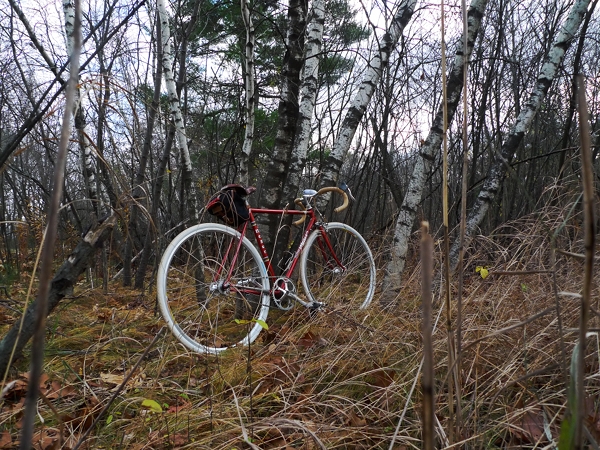
Yesterday I cycled to a wooded area 15 miles away to take pictures for a backdrop for a painting I am working on. I needed some detailed shots of birch trees, and November is the perfect time to get them - With most of the foliage gone, the birches stand out tall and lean, every detail of their beautiful bark crisply outlined against the bare landscape.

All in all, this is such a quiet time. A deep hush has fallen over the forest as it braces for the fury of winter storms. There is even a particular sound that goes along with this state of things - like a very quiet ringing.

Now that we are getting into late November, the number of cyclists out there - especially outside of the city, on the hilly roads and on the trails - has dwindled down remarkably. And those who remain apparently feel a sense of comradery with their fellow lone travelers, as I have never gotten so many comments from passing roadies before.

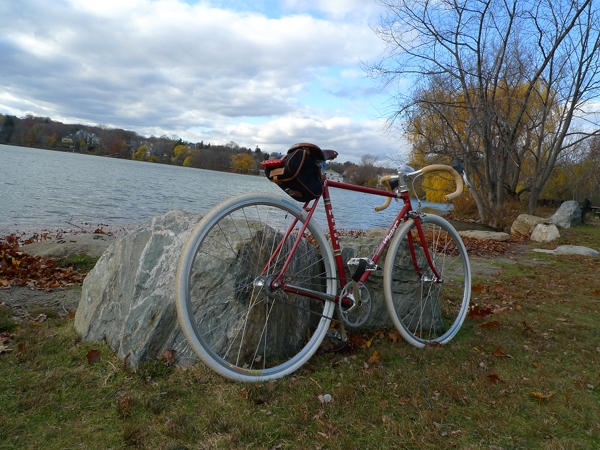
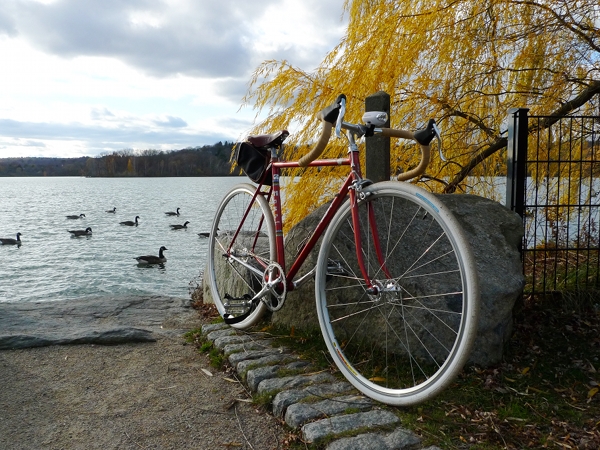
First I was asked by a cyclist where I got my Moser and how I like the bike. We discussed that for a bit, with him concluding that he must find a vintage Moser frame for himself (he-he, I am such an enabler!). Later, another cyclist (of the "pedantic retrogrouch" variety) was indignant that I was not only riding an Italian racing bike as a fixed gear, but that I fitted it with "rando-bars" (a French style of drop handlebars with a curvature better suited for long distance touring). I did not really know what to reply to that accusation except "yes".

And later still, I was complimented on my "trackstand" at a traffic light, which made me question whether I understand what trackstands are. I was pretty sure that a trackstand is when you are actually able to stand still, as a sort of balancing trick. I cannot do that at all. But I play games at intersections, where I cycle so slowly that I am basically moving forward mere millimeters at a time until the light turns green. It may look like a trackstand to an unscrutinous eye, but I am definitely cheating. But anyhow, my point really is that I haven't had verbal exchanges like these with other cyclists until now - whereas yesterday alone I had nearly half a dozen. The few cyclists who are out there this time of year must be feeling especially lonely.

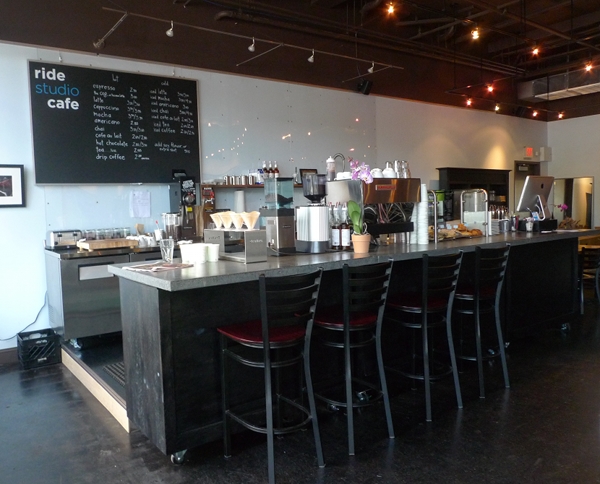
On the way back from my photo trip, I stopped by the Ride Studio Cafe that I wrote about earlier, when I saw through the window that their coffee bar was open. I just want to say one thing: If I could count on their in-house coffee shop consistently being open, I would go out of my way just to go there. They serve good coffee and hot chocolate - and they have back issues of Bicycle Quarterly! Once settled in, I had to almost forcibly pry myself away. Funny, because I remember reading Bicycle Quarterly last year and finding the articles difficult to understand, whereas now everything makes sense and seems terribly interesting. I should probably start subsrcibing to it.  And for those who have been reading BQ all along: Could you tell me in what issue I can find Jan Heine's review of a Rivendell? I am pretty sure he wrote one, but haven't been able to locate it.

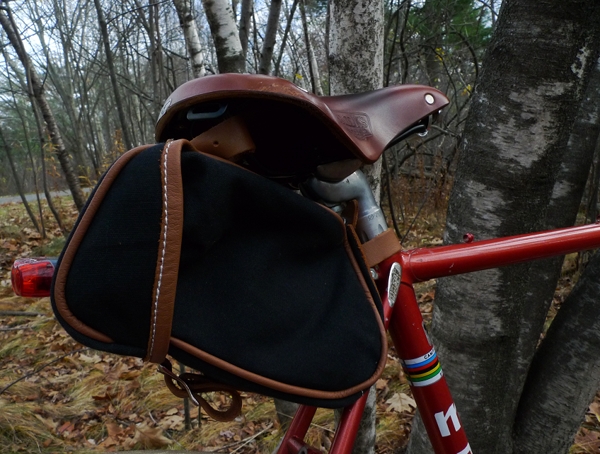
As I needed to run some additional errands in different parts of town, I ended up spending the entire day on my bike  - which made me realise just how quickly both the temperature and the light conditions can change this time of the year. I am paranoid about getting stranded in the dark, so even for my sporty bicycles I carry at least some battery-operated lights that I can quickly attach to the handlebars and to my saddlebag. As winter approaches, I somehow find myself riding this particular bike more and more - so maybe it is time to find a more permanent and attractive lighting solution for him (bottle dynamo on a fixed gear, anyone?).

And it is surprising how much stuff my tiny saddlebag can fit, as long as I don't need to carry my laptop around. Perfect for a short trip by a lone traveler on a late November day.
Read More
Posted in fixed gear, Italian bicycles, Moser | No comments

Friday, November 19, 2010

Winter Project: a Roadbike for the Ladies Who Fear Roadbikes

Posted on 4:11 PM by dvdsvdsdv
The house is full of excitement, as the Bicycle Fairy has visited me again! It was a Japanese bicycle fairy. She spoke through an interpreter, and these were her words:
The bicycle fairies have decided that you need a winter bike project! We have chosen this bicycle for a reason. When you see it, you will know what to do with it...
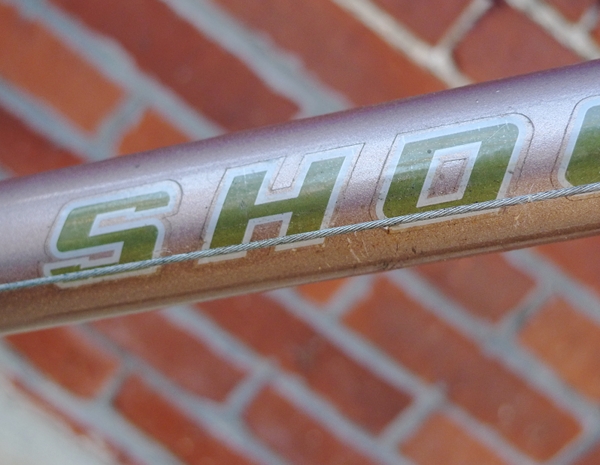
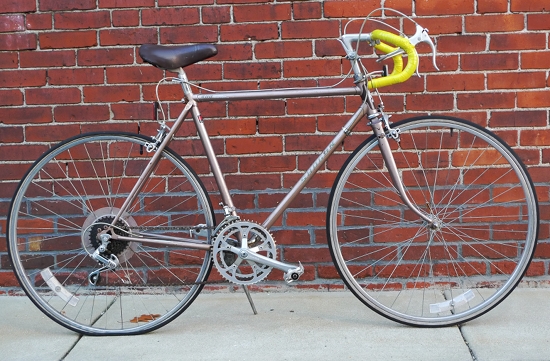
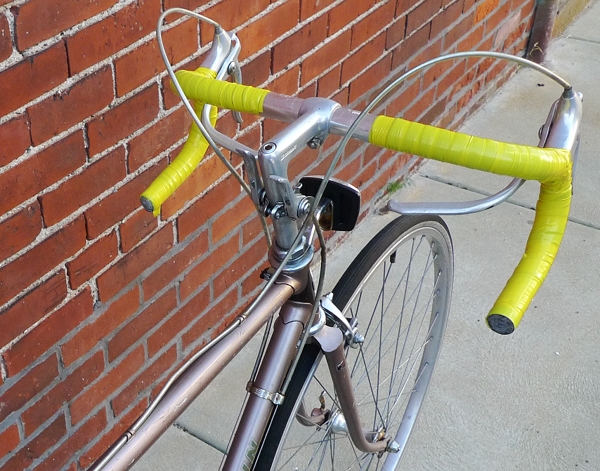
And indeed I knew exactly what to do once I saw this neglected beauty, her frame an enchanting mixture of mauve and champagne. She is a 1980's Shogun - a Japanese touring bike in double butted cromoly steel.

While I don't need another roadbike, I think that many other ladies out there do - particularly this bicycle, once I get through with it! What's so special about this bike? Well, I will start from the beginning. I hear a lot of stories from women who have tried to ride a roadbike, but felt that it was too aggressive and uncomfortable and gave up - as well as from women who would like to ride a roadbike, but are too nervous to try in the first place. I understand that state of mind, because when I first tried to ride a bike with drop bars, it felt awful and I eventually gave up. What then made me succeed on my Rivendell this year? For me, the big difference was comfort, stable handling, and a choice of components that I believe works especially well for women.

As far as comfort and stable handling, this Shogun has that down - whereas the same is definitely not true for all vintage roadbikes. This particular bicycle is stable and fairly relaxed - a vintage predecessor to the Rivendell philosophy, if you will. Just like I had an easy time learning on my Rivendell, I think this Shogun will be great for that -  with the benefit of a much lower price point.

My plan is to give this bicycle a make-over, to learn a thing or two about vintage Japanese bikes in the process, and then to find a new home for it in the spring. I will keep a lot of its vintage goodness, but will replace some of the components with my own mix that I have found especially comfortable and easy to use - and I think that other women will too. As I begin to work on the bike, I will explain what it is I am changing about it, and why. And I will also post a test ride report soon, comparing it to other vintage roadbikes that I have tried. I am excited about this project, because I think this bicycle is just perfect for a woman who would like to try a roadbike but is not confident about her skills. The right bike can make all the difference!
Read More
Posted in diamond frame, restoration, vintage | No comments

Thursday, November 18, 2010

Mixte vs Mixte: What's the Difference?

Posted on 3:10 AM by dvdsvdsdv
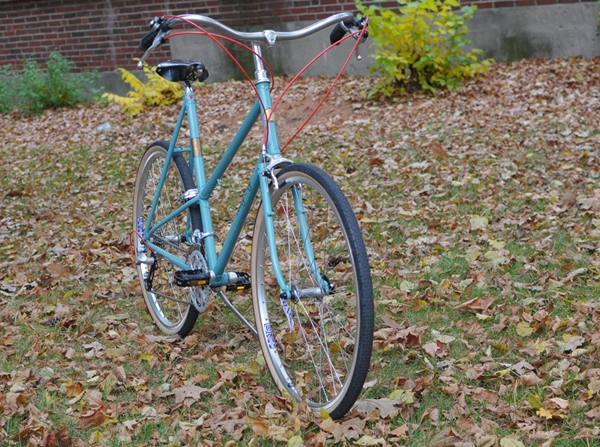
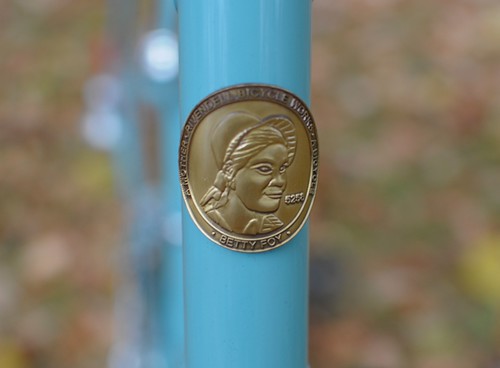
Mixte-frame bicycles have become popular again over the past couple of years, with many women buying them, or considering buying them. But what kind of bicycle is it that they are looking for? Mixtes can differ from one another considerably, both in looks and in ride quality: You cannot assume that because you have ridden one, you know them all. Just to give you an example, I have prepared a side-by-side comparison between my custom Royal H. mixte and the Rivendell Betty Foy. It takes some time to train your eye to differentiate between bicycles that may seem similar at first glance. But see whether you can get a sense of the differences just by looking at the pictures. 

To break it down, I will describe the most obvious and significant differences between these mixtes' geometries. And as an aside to the experts out there: If you are cringing at my explanations, please keep in mind that I am trying to make this as visual as possible, as opposed to as technical as possible!

Overall proportions
Take a close look at the overall "body types" of the two bicycles. Despite their being the same size in relation to me, my custom mixte has a "short and fat" look to her, whereas the Betty Foy looks "tall and skinny". That is because my mixte is dominated by the round forms of the large wheels, whereas the Betty is dominated by the angular forms of the large frame. The Betty Foy has smaller wheels, so the frame automatically needs to be larger in order for the overall bicycle to be the same size as mine. This also explains why my mixte frame is 52cm and the Betty Foy frame is 58cm - yet when the bicycles are assembled they are both my size.

The "short and fat" vs "tall and skinny" difference between the two bikes is accentuated by the position of the handlebars. The handlebars on the Betty Foy are set higher, with some stem showing - which further elongates Betty's "body."  The handlebars on my mixte are pushed almost all the way down - which accentuates the round look. Both bicycles were designed to be set up with the handlebars in these respective positions.

If you look at the vintage René Herse mixtes in this post from last year, as well as at some modern bicycles that emulate them, you will notice that they all have similar proportions to my custom mixte. Not a coincidence, because that is the look I was going for. The Rivendell Betty Foy, on the other hand, is a more contemporary take on the mixte and does not conform to this traditional design. Other modern framebuilders have taken a similar approach - playing with proportions to create their own versions.

Wheelbase 
"Wheelbase" is the distance between the center of the front and the rear wheel of a bicycle. But to get a more concrete idea of what that means, look at the space between the wheels. On my custom mixte (left) you can see that the wheels are fairly close together, while on the Betty Foy (right) there is an enormous amount of space between the wheels.

Another easy difference to spot is the length of the chainstays. The chainstays are those skinny tubes on the frame that run parallel to the ground along the rear wheel. If you look closely, on the Betty Foy these are considerably longer than on my mixte.

Angles
The angles of a frame are actually directly related to the wheelbase, but I am not going to go into this here and will discuss angles separately.

Even without measuring, you can see in the side by side pictures, that both the seat tube and the head tube on the Betty Foy are more relaxed (they lean further back) than on my custom mixte. The difference in angles is actually very small (1 degree difference in the seat tubes and 2 degree difference in the head tubes), which makes it all the more interesting that it is visually apparent. Even a small difference can be important.

Step-over height
Not related to any of the previous factors, but worth mentioning, is that the Betty Foy top tube is lower than my mixte's twin lateral stays. On the Betty this was achieved by virtue of not continuing the top tube in a straight line after the seat post, but angling it a bit. This angle produces a similar effect to creating a "swoop" or slight loop in the frame's top tube. It is still not as easy to step over as a step-through, but it is lower than other mixtes out there.

Ride quality
If you have managed to read this far and not fall asleep or close your browser window, you are probably wondering how these features affect ride quality. After all, it is useful to be able to look at a bike and have an idea of how it rides compared to other bikes.

Speaking very generally and summarily, bicycles with a longer wheelbase and more relaxed angles tend to feel more comfortable and stable, whereas bicycles with a shorter wheelbase and steeper angles tend to feel more aggressive and maneuverable. Of all these qualities, comfort is the most subjective - and also depends on other factors (such as tubing material and tires) that are independent of geometry. I would say that my custom mixte is equally comfortable to the Betty Foy - which means that the builder must have done something to enhance comfort despite the steeper angles and shorter wheelbase. As for the other factors, my mixte is indeed aggressive in comparison to Betty, with a ride quality that feels more "zesty." Both bicycles are fast and stable, but mine is quicker to accelerate and a tad more responsive, whereas Betty is more even-tempered.

Either of those qualities can be considered a virtue, depending on the cyclist's needs: A mixte like the Betty Foy is a better idea if you are looking for a relaxed, even-paced ride, whereas a mixte like mine will be more enjoyable if you want something more racy. And it helps to recognise which is which by looking at them.
Read More
Posted in comfort, framebuilding, mixte, Royal H | No comments

Tuesday, November 16, 2010

Got Skills? Riding a Bicycle without Knowing How

Posted on 9:38 PM by dvdsvdsdv
I tend to think of myself as having begun cycling when I got into it as an adult. But technically, that is not so. I learned to ride a bike when I was a child, and rode one all through junior high and most of high school. There was a nice post today on ecovelo, where Alan mentioned having "lived on his bike" as a kid, and in a sense it was similar for me. My friends and I did not race each other through wheatfields or pop wheelies, but we did use our bikes to get around our small town. Even once old enough to drive, most of us somehow still stuck with bicycles: It just seemed easier and even kept us off our parents' radar (for example, they could not look at the odometer to determine whether we had gone out when we were told not to).

But during all those years of riding bikes as a child and teenager, I knew absolutely nothing about "technique." At some point I was given a 2-wheel bike, and I used it as a push-bike for a few laps around the park until suddenly I was able to pedal without the bike falling over. To me, that meant that I was pretty much done learning "technique." In the years that followed, I rode with the saddle low, never learned how to start and stop "properly" or to pedal while standing, and was not aware that turning involved leaning and balancing, rather than using the handlebars. Heck, I never even learned how to shift gears, because the shifters on my low-end bike were jammed!

When I think about how it feels to cycle today - and particularly, how it felt when I first started doing it as an adult - I am confused and frustrated by all those younger years spent riding a bike without knowing how to do it properly. It's odd that I did not naturally pick up any skills what so ever during that time. (How can that be? Surely no one is that unathletic?) Moreover, my friends must have been just as clueless, because no one ever made fun of me or told me I was "doing it wrong." And it's frustrating that those skills were so much easier to learn as a child than as an adult - so by not having learned them early, I am at a disadvantage that may take me some effort to overcome.

I first discovered the concept of leaning on turns by reading about it, and after that it took months before I physically became aware of it enough to gain some control over the process. Of course when I did, I was ecstatic - to the amazement of the Co-Habitant who had not realised the extent to which I never learned these things.

As for saddle height, it is an ongoing fiasco: It took over a year of gradually raising it until I was able to have it at more or less the height where it needs to be for good leg extension... But I still cannot mount a bicycle properly and have to do a graceless little lean-and-hoist maneuver to get myself onto that raised saddle. Terrified of falling, I am highly resistant to being taught, and watching videos of others doing it over and over has not helped. At least I am now finally able to pedal while standing: After months of riding fixed gear, I finally got it (at first I could do it only on the fixed gear, then the skill gradually transferred onto freewheel bikes). I have to say, that was not easy for me to "get". In my head I understood what to do, but my body refused to balance.

It seems absurd to me that I can ride a roadbike at 25 mph, handle long climbs and hilly descents, ride a fixed gear racing bike "for fun" - yet still lack some of the most rudimentary cycling skills after almost two years of trying to master them. Will I ever be able to handle a bike like a "real" cyclist? Who knows - maybe I can still learn. Or maybe I should just accept that my early years of "doing it wrong" ruined me for life. Is the way you cycle now different from how you did it as a child? And if you are a parent, at what age did you teach your children to ride a bike and how did they take to it? I wonder how many others there are who feel this way - as if they are riding a bike without knowing how.
Read More
Posted in technique | No comments

Monday, November 15, 2010

The Popular Girl: Test Riding the Rivendell Betty Foy

Posted on 9:20 PM by dvdsvdsdv
After last week's review of the Rivendell Sam Hillborne, it seemed appropriate to follow up with a test ride report of the Betty Foy. I have ridden her a couple of times before, but never had my camera with me until now. Harris Cyclery has just built up a new floor model in my size - so I took the opportunity to take some pictures and put my impressions into words. While the pictures reflect how this particular bicycle was built up, keep in mind that it is fully customisable: You can change everything from the saddle and grips, to the handlebars and pedals, to the type of components that are on the bike.

Rivendell released the Betty Foy in Spring 2009, in conjunction with the diamond frame Sam Hillborne model. Inasmuch as a hand-built, niche-market bicycle can "sell like hotcakes" I believe the Betty does. She is charming, comfortable, and tough - and the ladies love her for that. The price of the frame alone is $1,000 and a fully built up bike starts at $2,200 or so, depending on the options. To see how this bicycle compares price-wise to other lady's frames in its class, please visit my new Semi-Custom Options page (now linked in the upper left-hand corner).

In terms of construction, the Rivendell Betty Foy is a version of the mixte frame: What starts out as a sloped single top tube splits into two stays at the seat tube and continues (at a slightly different angle than the slope of the main top tube) all the way back to the rear dropouts. The frame is lugged, with custom-made lugs in the shape of hearts and elaborate filigreed designs.

There are many cute and feminine touches, such as the downtube decal featuring tiny red apples

and the filled-in curly-cues on the fork crown. Some of the lugs are also filled in with red, complementing the robbin's egg-blue of the frame.

The Betty Foy frame is available in several sizes (47cm, 52cm, 58cm and 62cm), with the middle two built for 650B wheels, the largest built for 700C wheels, and the smallest for 26" wheels. There is enough clearance for 40mm tires plus fenders.

The frame is made for derailleur gearing, and is typically built up with three gears in the front and eight in the rear. There are eyelets and braze-ons for fenders and racks.

Rivendell states that the Betty frame was designed to be built up with Nitto Albatross handlebars - which are wide and swept back, similar to (but wider than) the handlebars you would find on a vintage 3-speed. I have also seen her built up with drop bars, but the upright set-up is more typical. This floor model was fitted with black rubber grips and "thumbie" shifters, though some prefer cork grips and bar-end shifters.

One thing to note about the Betty Foy, is the unusual sizing: The frame sizes recommended by Rivendell seem larger than what a person would normally ride. For example, I am 5'7" and normally ride a 52-54cm road bike or mixte, yet it is recommended that I ride a 58cm Betty Foy. Having tried both the 52cm and the 58cm frames, I can confirm that the recommendation is accurate. The 52cm Betty Foy felt much too small for me, whereas the 58cm version felt just right. I could have raised the saddle by another inch from the position in which it is shown above, but did not feel like going back inside the shop once I started riding the bike.

I rode the Betty Foy on the roads near Harris Cyclery (actual test ride not pictured), both this time and the previous times I've tried her. It is difficult to compare her to other bicycles on the market, because in a way she is unique. If you are accustomed to road bikes and vintage mixtes, you will find the Betty to be considerably more upright, stable, and comfortable. She is more relaxed than a typical mixte and has a long wheelbase - so that there is no toe overlap with the front tire when turning at slow speeds. I also find the step-over height to be lower than on other mixtes I've tried, which is convenient.

If you are accustomed to Dutch-style city bikes, you will find the Betty Foy a faster and sportier ride, but still within your comfort zone. The posture is slightly leaned forward, but still more or less upright. The derailleur gearing may take some getting used to if you have only dealt with internally geared hubs before, but you will appreciate how easy it makes cycling uphill.

In my view, the Betty Foy's greatest asset is her versatility. If you combine the feeling of a vintage 3-speed with that of a derailleur-geared touring bike, she handles like a union of the two: a fast, comfortable bicycle that feels safe and pleasant to ride. I can imagine riding her around the city for transportation, as well as 20 miles over some hills to the next town over. The ride is soft over bumps and potholes (not as soft as on my Sam Hillborne with 42mm tires, but I would need to ride Betty with equally wide tires to compare). Maneuverability in traffic is good, but the handling is not aggressive. I did not ride her on any serious hills, but with the derailleur gearing, the light frame, and the somewhat leaned-forward posture, I imagine it should hardly be a problem. She is what Rivendell says she is: an "all around" bike. If you plan to have only one bicycle for both urban commuting and long distance cycling, this seems like the closest thing on the market to that ideal.

The question I am inevitably asked at this point, is why I did not get a Betty Foy for myself when I was looking for a mixte, if I think she is so great. My main reason, was that I wanted a specific kind of mixte: one with twin lateral stays and proportions that resembled the original French constructeurs. The Betty Foy is not that kind of bicycle. Additionally, I must admit that I find Betty's femininity overwhelming. All the hearts and the bright colours - it's very American 1950s, whereas I am more of a European 1920s kind of girl. And my final reason is ironic - because it is the reason most people love this bike: I don't like the way some of the lugwork is done. If you look at the seat cluster above (see here for what that is), you will notice that the seat stays are welded directly to the main lug, rather than capped. No other Rivendell bicycle is made that way, and I don't know why this model is the exception.  Personally, I would rather have a traditionally lugged seat cluster than hearts and curly-cues.

The same is repeated at the junction of the seat tube and support stays. My preference would be for something like this to have been done here instead. I recognise how nit-picky and obsessive these quibbles are, but little details like this are important to me and I have my preferences when it comes to the way a frame is put together. It's an excellent frame, just not what I was looking for.

After I posted the above image, it was pointed out to me by a couple of attentive readers that there is a blemish right at the weld junction, next to the big lug. I myself did not notice this until my attention was directed to it - but now that it has, it's only fair that I mention it. Personally, I am not particularly bothered by this blemish (I have seen worse on more expensive frames) and it would not stand in the way of my wanting the bike, if it were not for the other factors. Your views may vary.

These issues aside, the Rivendell Betty Foy is an attractive and well-constructed bicycle. A great deal of thought went into the design, with a special emphasis on versatility - which I feel has been achieved here better than on other bicycles I have owned or tried. And apparently others agree, as the Betty has an excellent record of owner satisfaction. All things considered, I think the Betty Foy's popularity is well deserved.
Read More
Posted in mixte, Rivendell, test rides | No comments

Sunday, November 14, 2010

Hats and Scarves for Cold Weather Cycling: What to Look For

Posted on 10:25 AM by dvdsvdsdv
This Fall I've been sick a lot, so I am using the downtime to knit. After making a couple of skirts, I moved on to a special project: hats and scarves specifically designed to resist the cold and wind while cycling.

While it may seem that any hat and scarf should be sufficient for this, last winter I discovered that this wasn't so. Store-bought knits can be a mixed bag in terms of how well they work, even if they "look" warm and cozy. So while making my own, here are some criteria I've come up with that may help as you're winter shopping.

1. Adequate coverage

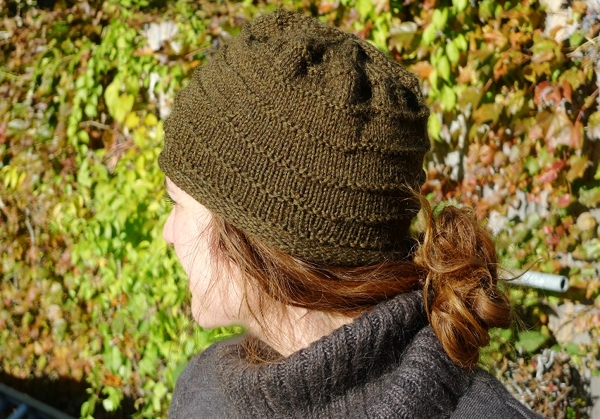
This may be obvious, but a hat is most effective if it covers your ears. It should also be tight enough around the opening so that it does not slide while cycling - especially if it's windy. For me, hats that are "slouchy" are often too loose and quickly slide off my ears - or off my head entirely - when I cycle. I solved this problem by making the openings on mine extra tight, and you can watch for that factor in store-bought hats as well.

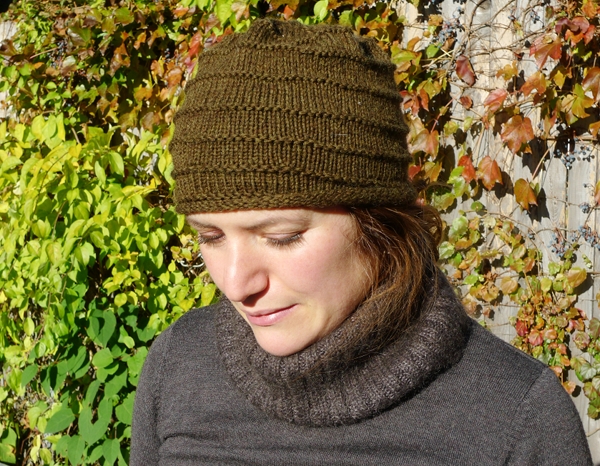
As for scarves, they can often come loose and unravel, or at least slip in a way that exposes your throat to the wind while cycling. If you have found this to be a problem, consider getting what is called a cowl neck, or a neck warmer instead. This is basically a thick, knitted turtleneck, without a sweater attached to it. You slip it on over your head and tuck the bottom under the collar of your coat. Unlike a scarf, it stays put and provides adequate coverage - even when cycling against the wind.

2. 100% wool

Assuming that you are looking for knit hats and not for sporty high-tech fleece, pay close attention to the material. I have been amazed to discover just how much better 100% wool is at keeping out the chill than a blend that includes even a small percentage of cotton, acrylic, or other materials. It can be convincing to see a fluffy knit hat with fair isle patterns of reindeer on it - but if it's even partly acrylic or cotton, it just won't work as well as wool.

Some might worry about wool feeling scratchy agains their heads or necks, but today it is easy to find wool with soft textures - wool that feels cotton-like or silk-like. While cashmere is nice, it is not necessary if you can't afford it. To me, peruvian alpaca has a very pleasant feel to it, and it is fairly affordable.

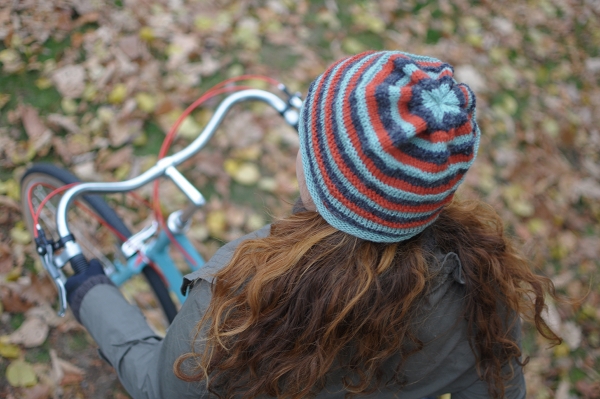
Even a gauze-thin wool hat can be surprisingly effective against the cold and wind while cycling. I made this one when it was still summer-ish, but it works well even in November.

2. Dense stitching

It is easier, less time consuming, and requires less wool to make a loosely-knit piece than a tightly-knit one. Chunky, loose stitching also "looks" warmer. But in actuality, it means that the knit is more porous - making it easier for the wind and the cold air to pierce right through it. If you want a hat or scarf that will really provide an impenetrable border against the frost and wind, look for one with dense stitching, and not necessarily in the chunkiest wool possible. It will be more functional.

Cycling in the cold is a special challenge for knitted hats and scarves, because they need to remain effective when you are moving against the wind at 10-20 miles per hour. I own lots of knitted accessories, but when the temperatures fell to below freezing last winter, I discovered that only a few of them truly kept me warm. Pieces that provide full coverage of the ears and throat, are 100% wool, and are densely knit, will be up for the job where others fall short.

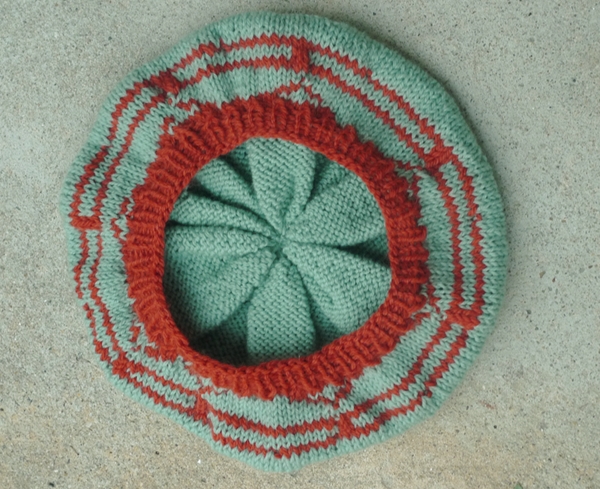
{all hats and scarves pictured here made by me}
Read More
Posted in clothing, comfort, winter cycling | No comments
Newer Posts Older Posts Home
Subscribe to: Posts (Atom)

Popular Posts

  • Computer Games
    I have never liked computer games, but with the influence of the Co-Habitant I am finally starting to get into them. Here he is, taking a br...
  • Upside Down!
    Fate has been kind to Marianne! Rather than being torn apart for donor components , she has been spared, and fitted with new handlebars. Wha...
  • Matters of Identity
    Well... I thought that I could quietly change my blogspot username without anybody noticing or caring, but it's caused some confusion. S...
  • Celestial Beings
    [image via Spernicelli ] Depending on who you speak to, it is either the most over-rated vintage bicycle in existence, or the Holy Grail: Th...
  • The Pashley Roadster Sovereign: Review After Two New England Winters
    If you are a regular reader, you probably know that the Co-Habitant owns a Pashley Roadster Sovereign. We bought a pair of Pashleys  when I...
  • Crime vs. Accident?
    I was cycling across town with a friend today, who suggested that we take the side streets instead of my usual route along the major roads. ...
  • Pulling the Trigger vs Doing the Twist: Thoughts on 3-Speed Gear Shifters
    On bicycles with internally geared hubs, we typically see two types of gear shifters. The trigger shifter (pictured above) is a small gadget...
  • Putting Your Foot Down
    Enough people have asked me about this now that I thought it worth writing about: How do I put a toe down in traffic while remaining on the ...
  • Manufacturers with 'History': Does Continuity Matter?
    What does it mean, when we say that a bicycle manufacturer has a long history? There are manufacturers out there, whose names are legendary ...
  • An Igleheart and a 'Sex Hub'
    At the New England Bicycle Expo  a couple of weekends ago, I had the pleasure of meeting legendary New England framebuilder Christopher Igle...

Categories

  • ANT
  • art
  • bags
  • basket
  • beginners
  • Bella Ciao
  • bicycle events
  • bicycle industry
  • bicycle reviews
  • bike friends
  • bike shopping
  • blog development
  • blogiversary
  • books
  • Boston
  • Brompton
  • Brooks
  • Cape Cod
  • cargo bikes
  • cars
  • cats
  • children
  • clipless
  • clothing
  • Co-Habitant
  • coaster brake
  • comfort
  • Constance
  • countryside
  • diamond frame
  • DIY
  • DL-1
  • dress guards
  • drop bars
  • Eustacia Vye
  • fashion industry
  • fenders
  • films
  • fixed gear
  • flowers
  • food
  • framebuilding
  • Gazelle
  • Geekhouse
  • gender
  • give-away
  • grips
  • handlebars
  • handmade
  • holidays
  • Interbike
  • Italian bicycles
  • Jacqueline
  • knitting
  • lights
  • local bike shops
  • locking up
  • loop frame
  • lugs
  • Maine
  • Marianne
  • mercian
  • Mercier
  • mixte
  • Moser
  • Motobecane
  • Myles
  • night time cycling
  • North Shore
  • paceline
  • Pashley
  • pilen
  • poll
  • product reviews
  • racks
  • rain
  • Raleigh
  • Randonneur
  • randonneuring
  • restoration
  • Rivendell
  • roadcycling
  • rod brakes
  • Rodney
  • Romania
  • Royal H
  • Royal H. Mixte
  • saddles
  • safety
  • Seven
  • shop visits
  • silliness
  • skirt
  • social commentary
  • Soma
  • somervillain
  • stories
  • summer cycling
  • sun and heat
  • Surly
  • tandem
  • technique
  • test rides
  • tires
  • tools
  • traffic
  • trails
  • transportation options
  • travel
  • unpaved
  • urban cycling
  • Urbana
  • Velo Orange
  • Velouria
  • Vienna
  • vintage
  • winter cycling

Blog Archive

  • ▼  2011 (236)
    • ▼  September (17)
      • Frills or Basics?
      • European City Bikes and the North American Market
      • Thoughts on Fixed Gear Cranksets?
      • From Holsters to Corsets: The Cycling Accessory Fe...
      • Yeah Baby! Transportational Elegance Reigns at Int...
      • Handmade Bicycles at Interbike
      • Bleak Prognosis for the Dutch Bicycle?
      • GB Components Are Back! ...And You Can Have Their ...
      • Song, Dance and Bicycle Romance: The Interbike Fas...
      • On Bicycle Reviews
      • What's the Difference?
      • In the Raw
      • Frames of Mind: Why Did We Not Cycle?
      • Embracing Wrinkles
      • Reunited
      • The Art of the Ride Report: a Touring Bicycle Give...
      • If a Branch Falls in a Forest...
    • ►  August (22)
    • ►  July (26)
    • ►  June (27)
    • ►  May (27)
    • ►  April (26)
    • ►  March (30)
    • ►  February (30)
    • ►  January (31)
  • ►  2010 (262)
    • ►  December (28)
    • ►  November (29)
    • ►  October (24)
    • ►  September (23)
    • ►  August (25)
    • ►  July (25)
    • ►  June (20)
    • ►  May (19)
    • ►  April (20)
    • ►  March (17)
    • ►  February (18)
    • ►  January (14)
Powered by Blogger.

About Me

dvdsvdsdv
View my complete profile