lindaikeji35

  • Subscribe to our RSS feed.
  • Twitter
  • StumbleUpon
  • Reddit
  • Facebook
  • Digg

Monday, May 16, 2011

On the Road in Stormy Weather

Posted on 11:22 PM by dvdsvdsdv
The clouds gathered darkly as Francesco and I set off on our fateful voyage. Braving the wind in my long tights, jacket, gloves and hat, I could not believe that in the third week of May the weather was identical to what it had been in November. No sooner had the flowers finally bloomed, than their petals were assaulted by harsh winds and pelting rains. Now they lay scattered all over the roads - a pink and lilac watery mush for everyone to trample.

"How fitting," said Francesco, "that it is on such a day you are taking me away to be left with strangers. For the dark skies reflect the darkness that will reign in my heart."

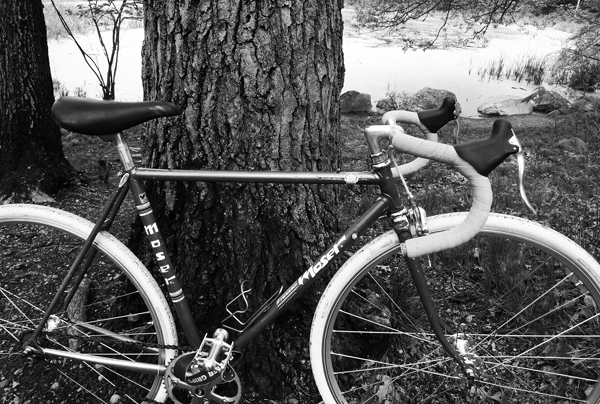
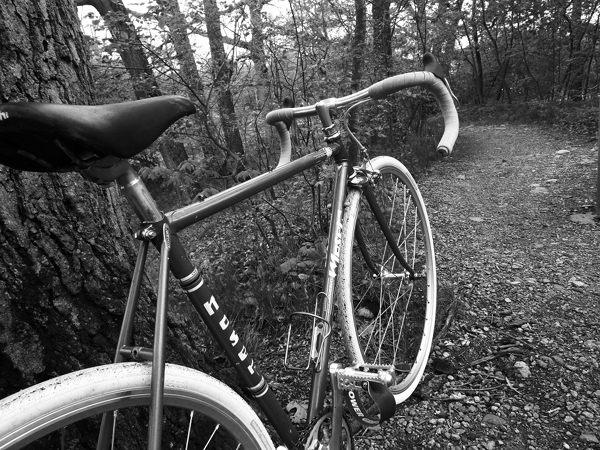
Oh Francesco! So melodramatic. In fact, we were on our way to the Ride Studio Cafe, who are loaning me a roadbike for the formidable paceline rides. Since the RSC is nearly 10 miles away and I can only get there by bike, it was agreed that I would arrive on Francesco and then swap him for the loaner bike. It will only be for a few weeks. And as soon as we arrived it was clear that my Moser was in good company: A pastel Pinarello beauty made eyes at him from across the storage room, whispering "Buena Sera" in a sultry voice. He forgot about me immediately, and with a light heart I began my journey home on a sleek titanium machine.

But my sense of relief was short-lived. The skies opened up within minutes of my departure and rain began to pour with a violence that even the forecast had not predicted.

Soon my 23mm tires were cutting through lake-sized puddles and skipping over slippery tree-roots that protruded from the cracked asphalt, as water came down in buckets from the ever-darkening skies. I could not see where I was going, and it was only thanks to the miracle of the homing instinct - aided perhaps by the bicycle's admirable handling - that I got back intact.

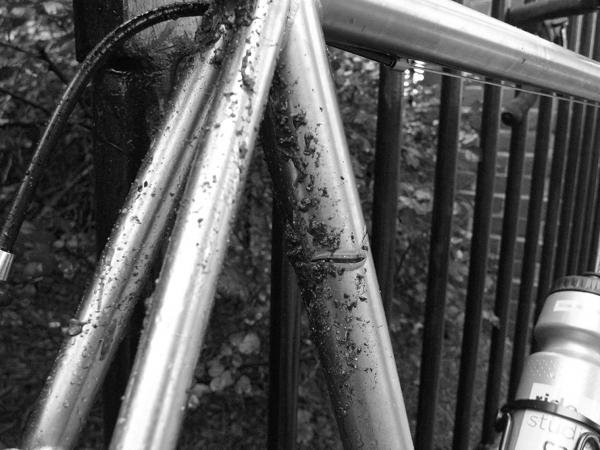
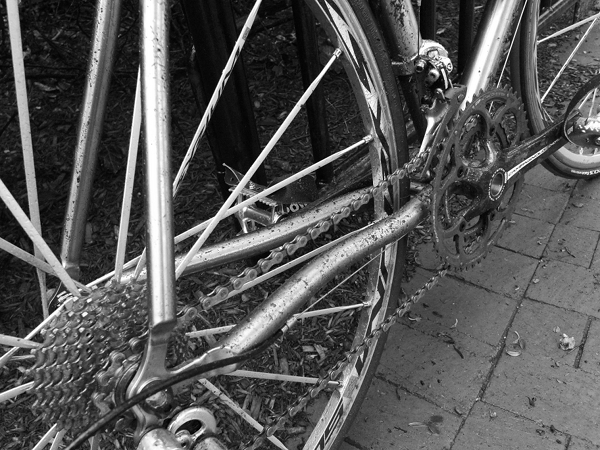
When I finally dismounted the bike, the sight that awaited me was gruesome. Every inch of the formerly pristine machine was now covered with sand, dirt, pine needles, and all manner of road filth. Even the minuscule saddlebag they took the trouble to assemble for me was now a soggy, grime-covered mess. Then I took a look in the mirror, and realised that the same could be said of me! Forget "skunk tail" - My entire back, my legs, and also parts of my face were covered with what I hope is just wet sand, but looked far more disgusting. Is this what normally happens without fenders? It is far more dramatic than what I'd imagined!

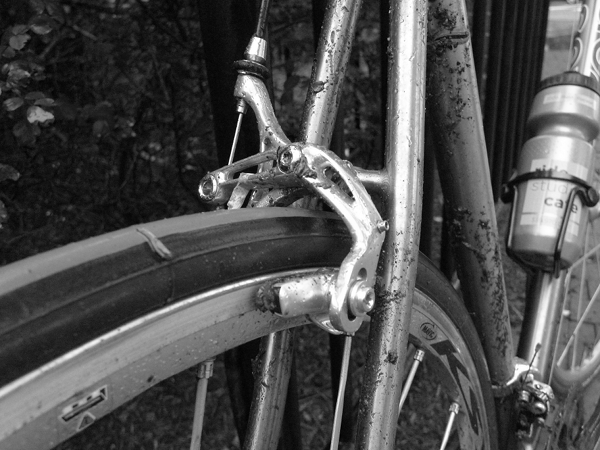
The rest of the evening was spent showering, loading the washing machine, and scooping bits of plantlife (please don't let it be anything more gross than that!) from under the brake calipers and off the brake pads. Later, the Co-Habitant came home and thoroughly examined my loaner steed... upon which he discovered a substantial gash in the front tire. Seriously? Argh! But I guess I should be glad - otherwise it could have failed during a paceline ride, which is one of my biggest fears. So I think I will be putting some tires with puncture protection on this bike. Continental GatorSkins might be a tad slower than the Michelin ProRace3s currently on it, but the gash in the rubber is enough to persuade me it's worth it. What is your favourite "fast" road tire with puncture protection?

The forecast promises pretty much constant rain and autumnal temperatures for the entire week, and the gloomy weather is really becoming difficult to take. I will probably be going roadcycling in the rain again, simply because otherwise I will never get back into a regular practice of riding. At least next time I will know what to expect.
Read More
Posted in Italian bicycles, rain, roadcycling | No comments

Sunday, May 15, 2011

Custom Leather Pannier by Cristobal &Co

Posted on 10:39 PM by dvdsvdsdv
Since having written my "short chainstay lament" some time ago, I've connected with a number of small manufacturers and artisans who have developed panniers specifically to solve this problem. And yes, I will be reviewing them all to the best of my ability! This month I bring you Cristobal &Co. I am familiar with the owner of Cristobal via bikeforums and obtained this pannier in an equal value trade.

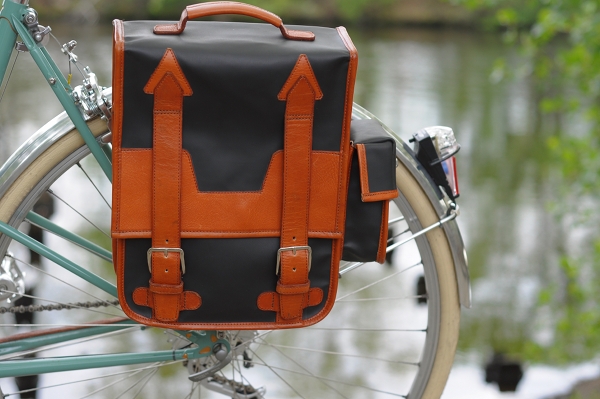
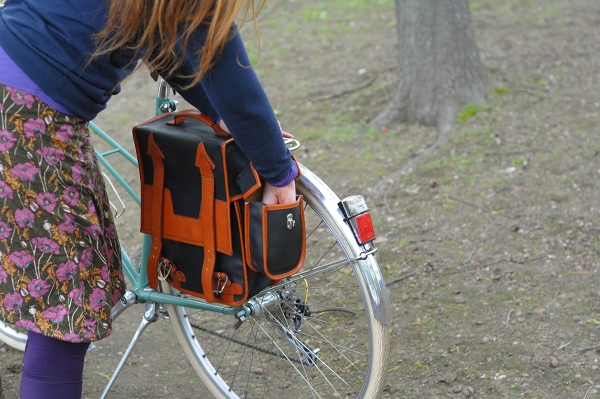
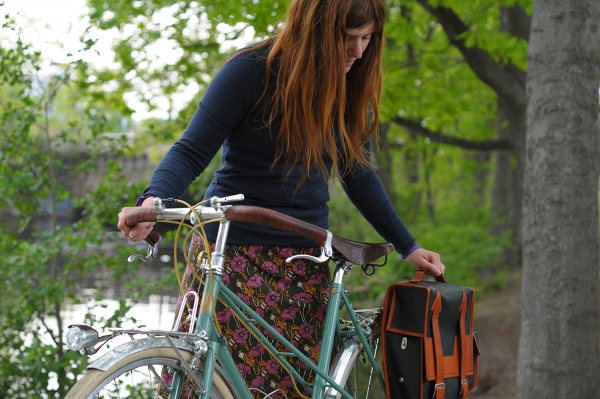
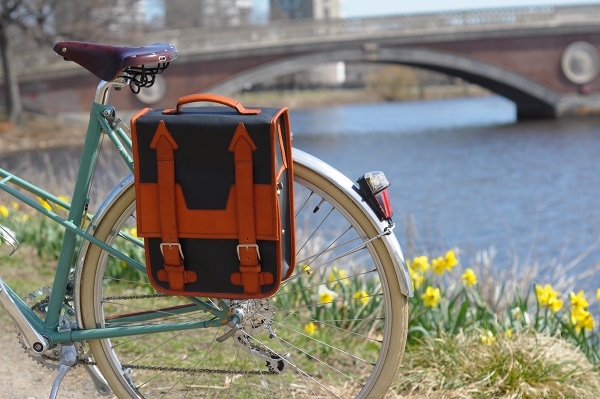
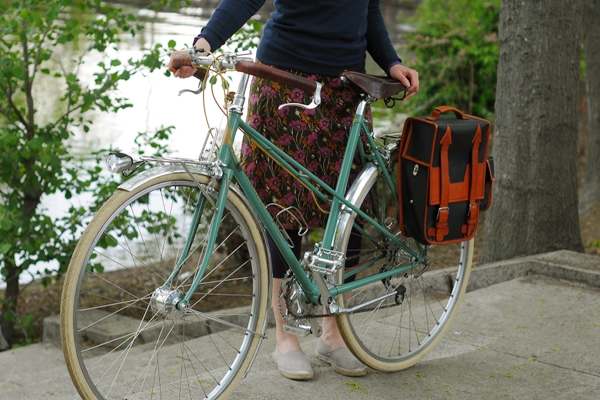
Cristobal panniers are custom-made by hand by traditional artisans in Mexico. They are made of leather and covered with a thin layer of weatherproof and UV-resistant synthetic fabric. Although standard models are available, the nicest thing about Cristobal is the possibility for customisation. I asked for a pannier that would fit my MacBook without inducing heel strike when used on my mixte. I sent measurements of my bike's chainstays and rear rack, we discussed dimensions, and I also indicated how high I wanted the pannier to sit. Shortly thereafter I received the cute, boxy Cristobal with honey leather and removable side-pocket. It fits my MacBook with much room to spare without a hint of heel strike.
Having used a variety of leather satchels in the past, I would describe the Cristobal pannier as exceptionally well made. The leather is of high quality and the stitching is precise. There are no loose threads, no botched edges. 

The underside of the leather is soft to the touch. There is an option to get a flap that will cover the rivets holding up the hooks on the back of the pannier, and I asked for this feature - making the interior completely safe for my laptop and camera equipment. 

The removable pocket can be fitted to either side of the pannier via a built-in attachment system.

It is large enough to fit a mobile phone and a small digital camera at the same time, which is useful.

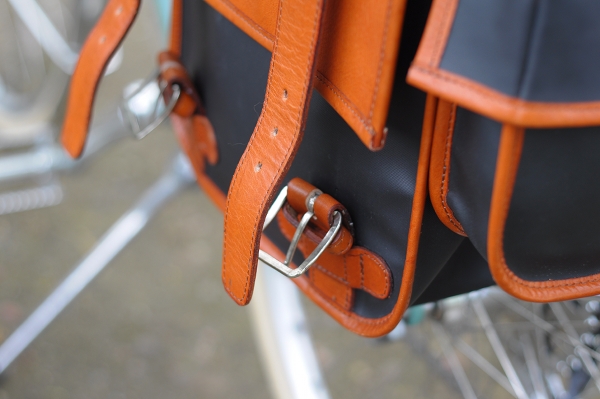
The extra long leather straps with metal buckles are designed to hold a jacket when closed.

However, I usually just leave mine open, because it takes too long to mess with them (a quick release design could work nicely here). 

The attachment system consists of straps with buckles and two hooks. The open hooks go over the rack's tubing to keep it stable, and the straps are used to secure it. The hooks are standardly sized - similar to those used by Arkel - and will not fit racks with thick tubing, such as heavy duty Dutch bike racks. 

A lower pair of straps attaches to the rack's stays for greater stability. You can see in the pictures that the straps are easily moveable via the slots in the leather, which makes it possible to adjust the pannier to fit different bikes. You could also remove the lower straps altogether if you do not feel them to be necessary.

I found the Cristobal pannier convenient to use in that it makes for a great carry-all. With its rigid boxy shape, it is like a bottomless trunk that I can keep stuffing and stuffing with my personal belongings and groceries. On the other hand, the pannier takes some time to affix and detach, and its hooks are only compatible with some of my bicycle racks. Without a more versatile quick release system, I consider this to be more of a touring pannier than a commuter's pannier. Cristobal is willing to use alternative attachment systems upon customer's request, and I suggest getting something like the R&K Klickfix if you need an easy on-off feature that is compatible with a wide variety of racks (I didn't opt for that, because I was curious what the standard attachment system was like).

It is also worth noting that while leather is more durable than cloth, it is also heavier. If you value durability, waterproofness and craftsmanship over weight, then this shouldn't bother you. But if you are seeking the lightest set-up possible, leather is generally not the way to go. 

Cristobal panniers are starting to appear in bicycle shops across the US, and can be ordered directly from the manufacturer with various degrees of personalisation. Prices vary depending on dimensions and the amount of custom work, so please inquire with them directly. I am impressed with the craftsmanship and design of the pannier, and will consider retrofitting mine with a quick release system. 
Read More
Posted in bags, mixte, product reviews | No comments

Saturday, May 14, 2011

Perfect Just the Way You Are

Posted on 9:25 PM by dvdsvdsdv
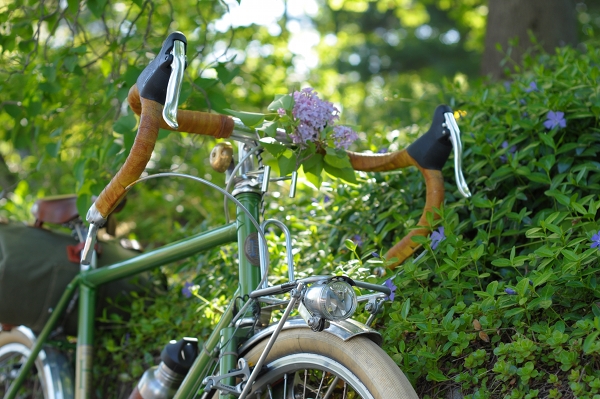
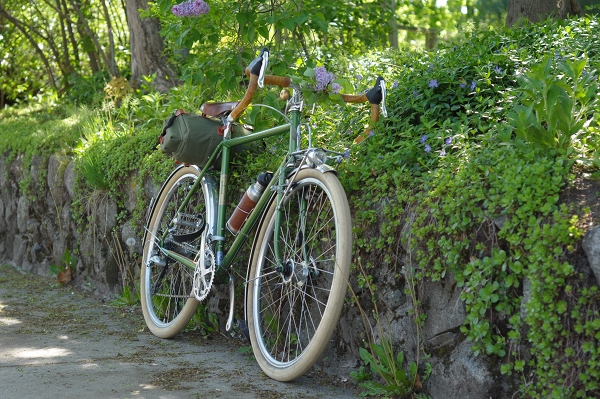
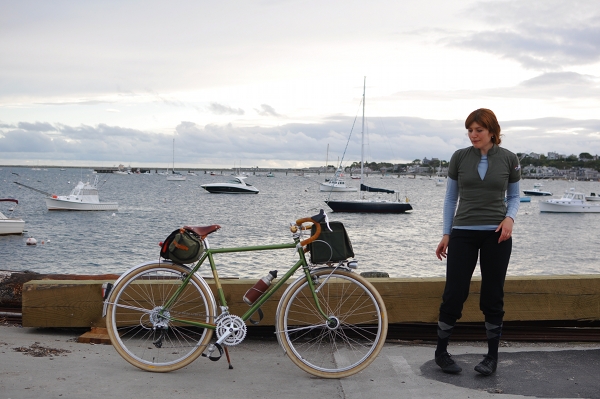
In describing my experience in a paceline training ride earlier, I had written that my Rivendell was not the right bike for that ride. Subsequently, I've received some suggestions for how to make it faster - including getting narrower tires, installing "brifters," removing the saddlebag, rack and fenders, and stripping off the dynamo lighting. While I appreciate the advice and agree that all of that may indeed improve my paceline performance, I do not plan to make any changes to this bicycle. Right now, I have a bicycle that is perfect for me as a touring bike. Why turn something that's perfect for one activity into something that's okay but not ideal for another?

In stating that my Rivendell was not the right bike for a racing team-sponsored paceline ride, I was by no means criticising it or expressing unhappiness with it. I was merely reiterating a simple fact: Touring bikes are not racing bikes.

A touring bicycle is about exploration and about experiencing one's surroundings. You cannot do that when cycling 6" behind someone's rear wheel at 20mph.

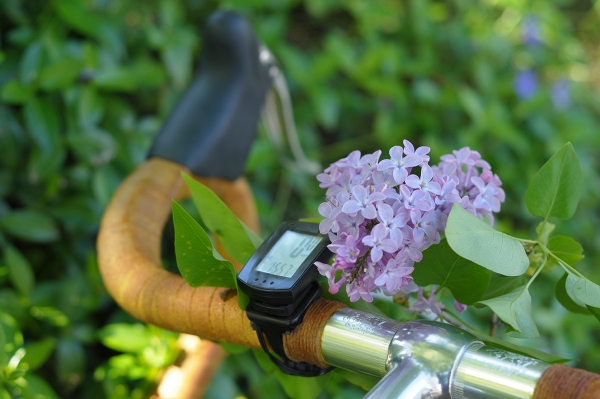
A touring bike is about the long haul and about going at one's own pace.  I use the computer as a handlebar-mounted clock and odometer more than I use it as a speedometer - because "how far" is a more interesting question for this bike than "how fast."

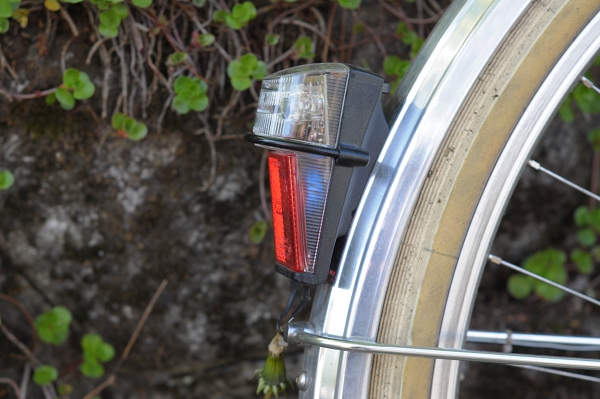
A touring bike is about the freedom of going anywhere, without having to cultivate the handling skills of a pro racer. Comfortable geometry and stable handling enable novice and experienced cyclists alike to ride. My bicycle is easy, and its wide, cushy tires make me immune to most of the fears that plague cyclists on modern roadbikes: potholes, rain, sand, uneven terrain - bring them on. I can even wear nice clothing while I'm at it, because the fenders will protect me from road grime. And with my bright, dynamo-generated lights I can cycle through the night and not worry about batteries.

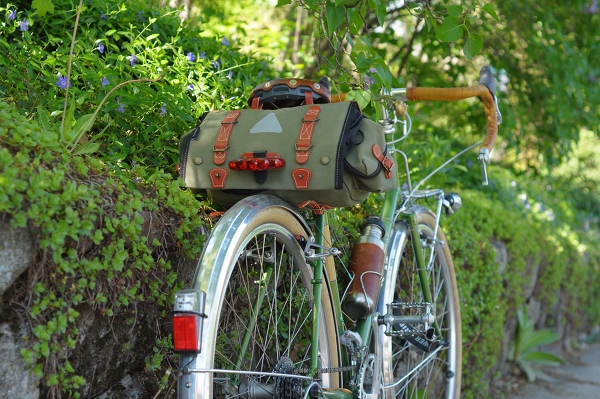
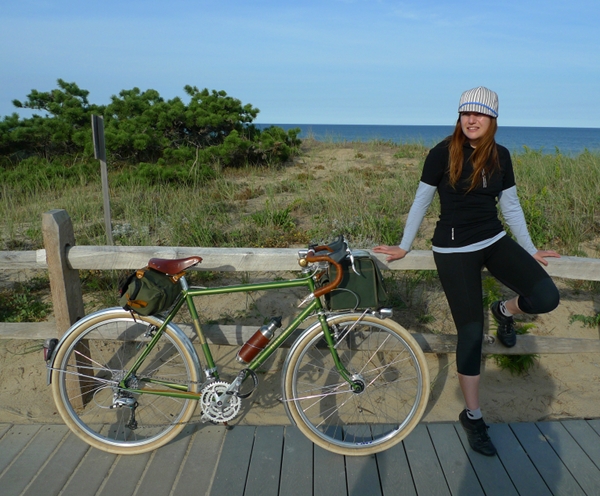
A touring bike is a home away from home. In my saddlebag, on the day this picture was taken I carried: a large DSLR camera, a sweater, a hat, an apple, a notebook, a fountain pen, a bar of chocolate, a saddle cover, gloves, sunscreen, a lock and a mini pump. And that's nothing compared to what I could have brought had I also attached my handlebar bag. Setting off on a racing bike limits you to a training ride and nothing more. On a touring bike a ride can start out as one thing and morph into another. Groceries can be involved, or a spontaneous visit to a friend's house. Who knows!

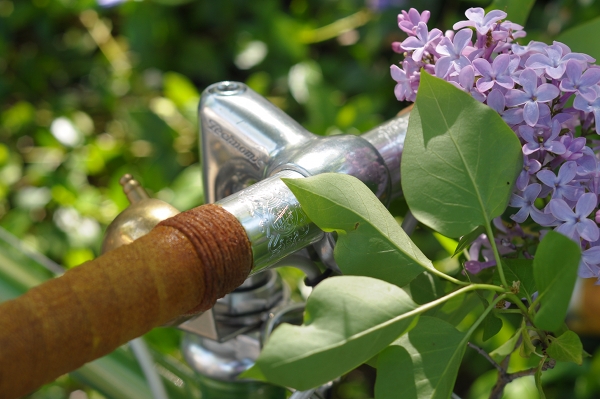
Riding a touring bike is an organic experience. My Rivendell's steel, brass, canvas, leather, twine, shellac and rubber fit harmoniously with its riding style and with my enjoyment of exploring nature. It is not about competing with nature with ever-more-efficient materials and aerodynamic postures, but about simply existing.

In turning this bicycle into a performance-oriented bike, I would essentially be giving up the very things that make it special. And that would be a shame.

Sure, we may be curious about pacelines and racing.

But not at the expense of smelling the flowers. Some bicycles are perfect just the way they are.
Read More
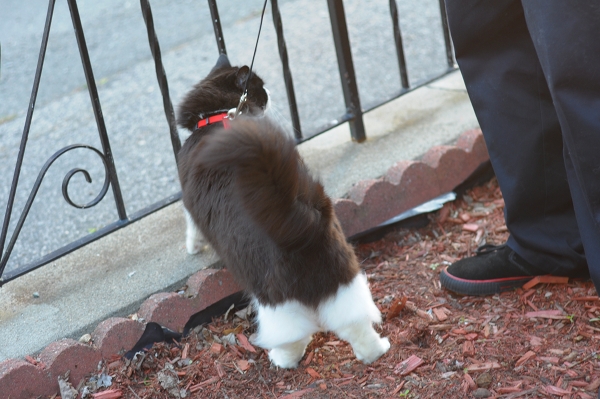
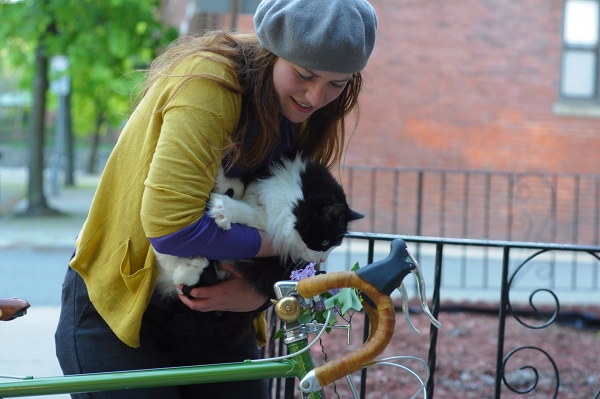
Posted in cats, fenders, Rivendell, roadcycling | No comments

Keeping Your Bike Outdoors

Posted on 12:02 AM by dvdsvdsdv
Last week I finally turned my Gazelle into an outdoor bicycle. It has become clear to me over time that parking a transportation bike where it is easily accessible - instead of maneuvering it in and out of doors and up and down stairs every time I need to go somewhere - increases its utility tremendously. Dutch transport bikes in particular were simply not designed to be kept inside apartments. They are heavy, unwieldy and also durable - with all their delicate parts covered from the elements. And while theft is a concern, I think that our fear of it - when it comes to heavy transportation bikes - is disproportional to its actual risk. Bike theft in the US is not nearly as bad as in places like the Netherlands and Denmark, yet in those places bikes are kept outdoors 24/7. Plus, I seriously doubt that a 45lb clunker would be on a bicycle thief's priority list. Why chose fear over convenience when statistics are on our side?

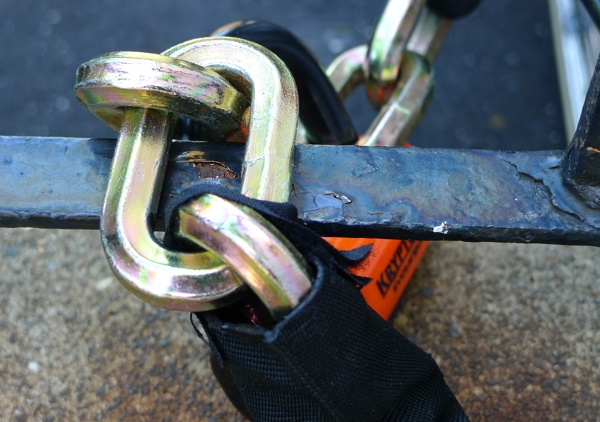
That is not to say that precautions should not be taken: My first order of business was to get one of those huge, heavy chains. I deliberated over Abus vs. Kryptonite and received feedback both for and against each of them. In the end, I think that either chain is sufficient. I chose Kryptonite because a local bike shop had them in stock. The chain is thick and the system is easy to use.

I keep the chain wrapped around an iron rail in a convenient spot at the back of our house. When the bike is parked there, I chain it up. When I use the bike, I leave the chain behind. The key to the little U-Lock that connects the chain is attached to my housekeys, and we have spares at home.

The space next to the railing is cramped, making it impossible to wrap the chain around the frame. So instead, I wrap it around the bicycle's rear wheel. If you are familiar with classic Dutch bikes (full chaincase, dressguards, bolted rear triangle), you will know that removing a rear wheel on these babies requires tools and takes about a half hour - so locking up this way is not much riskier than chaining it through the frame. I also put a cable lock through the frame and front wheel (the cable lock goes with me when I take the bike out). While no lock-up method is 100% secure, I feel comfortable with mine. I weighed the utility of this arrangement against what I perceive to be the risk of theft, and to me it's worth it.

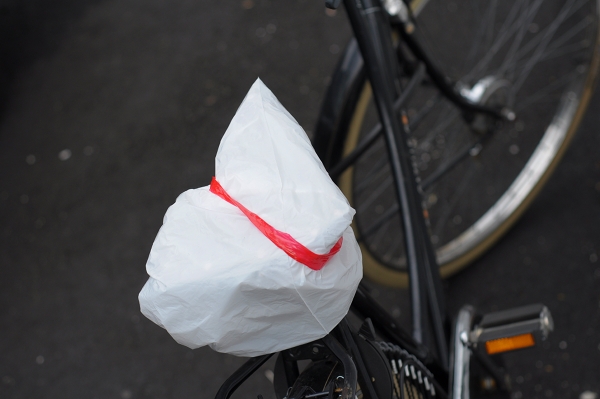
One thing I still need to get is a heavy-duty waterproof saddle cover; ideally something that doesn't look expensive. I have a bunch from Brooks and Rivendell, but they either do not fit the huge saddle properly or are not entirely waterproof. Any saddle cover suggestions for a Brooks B66?

It is not my intent to suggest that everyone ought to keep their bike outdoors. Judge for yourself based on how much extra utility you think you would get from that, as well as how comfortable you are with leaving it out. If you do decide to go that route, I suggest a good chain, a plan for saddle protection (it will rain if you leave it uncovered overnight!), and a lock-up ritual that does not end up being too fussy and time consuming. Do you lock your bike outdoors?
Read More
Posted in Gazelle, locking up, urban cycling | No comments

Friday, May 13, 2011

Surviving a Paceline Training Ride

Posted on 11:45 PM by dvdsvdsdv
[image via alharbiseye]

Well, I did it. I showed up at the weekly women's paceline training ride that is organised by a local cycling team. The very same one I've been talking about forever. It was the first ride of the season and I figured that I should just go, before I lose my nerve and spend every week telling myself "maybe next time" while the entire summer goes by. So I went, and apparently survived - though just barely. Let me tell you about it from the beginning...

It was overcast and threatening to rain all afternoon, but I checked the team's website before leaving the house, and the ride was on. The meeting point was in Lexington, MA - which is 10 miles from where I live. I rode my bike there, taking care to go at a leisurely pace so that I wouldn't already be tired upon arrival. I was so nervous, that I needed all of those 10 miles just to calm down.

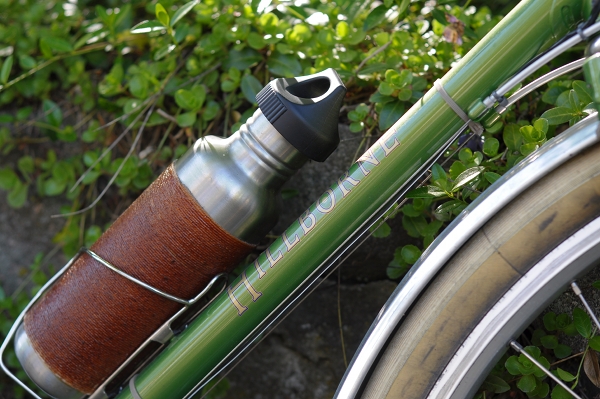
I spotted the meeting location immediately. There was a crowd of several dozen women in roadie attire and as many bikes lying on the grass and propped up against trees. My heart sank as I saw them. I guess I had expected more of a mix: Some women on modern carbon fiber and others on old 10-speeds; some in clipless shoes and others not; some in lycra and others in gym shorts. But no: Every single person there had a super-light modern roadbike with "brifters." Every single person there was wearing clipless shoes. Not a soul had a kickstand, fenders or racks on their bike but me. Not a soul had a bag attached to their bike. No one else had, um, a twined stainless steel water bottle. And all wore lycra - the club-affiliated cyclists readily distinguishable by their team kit. Thankfully, at least I wore my wool cycling knickers and jersey and not something more casual. Reluctantly, I approached.

Greeted by a woman in team kit who looked like she was in charge, I was pointed to a bench where everybody was signing waivers. I made the mistake of starting to read the waiver, but the things described there were so horrible that I stopped and just signed it. When I returned to the spot I'd left my bike, two other women-in-charge were gathered in front of it. Was this my bike? Yes... The one I was planning to ride? Yes... They examined my Rivendell touring bike as if it were a 100-year-old antique or a creature from outer space. There was some debate as to whether it would be allowed: My bicycle was extremely heavy, the tires were too wide, and I did't have the right shifters. I would have trouble doing the ride. Was this even a roadbike? Only roadbikes were allowed. Finally, the senior-most woman was called to resolve the issue. In the end my bicycle was deemed allowable, but I was warned that I might have trouble doing the ride; in the long run I would need a different bike. I tried not to get too intimidated by this. The group I planned to join was described as "paceline learning skills for beginners, 12-15mph." I could ride at that speed with my eyes closed (just a figure of speech, don't worry), so all I had to do was focus on the skills. So I stayed.

The crowd was split into groups and the beginner's group consisted of eight of us: six newcomers and two leaders. The leaders gave us a brief explanation of what it meant to ride in a paceline: The group cycles in a single-file procession, staying close to each other's wheels in a straight line. When the person in front gets tired, they move over to the left and drift to the back of the line, then merge with the paceline in the rear. This gets repeated every few minutes. One thing that makes perfect sense but I hadn't realised in advance, is that you cannot coast in a paceline. Whether going fast or slow, cyclists must keep pedaling at all times, because that is how members of the paceline are able to maintain uniform speed - they synchronise their leg movements. So, coasting is forbidden. Hard braking is also forbidden, as it can cause the person behind to crash into you. To slow down, you need to keep pedaling while "feathering" the brakes. Finally, there is a system of signals that members of a paceline must use - from the person in front indicating that they will move to the left now, to warning about potholes, to asking to merge into the middle of the paceline if you are drifting back on the left and there is a car coming. We were quickly shown all of these, and without further ceremony we set off on our 20 mile ride through rolling hills.

Apparently I am an extremely poor judge of my own strengths and weaknesses when it comes to cycling. I had thought that my biggest problem would be technique. I expected to experience debilitating fear when cycling 6" behind someone's wheel, to be dangerously clumsy at executing paceline maneuvers, and to be slow on the uptake whenever instructions were given. On the other hand, I expected myself to have no problem at all with the pace and terrain of the ride: I mean, 12-15mph? Please!

Instead, the exact opposite happened: I found the paceline training itself to be natural and had no problems with technique. I behaved predictably and signaled appropriately. I didn't coast and I feathered the brakes, modulating my speed smoothly (having ridden fixed gear made this pretty intuitive actually). I reacted quickly and calmly when instructions were given to me. I never once swerved or did anything crazy out of fear or incompetence. In short: all my worries about being poorly coordinated and getting flustered around other cyclists were completely unfounded.

On the other hand, keeping up with the pace proved to be challenging and I wish I could say it was the bike's fault. I don't know how to explain it. Maybe it was the no-coasting thing that did me in, combined with the fact that 15mph was the typical speed on flats, with 12mph being the uphill speed and 25mph the downhill speed (while still trying not to break the paceline). Anyhow, I felt extremely unfit on the uphill portions of the ride, huffing and puffing as I struggled not to lose the wheel of the person in front of me. On these occasions, the leader cycled alongside attempting to reassure me: "You see now?... You're at a real disadvantage with that bike... But you're doing well... Breathe... That's right... Good... Next time, different bike..."

Truthfully, I don't know whether it was the poor bike's fault or mine. All the other girls on the ride were athletes of some sort - runners or "spinners" (i.e. at the gym, on stationary bikes), looking to transition to roadcycling as a new sport to try. My background is very different. I am not an athlete and have never been an athlete. And I have done zero exercise all winter other than riding upright bikes for transportation. So maybe it's really a case of "next time, stronger leg muscles." I would be curious to try the same ride on a modern roadbike and see whether it's any less difficult, but I am skeptical.

There were other problems with my bike on this ride: Namely, the shifters, brake levers and possibly even handlebars. With my friction bar-end shifters, I was at a distinct disadvantage to the other girls, who could shift instantaneously thanks to their indexed "brifters." It was a little ridiculous actually. Moreover, moving my hand to the edge of the right handlebar in order to shift was problematic, because it is a similar gesture to the signal used for indicating pulling over to the left (you have to wiggle your right elbow). In that sense, using bar-ends in a paceline where no one knows what they are has the potential to cause an accident if the person behind me interprets my changing gears as inviting them to move forward.  Do I want to be responsible for that?... As for using the drops: I cannot modulate my brakes well from that position because of how my handlebars are shaped and set up, and so I only brake from the hoods. When going downhill, the leader wanted us all to get in the drops for maximum "aerotuck." She kept telling me to do this, but I refused because it wasn't a safe position for me to feather the brakes from.  So I stayed on the hoods, but bent my elbows so much that my chin was practically on my handlebars, achieving the aerodynamic positioning they wanted. They were okay with it under the circumstances... but it was yet more evidence of my needing a different bike - with shallow drops and with brake levers I could modulate from all positions.

If all of this sounds like a miserable, degrading struggle, then I've done a good job of describing it. It went on for an hour and a half as we cycled past farms, forests and highways practicing paceline maneuvers. But there were a few minor advantages to my bike as well. At some point it began to rain, and the group leaders grew alarmed - contemplating shortcuts back in case the rain continued. At first I could not understand what the problem was, but eventually realised that their bikes were prone to "wiping out" on wet terrain. Thankfully, that is one problem I don't have on my own bike. There was also a fear of sand. Sand on the road was signaled down the paceline as if it were a pothole to avoid. Not something I normally worry about. While these advantages were fairly minor compared to the disadvantages I experienced, they provided at least some relief.

We arrived back at the meeting point just as it was growing dark, and the girls began taking their bikes to their cars. When they learned that I had cycled from Somerville and now planned to cycle back, several of them offered to give me a lift. But I opted for a quiet ride home on the (now pitch-black) Minuteman Trail, to review the evening'e events in my head and relax. I cycled slowly as the lights on my bike illuminated my path. It was a beautiful night, and when the rain started up again the smell of the surrounding meadows grew pleasantly strong. I never, ever had to do the paceline ride again if didn't want to, but could just quietly cycle in the dark like this on my own forever. And yet?...
Read More
Posted in paceline, roadcycling, technique | No comments

Wednesday, May 11, 2011

Review of Three Wool Cycling Jerseys: Ibex, Icebreaker and Swobo

Posted on 9:42 AM by dvdsvdsdv
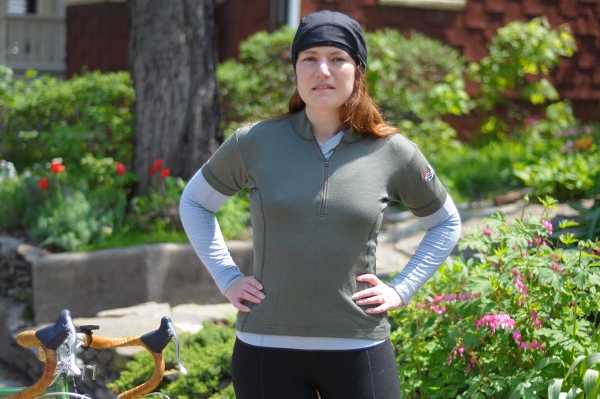
I started buying wool cycling clothing last summer and I now own three bicycle jerseys. What I like about cycling jerseys - as opposed to regular t-shirts - is that they are well-ventilated, elongated in the back (good for a leaned-forward posture), and have built-in pockets, making them convenient to wear on a roadbike. Here are some details about the three I own:

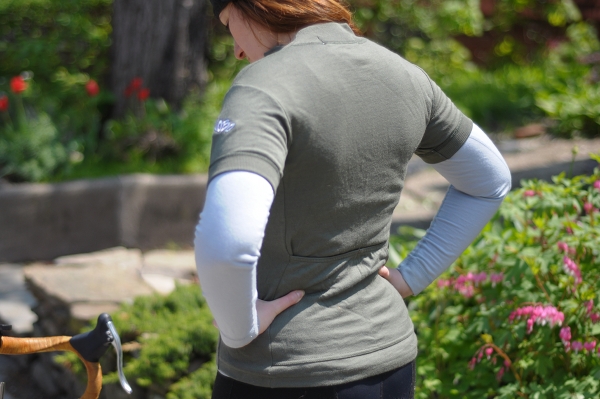
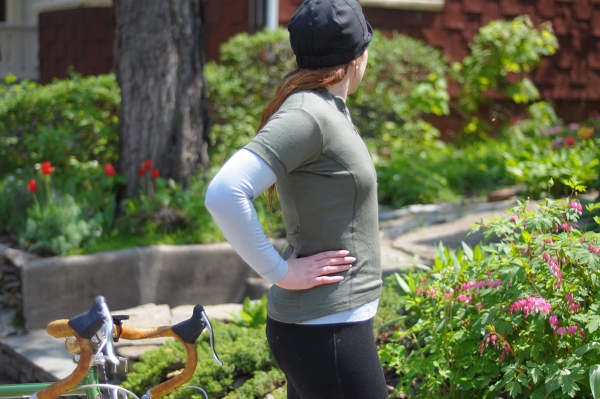
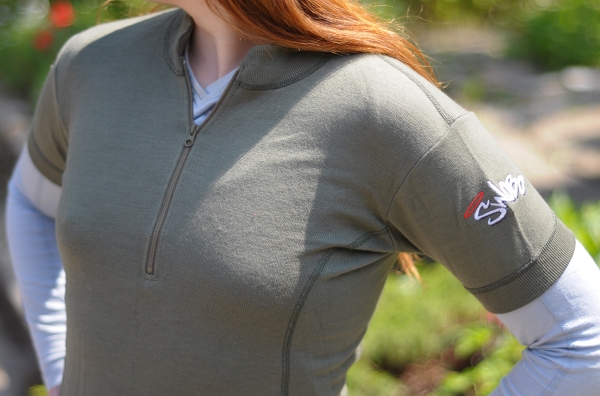
The first wool cycling jersey I bought is this one by Swobo. I heard good things about these and they were on clearance. The entire line is now discontinued, which means that you can find these jerseys on sale at various online outlet stores. The colour of mine is "tree mud."

The Swobo jersey is styled like a vintage cycling jersey in everything from overall design to texture, featuring a classic front zip collar and side panels.

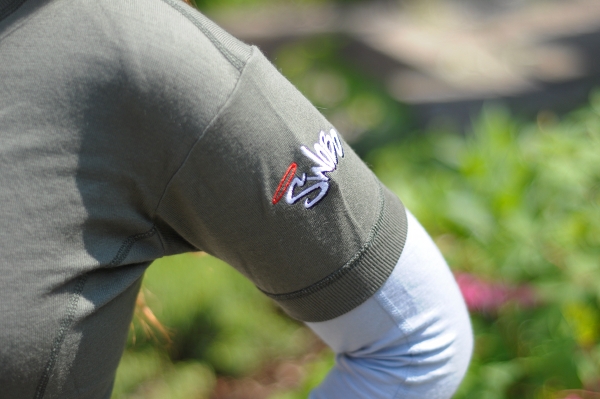
Medium-lenght polo-style short sleeves. 

The wool is on the thick side. It is much softer than vintage wools, but similarly bulky. This makes the Swobo jersey not the most flattering on female bodies - especially in the tummy and upper arm areas. It is cut with practicality in mind.

The back of the Swobo is long and features two very deep pockets, each large enough to fit things like a camera, wallet, phone, sandwich or apple. 

I wore this jersey frequently during our stay on Cape Cod last September, and it is especially good for cooler weather and for cycling in the wind with occasional rain. A durable and practical jersey, but not the most flattering or lightweight fabric. 

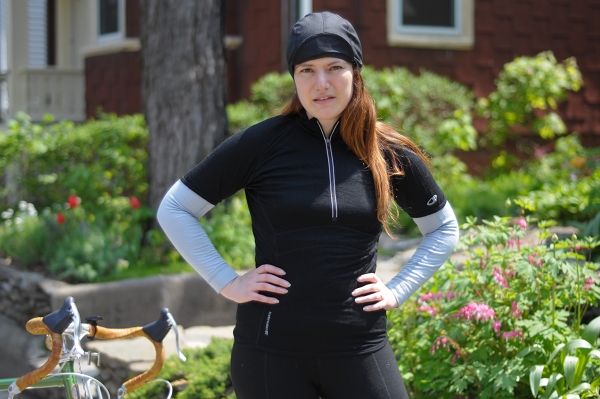
After the Swobo, I purchased this GT jersey by Icebreaker. I wanted a lighter-weight alternative for warmer weather, and was also hoping for a more flattering fit. The Icebreaker is great on both accounts. This is a "multi-sport" model and I bought the previous season's version, on clearance from an online reseller (forgot which one). The current production model is styled a little differently, but it's same general idea.

The wool fabric is almost gauze-thin and 4% lycra, which makes it stretchy. The result is supremely flattering. 

This might be hard to see, but there are panels made of a perforated fabric that run along the back and sides of the jersey. These provide great ventilation and contribute to the flattering styling. The back is quite long, and the stretchiness keeps it from riding up.

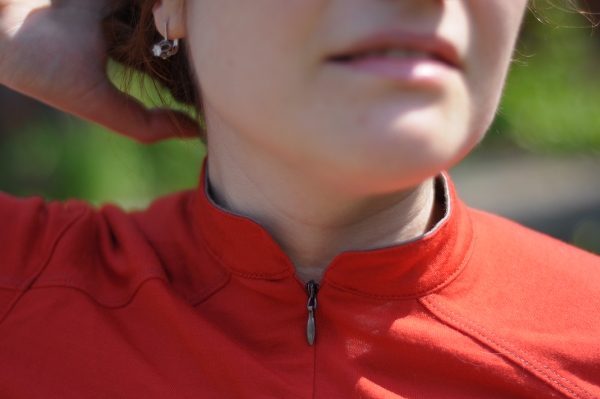
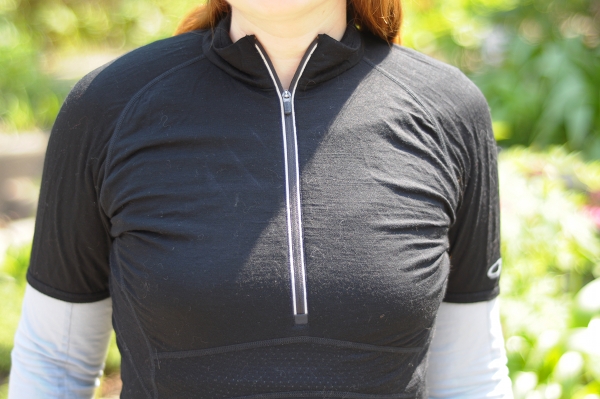
Mock turtleneck collar, reflective zipper, perforated panel under the chest, and elongated short sleeves that can be pushed up or pulled down.

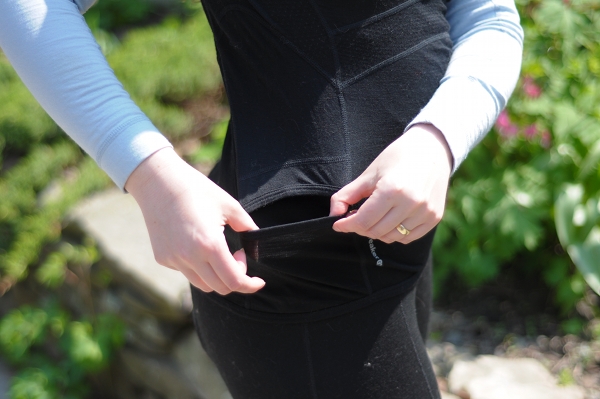
The one flaw of the Icebreaker jersey is the pocket. Because it is not a cycling-specific garment per se, the pocket is on the side. This works so-so in a leaned forward position, but is not ideal because whatever you put in it will add more weight to one part of your body than the other and will pull forward. If you're carrying just a credit card, bills, or folded-up directions then it does not matter, but heavier things like keys or a phone may pull uncomfortably on a bike with dropbars. 

I wore the Icebreaker jersey a lot at the end of last summer, and am starting to wear it again now that it's getting warmer. With all the perforated vents and the long zipper, it keeps me extremely cool. 

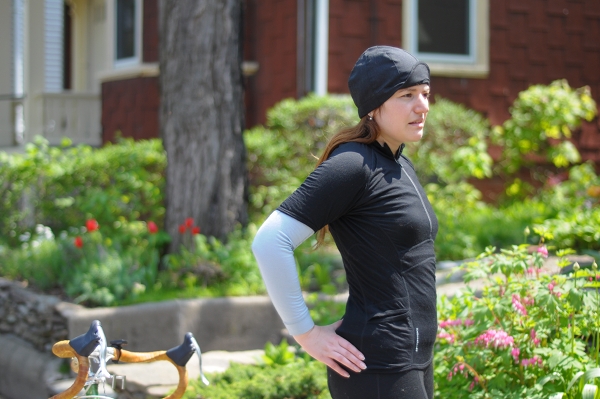
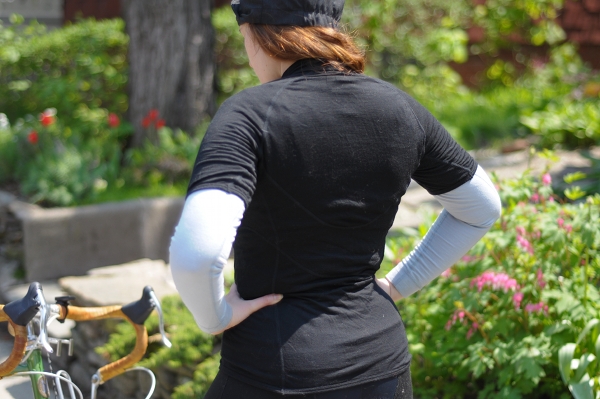
My latest wool jersey is from Ibex, received as part of an equal-value trade directly from the manufacturer. Last summer I bought a pair of Ibex wool cycling knickers (shown in all the pictures here) and I love them so much that I was happy to get anything else Ibex makes. The Indie Mountain jersey did not disappoint. It is flattering and lightweight, and while Icebreaker achieves its flattering look via adding lycra for stretch, Ibex does it via careful tailoring. 

The elaborate multi-panel construction is almost architectural. It cinches the jersey at the waist, expands it over the chest, and drapes it over the tummy in a way that hides the treacherous folds that can form there. 

The elegant Mandarin collar makes the jersey look almost dressy.

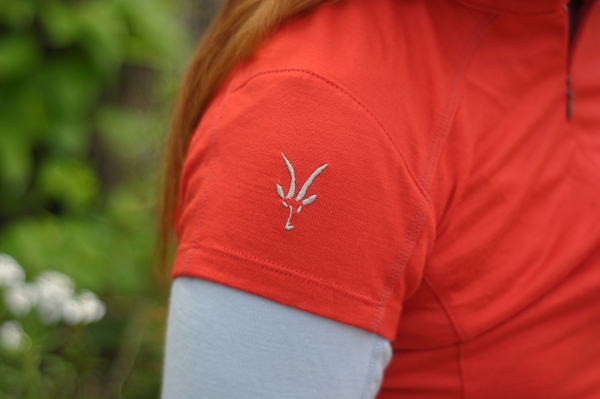
The short sleeves are finished so that they are loose around the upper arm, as opposed to cutting into it. This is more flattering than typical cycling jersey sleeve designs, especially for those of us who do not have upper arms of steel.

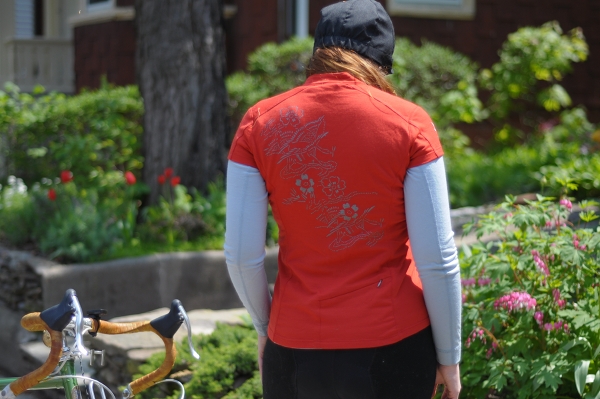
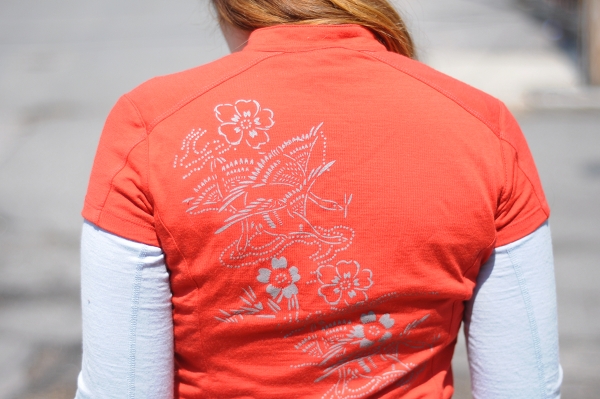
The one thing I could do without on the Ibex jersey is the cherry blossom/ crane rendering. It's just too girly for me, and I also think that it makes what is otherwise a subtle Asian theme way too explicit. This jersey is beautifully styled; it didn't need cranes and flowers. 

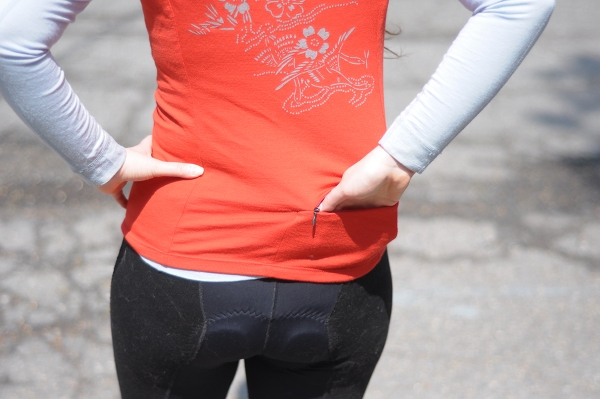
The rear pocket is on the small side, but fits my smaller camera and zips up, so no complaints. Overall, this is a versatile jersey good for both warmer and cooler weather, and I've been wearing it more than my other two since I began cycling this season. (Ibex: Could you make just some plain versions without the drawings, please?)

The three jerseys described here are very different from one another, and I think either could be a good choice depending on the cyclist's needs. Several serious local cyclists I know swear by the Swobo jerseys, but I am not in love with the bulkiness. Icebreaker's performance range is paper-thin, flattering, and offers excellent temperature control - but consider a cycling-specific design instead of multi-sport if you don't like the side pocket, and notice that some of the models are made with a touch of lycra. With its impressive tailoring and soft, thin 100% wool fabric, Ibex would be my perfect jersey - were it not for that drawing on the back. Hopefully this was a useful comparison, and I'd love to hear which wool cycling jerseys you've tried and what you thought - especially the ladies, as there seem to be far fewer choices for us in that regard. 
Read More
Posted in clothing, product reviews, roadcycling | No comments
Newer Posts Older Posts Home
Subscribe to: Posts (Atom)

Popular Posts

  • Computer Games
    I have never liked computer games, but with the influence of the Co-Habitant I am finally starting to get into them. Here he is, taking a br...
  • Upside Down!
    Fate has been kind to Marianne! Rather than being torn apart for donor components , she has been spared, and fitted with new handlebars. Wha...
  • Matters of Identity
    Well... I thought that I could quietly change my blogspot username without anybody noticing or caring, but it's caused some confusion. S...
  • Celestial Beings
    [image via Spernicelli ] Depending on who you speak to, it is either the most over-rated vintage bicycle in existence, or the Holy Grail: Th...
  • The Pashley Roadster Sovereign: Review After Two New England Winters
    If you are a regular reader, you probably know that the Co-Habitant owns a Pashley Roadster Sovereign. We bought a pair of Pashleys  when I...
  • Crime vs. Accident?
    I was cycling across town with a friend today, who suggested that we take the side streets instead of my usual route along the major roads. ...
  • Pulling the Trigger vs Doing the Twist: Thoughts on 3-Speed Gear Shifters
    On bicycles with internally geared hubs, we typically see two types of gear shifters. The trigger shifter (pictured above) is a small gadget...
  • Putting Your Foot Down
    Enough people have asked me about this now that I thought it worth writing about: How do I put a toe down in traffic while remaining on the ...
  • Manufacturers with 'History': Does Continuity Matter?
    What does it mean, when we say that a bicycle manufacturer has a long history? There are manufacturers out there, whose names are legendary ...
  • An Igleheart and a 'Sex Hub'
    At the New England Bicycle Expo  a couple of weekends ago, I had the pleasure of meeting legendary New England framebuilder Christopher Igle...

Categories

  • ANT
  • art
  • bags
  • basket
  • beginners
  • Bella Ciao
  • bicycle events
  • bicycle industry
  • bicycle reviews
  • bike friends
  • bike shopping
  • blog development
  • blogiversary
  • books
  • Boston
  • Brompton
  • Brooks
  • Cape Cod
  • cargo bikes
  • cars
  • cats
  • children
  • clipless
  • clothing
  • Co-Habitant
  • coaster brake
  • comfort
  • Constance
  • countryside
  • diamond frame
  • DIY
  • DL-1
  • dress guards
  • drop bars
  • Eustacia Vye
  • fashion industry
  • fenders
  • films
  • fixed gear
  • flowers
  • food
  • framebuilding
  • Gazelle
  • Geekhouse
  • gender
  • give-away
  • grips
  • handlebars
  • handmade
  • holidays
  • Interbike
  • Italian bicycles
  • Jacqueline
  • knitting
  • lights
  • local bike shops
  • locking up
  • loop frame
  • lugs
  • Maine
  • Marianne
  • mercian
  • Mercier
  • mixte
  • Moser
  • Motobecane
  • Myles
  • night time cycling
  • North Shore
  • paceline
  • Pashley
  • pilen
  • poll
  • product reviews
  • racks
  • rain
  • Raleigh
  • Randonneur
  • randonneuring
  • restoration
  • Rivendell
  • roadcycling
  • rod brakes
  • Rodney
  • Romania
  • Royal H
  • Royal H. Mixte
  • saddles
  • safety
  • Seven
  • shop visits
  • silliness
  • skirt
  • social commentary
  • Soma
  • somervillain
  • stories
  • summer cycling
  • sun and heat
  • Surly
  • tandem
  • technique
  • test rides
  • tires
  • tools
  • traffic
  • trails
  • transportation options
  • travel
  • unpaved
  • urban cycling
  • Urbana
  • Velo Orange
  • Velouria
  • Vienna
  • vintage
  • winter cycling

Blog Archive

  • ▼  2011 (236)
    • ▼  September (17)
      • Frills or Basics?
      • European City Bikes and the North American Market
      • Thoughts on Fixed Gear Cranksets?
      • From Holsters to Corsets: The Cycling Accessory Fe...
      • Yeah Baby! Transportational Elegance Reigns at Int...
      • Handmade Bicycles at Interbike
      • Bleak Prognosis for the Dutch Bicycle?
      • GB Components Are Back! ...And You Can Have Their ...
      • Song, Dance and Bicycle Romance: The Interbike Fas...
      • On Bicycle Reviews
      • What's the Difference?
      • In the Raw
      • Frames of Mind: Why Did We Not Cycle?
      • Embracing Wrinkles
      • Reunited
      • The Art of the Ride Report: a Touring Bicycle Give...
      • If a Branch Falls in a Forest...
    • ►  August (22)
    • ►  July (26)
    • ►  June (27)
    • ►  May (27)
    • ►  April (26)
    • ►  March (30)
    • ►  February (30)
    • ►  January (31)
  • ►  2010 (262)
    • ►  December (28)
    • ►  November (29)
    • ►  October (24)
    • ►  September (23)
    • ►  August (25)
    • ►  July (25)
    • ►  June (20)
    • ►  May (19)
    • ►  April (20)
    • ►  March (17)
    • ►  February (18)
    • ►  January (14)
Powered by Blogger.

About Me

dvdsvdsdv
View my complete profile