lindaikeji35

  • Subscribe to our RSS feed.
  • Twitter
  • StumbleUpon
  • Reddit
  • Facebook
  • Digg

Monday, November 1, 2010

Mixed Impressions: a Look at the Trek Belleville WSD Mixte

Posted on 5:23 AM by dvdsvdsdv
Lately, readers have been asking about the Trek Belleville WSD mixte. It has been out for about a year and looks promising in pictures, but what is it like in person? I had noticed this bicycle earlier at one of my local bike shops - the Wheelworks in Somerville, MA - and recently had a chance to try it.

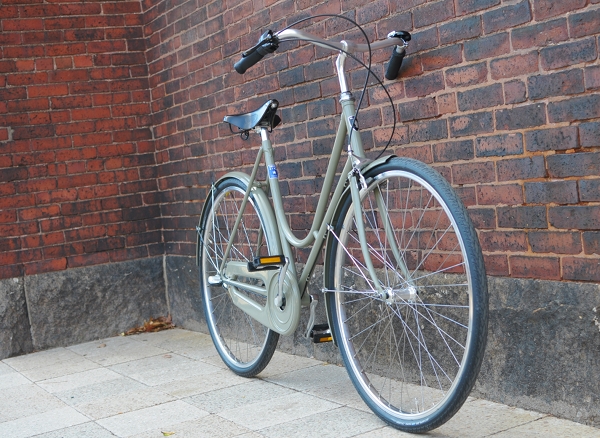
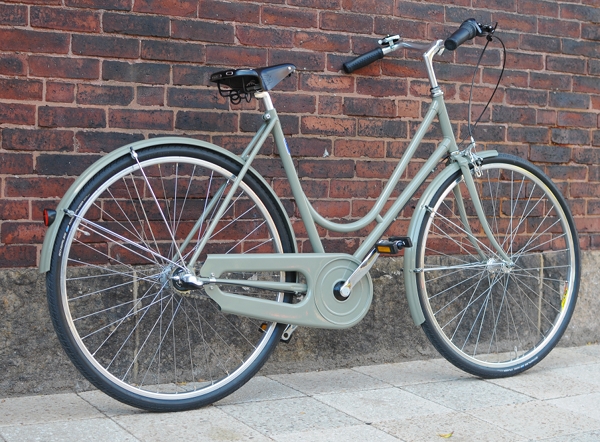
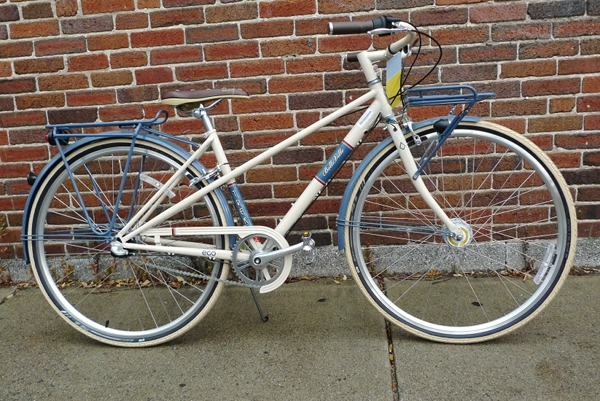
The Trek Belleville mixte is a "real" mixte  - in the sense that it is built with twin lateral stays that extend from the head tube to the rear dropouts. The bicycle reflects the ideas of the French constructeurs (or, more likely, the contemporary builders who emulate the original constructeurs) in that it is fully equipped with fenders, front and rear racks, and dynamo-powered lighting. However, unlike classic mixtes with their elegant lines and lugged steel construction, the Trek Belleville's frame is made of a strangely thick, welded cromoly tubing. The tubing is so chunky in fact, that I was certain the bike was aluminum until I was corrected. In industry photos the chunkiness is easily disguised with good lighting and careful choice of angles. But in person, the bicycle looks like what it is: a somewhat clumsy mass-produced bike fitted with some admittedly impressive extras. Trek also promotes the "eco-design" of this model, which you can read about here.

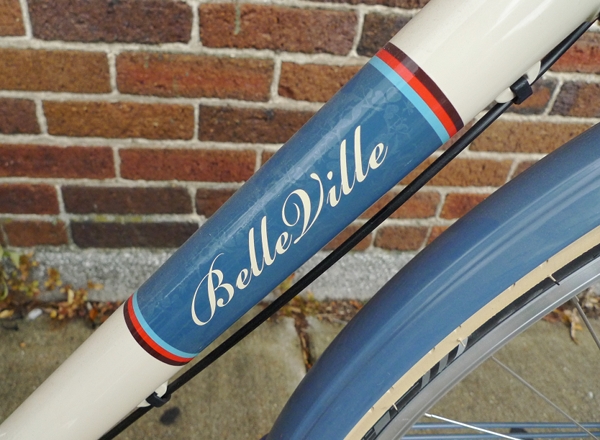
I think that one of the most successful aspects of the Trek Belleville is the colour scheme and graphics. We like to fool ourselves into thinking that this stuff does not influence us, but it does. The slate-blue and cream colour combination with subtle red accents is harmonious, beautiful, and nostalgic. It dominates the aesthetics of the bicycle, distracting the eye from its less appealing aspects.

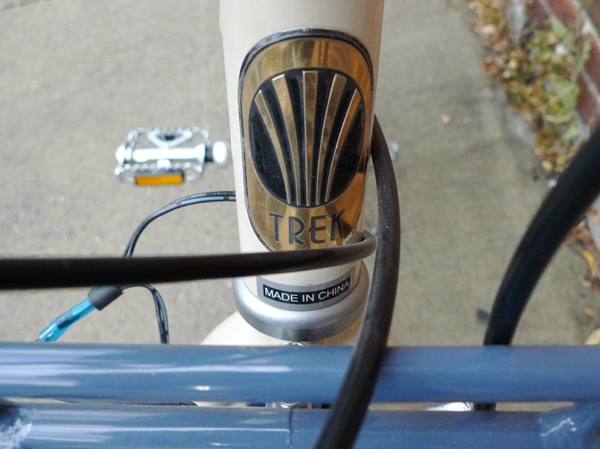
Trek also used a vintage headbadge for the Belleville, which goes nicely with the classic theme.

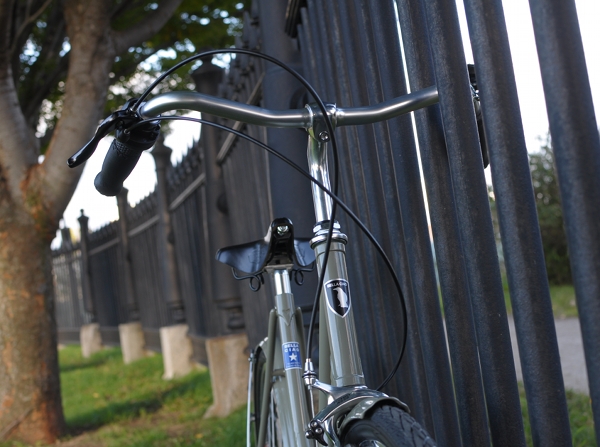
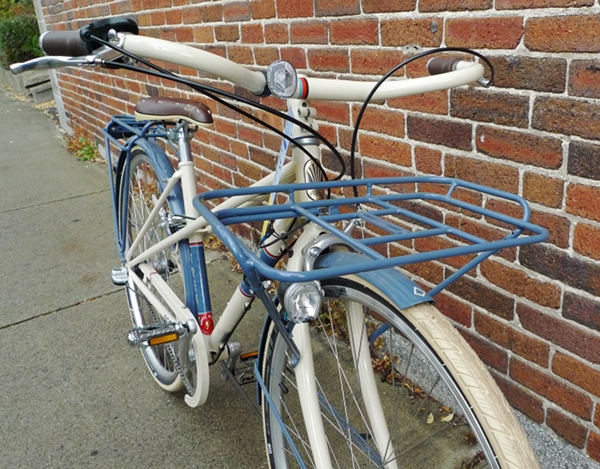
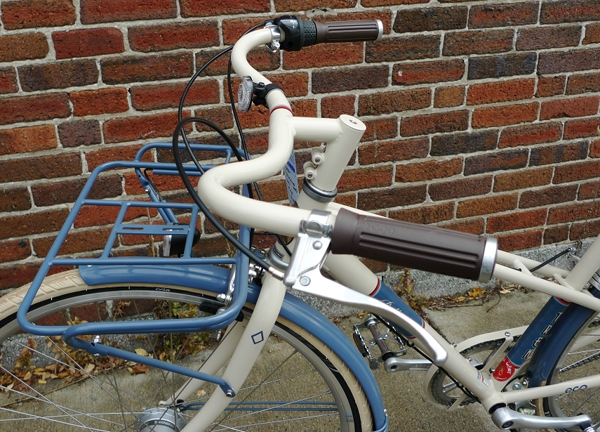
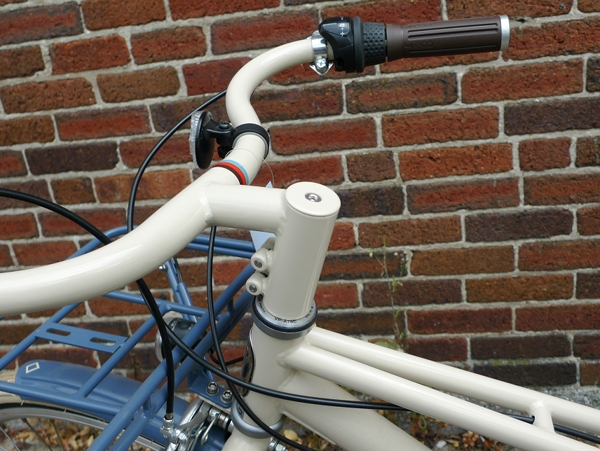
The Trek Belleville uses a threadless stem and Porteur-style handlebars. Both the stem and the handlebars are painted body colour, which is nice. A Porteur-style front rack is attached to the fork.

Close-up of the stem, grips, shifter and the points where the lateral stays attach to the head tube. While I do not normally like threadless stems and integrated handlebars, I think here the look is appealing. However, the design makes it impossible to adjust stem height and the angle of the handlebars, which is problematic.

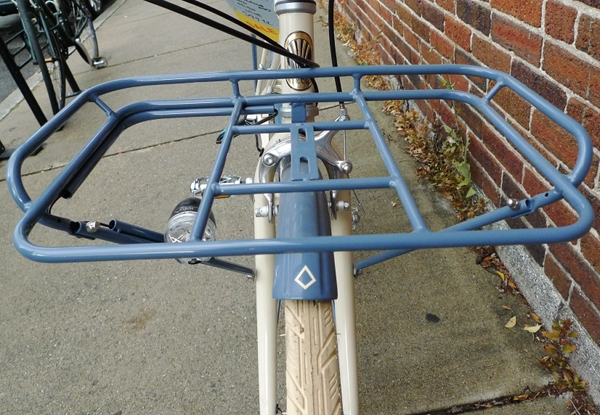
The front rack is quite elegant, as well as smoothly integrated with the body of the bike. The tires are Bontrager, cream with black sidewalls.

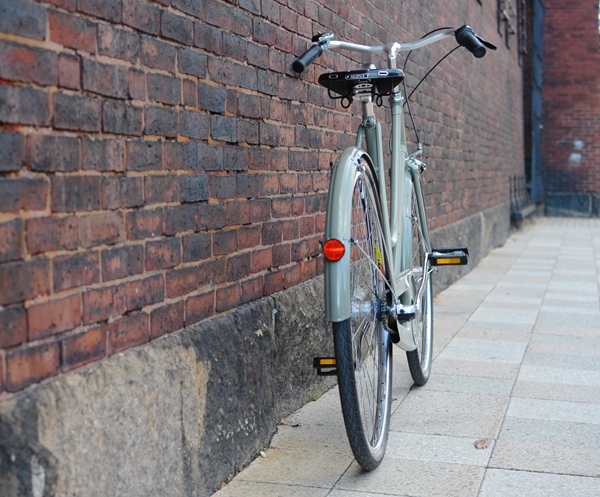
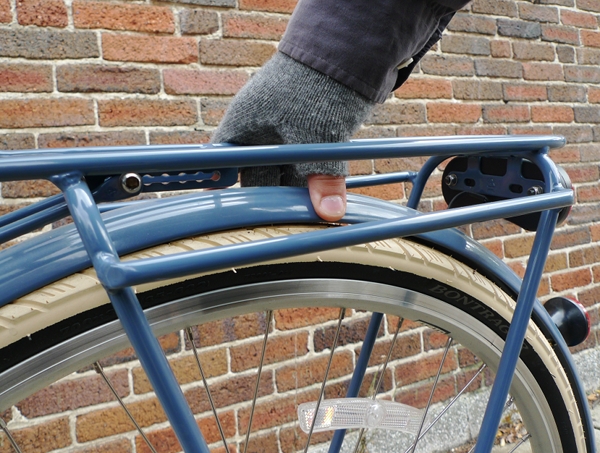
The rear rack is nice as well.  I don't remember the weight rating, but it was considerable. One thing I noticed, is that the attachment points are set back from the rear dropouts - presumably because the chainstays are otherwise not long enough to accommodate a rack?

The Trek Belleville is fitted with an internally geared hub (Shimano Nexus 3-speed), caliper brakes, a decent-looking crankset, touring-style pedals, and a body-coloured chainguard.

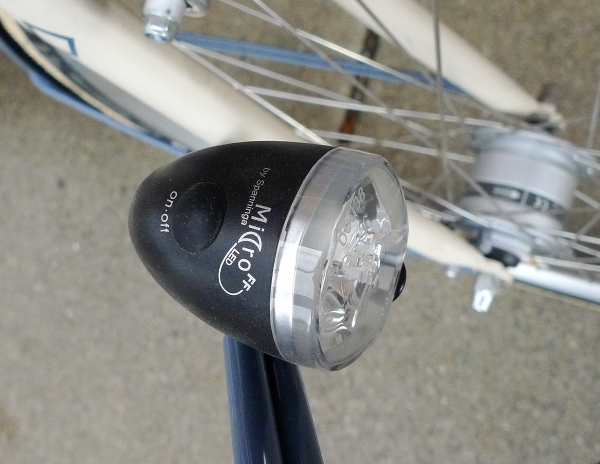
The front dynamo hub is a Shimano (I did not see the model name), and the lights used are Spanniga. The headlight is a Spanniga Micro, mounted on right stay of the front rack.

The tail light is a Spanniga Eclipse, attached to the rear rack. I have not tried the lights, as it was daytime, but I have heard good things about these models.

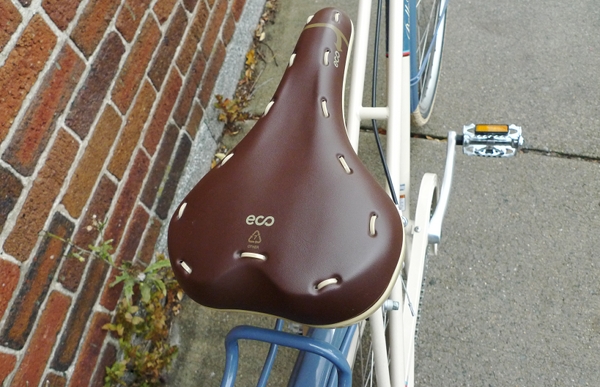
The saddle has a faux-handsewn leather look to it and feels like a typical padded vinyl saddle. I have read that it was designed to be disassembled and recycled after use, though I am not clear on the details.

The Trek Belleville mixte comes in two frame sizes - 43cm (17") and 50cm (20"). I am fairly certain that I tried the smaller frame, because I had to raise the saddle half a foot from its original position in order to ride the bike (note that the pictures here show the original position, not the raised position). However, while the seat tube was short, the rest of the bicycle seemed quite large. The step-over was high and bringing my leg over took some careful negotiating. And the reach from the saddle to the handlebars was characteristic of a larger frame.
I would estimate the weight of the Belleville mixte around 35lbs. Very reasonable, considering the steel tubing and all the extras.

Preparing to test-ride the bike, I walked it off of the sidewalk curb - at which point it made loud clunking noises. Upon investigation, we discovered that the fenders were wobbly - and the cause seemed to be in the design of the attachment points, rather than in the assembly. This could be an issue when riding over bumps or potholes.
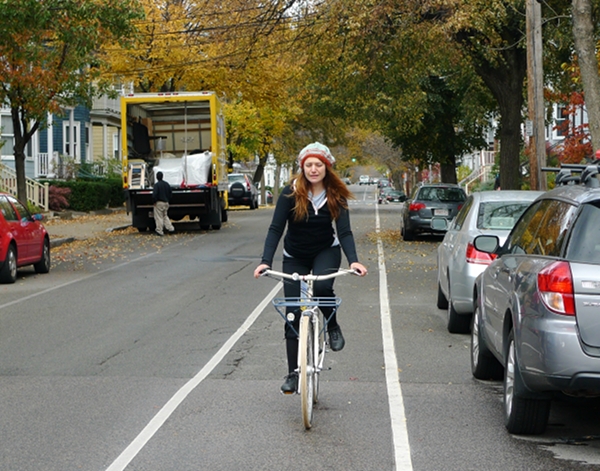
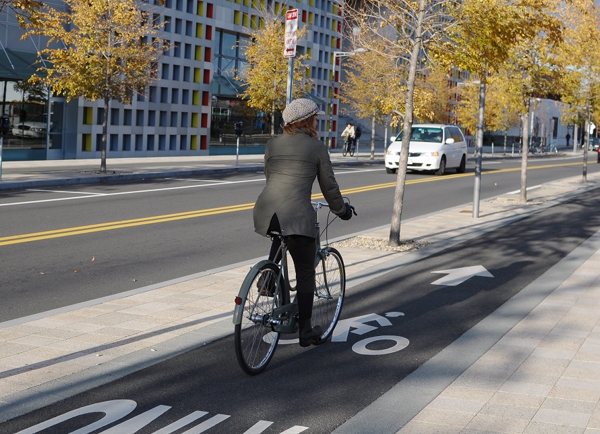
I test-rode the Trek Belleville mixte briefly, and I apologise for my disgraceful "salmoning" - it was only done for the photo. As reflected in the picture, the first thing I noted was the unusually generous width of the handlebars - I almost felt as if I were holding the edges of a hula hoop. Maybe this was the cause of the strange feel to the steering, because I found the front end to be "aloof" - almost as if it was receiving its steering instructions via a third party rather than from me directly. I wonder whether it would handle differently with a front load, but that is not something I was able to test. Otherwise, the ride felt okay - with the exception perhaps of too much pressure on my hands despite the upright handlebars.

Of all the other bicycles I have test ridden, the Trek Belleville mixte is the most similar to the Specialized Globe Haul I tried last year. Both feature mixte-style construction and integrated racks, and are roughly in the same price range. Comparing the two, my impression is that the Globe Haul's construction is of somewhat better quality and I preferred the feel of the Globe's ride. In pictures and from a distance, the Trek Belleville comes across as a prettier and more classic-looking bicycle, but in person this is not so. As for comparing the Trek Belleville WSD to traditional, classic mixtes - there is something clumsy about the Trek, as a result of which it does not resemble the real deal despite the twin-stay construction.

The racks on the Trek Belleville mixte are impressive, and the fact that dynamo lighting comes standard on this bicycle is nothing short of amazing. The gorgeous paint job is also to be commended. But despite all the extras, the bicycle has an awkward and flimsy feel to it in person.  The current retail of the Trek Belleville mixte is around $650, and the Wheelworks in Somerville has it on sale at the moment for a lower price. Regardless of what I think of the Trek Belleville, one thing is for sure: A production bicycle with racks and dynamo lighting is a step forward for the industry that is in itself worth applauding.
Read More
Posted in bicycle reviews, fenders, local bike shops, mixte | No comments

Saturday, October 30, 2010

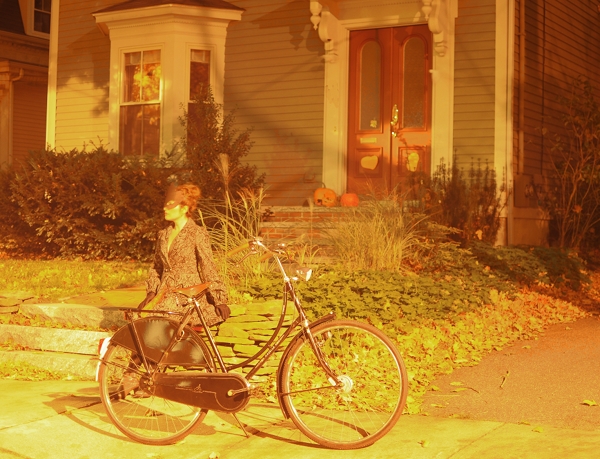
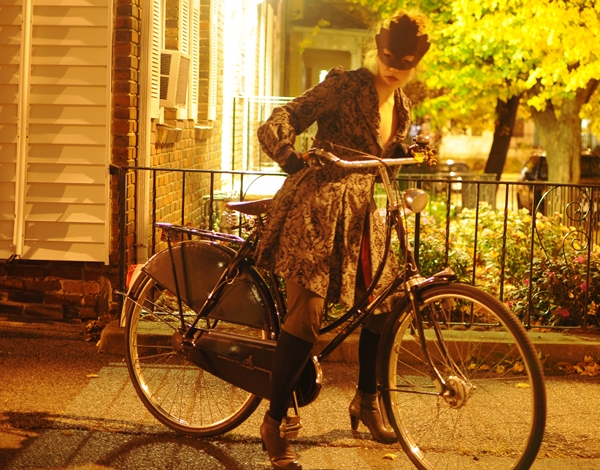
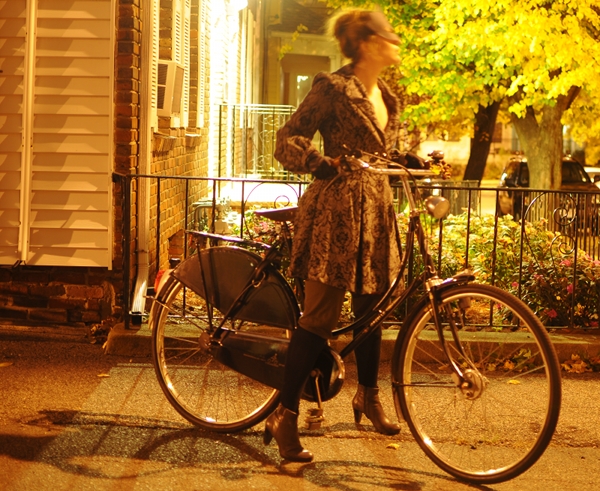
The Masked Cyclist: a Halloween Tale

Posted on 9:28 PM by dvdsvdsdv
Sit down, dear reader, and grab a cup of hot apple cider. For in honor of this Hallow's Eve, I shall tell you a tale that is as true as it is chilling: the tale of the Masked Cyclist.

It was a dark, crisp Autumn night many years ago and I was a mere high school girl, cycling home from piano lessons on my step-through mountain bike. The nonfunctional shifters and rusty chain emitted eerie creaking sounds as I rode through the nocturnal New England streets. My path was illuminated by moonlight, since my bicycle had no lights. Suddenly, I glimpsed something out of the corner of my eye - a moving shadow perhaps? I stopped, with a screech of my poorly adjusted brakes.

At first, I saw nothing at all. But soon, an image began to materialise before me.

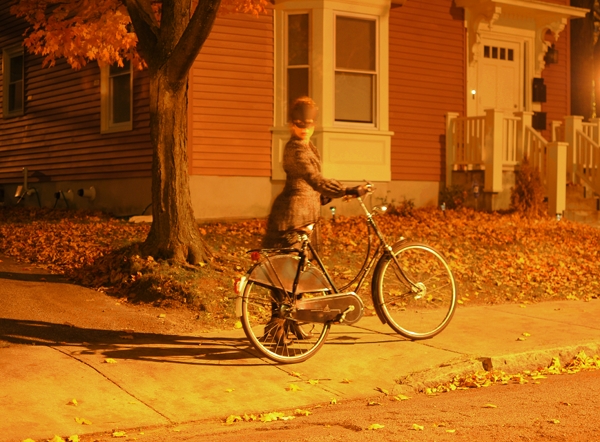
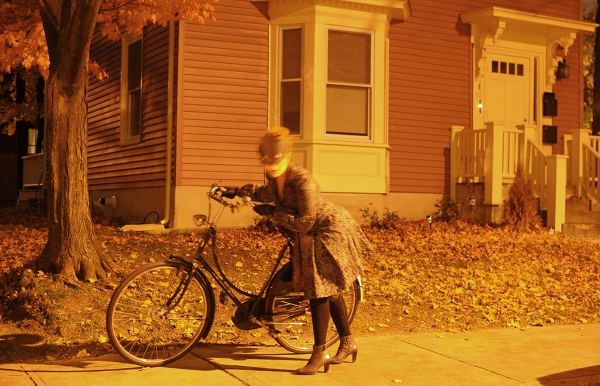
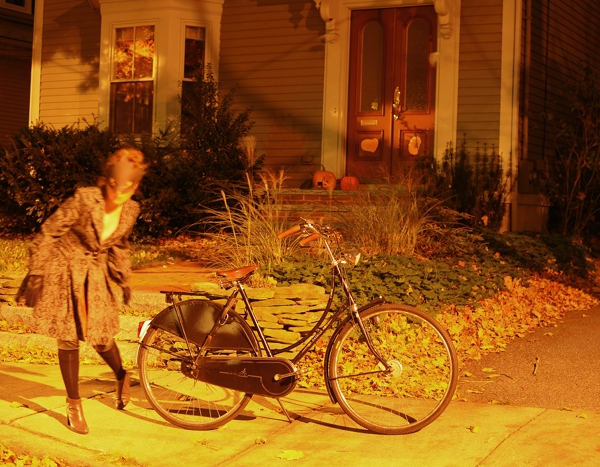
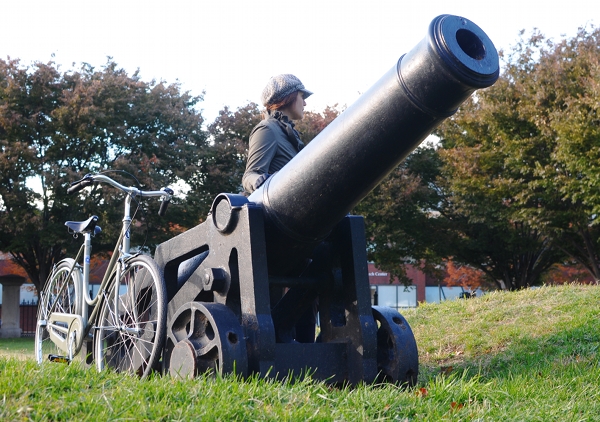
And then, there she stood: the Masked Cyclist!

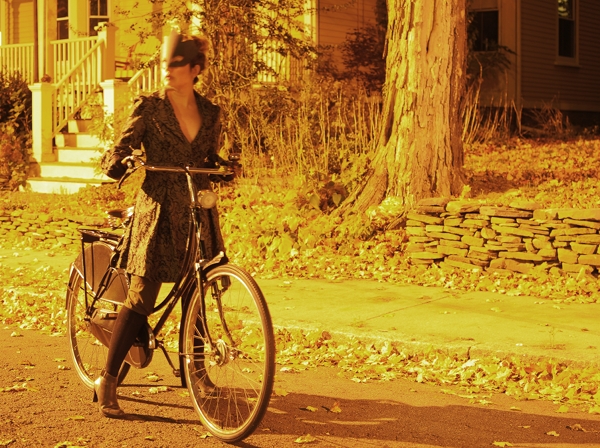
We had all heard of her, but only the very few had seen her - and never this closely. Legend had it, the Masked Cyclist haunted the roads of our town, clad in Edwardian garments and astride an old bicycle - her urgent pleas getting lost in the howling of the wind. What did she want? No one knew, but we all feared her intense gaze.

As I stood frozen in place, the Masked Cyclist moved closer and closer toward me - until suddenly we were face to face. "Who are you, and want do you want?" I managed to utter.

"I am the Masked Cyclist," said she, "and I am not at peace, because the beautiful bicycles that used to roam our land so famously have been all but exterminated by sinister forces. Many decades ago, these streets were full of ladies in their finery, gliding mirthfully through town and through farmland on their trusty loop frames with delightful chaincases, dressguards and lights. But now everything is dark and silent, and our towns are empty, and our farmlands have been replaced with strip malls, and the few bicycles in existence are carelessly built monstrosities that bring little joy to their owners. No, this is too horrifying and I cannot rest. Will you help me?"

"But how can I help?"

"I see that you enjoy riding your bicycle, and I pity you for its poor quality and lack of proper accoutrements. If you agree to help me bring the joy of lovely bicycles to our people, I shall be able to rest. You need only tell me that you agree, and the rest will be taken care of."

I looked at her lovely, ghostly bicycle, and without knowing what came over me, I agreed. "Thank you!" she said to me. "You shall go home now and forget all about our little talk. But 13 years from now I will visit you again to thank you."

And so it was. That same evening, I fell asleep and forgot all about my encounter with the Masked Cyclist, and life took its course. Little did I know that the otherworldly creature had decided to possess me, biding her time until the day was right to create Lovely Bicycle. Ignorant of the Masked Cyclist's influence, I knew not what compelled me to write post after post about lugs, loop frames, dynamo lighting, and local frame builders. And thus it continued for over a year, until a fortnight ago. I was cycling home along a popular bicycle commuter route when the Masked Cyclist once again appeared before me. Suddenly I remembered everything. But instead of fear, I was filled with affection - as I now shared the Masked Cyclist's devotion to lovely bicycles.
"Masked cyclist!" I exclaimed, "Is that you?"

"It certainly is," she replied, "I have come to thank you for helping restore the glory of lovely bicycles to our land.  Once again, I see many happy ladies gliding along our streets on their comfortable, trusty bikes, and I am finally able to rest with the knowledge that things are improving."

"But there is still so much work to do," said I, "surely you are not leaving me?"

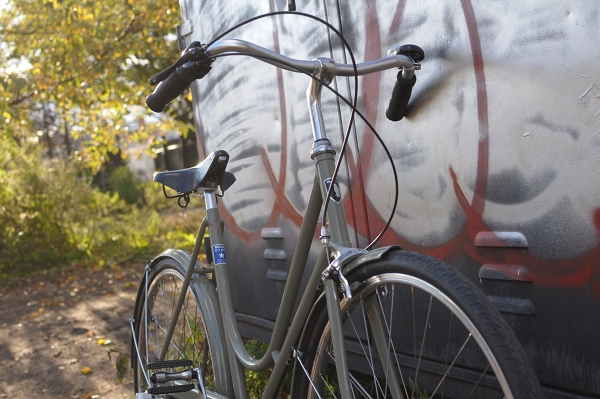
"Don't be sad," replied the Masked Cyclist. "It is time for me to go now. But my spirit will continue to guide you. And so that you always remember, I leave you my own bicycle. Please take it and cherish it always."

And with those words, the Masked Cyclist disappeared. I have not seen her since, but I can feel that her spirit is at peace.
Read More
Posted in Gazelle, loop frame, silliness | No comments

Friday, October 29, 2010

Happy Feet

Posted on 9:01 PM by dvdsvdsdv
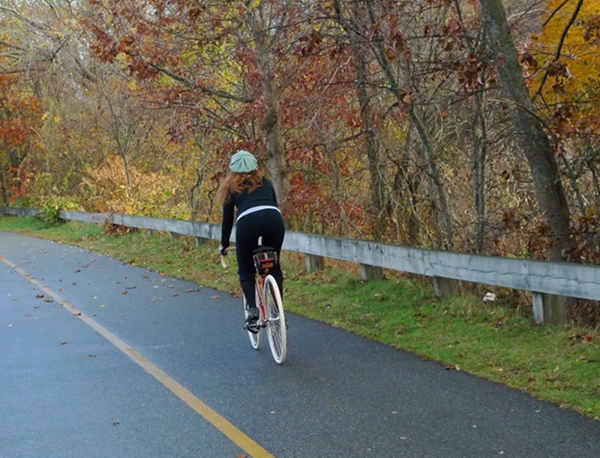
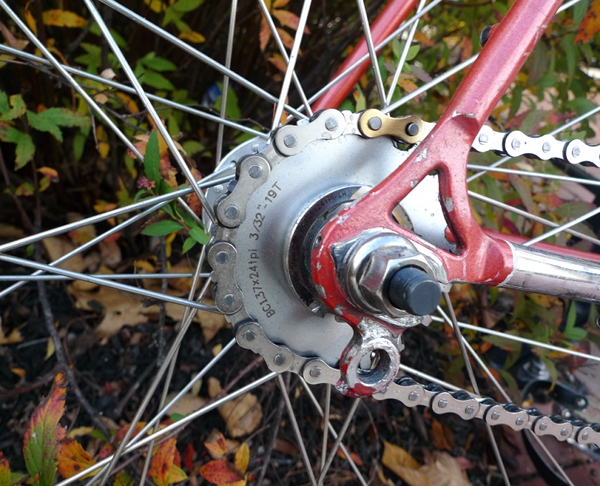
Today was the first time I felt well enough to ride a roadbike since having gotten sick last month. It was only 26 miles, but it felt great to have my full lung capacity and energy back.

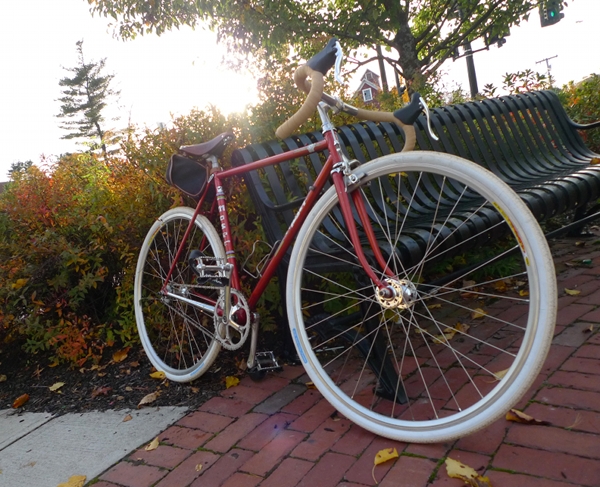
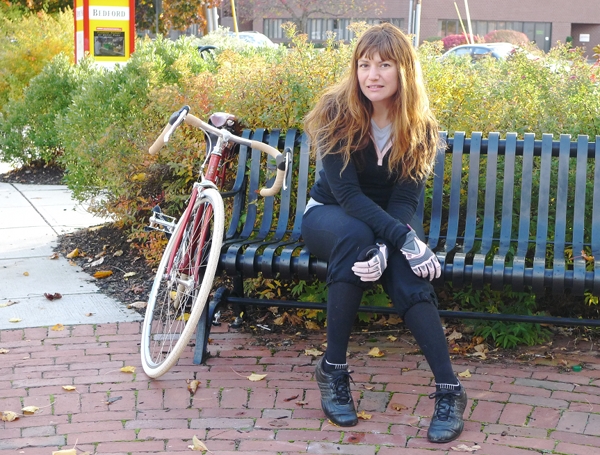
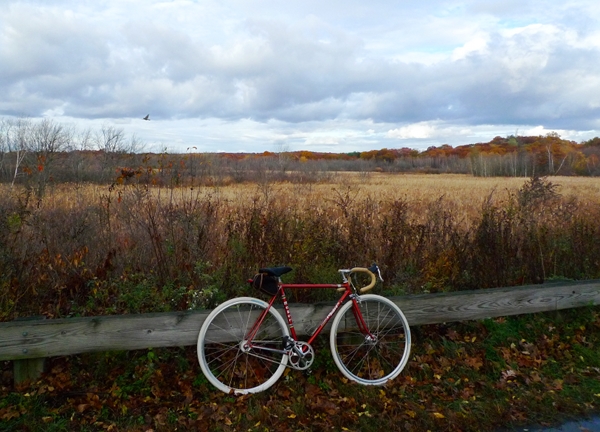
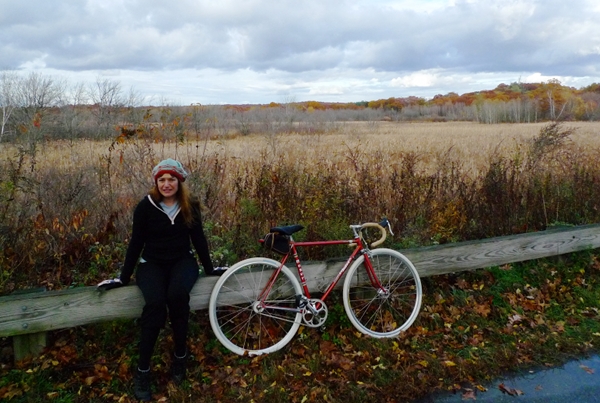
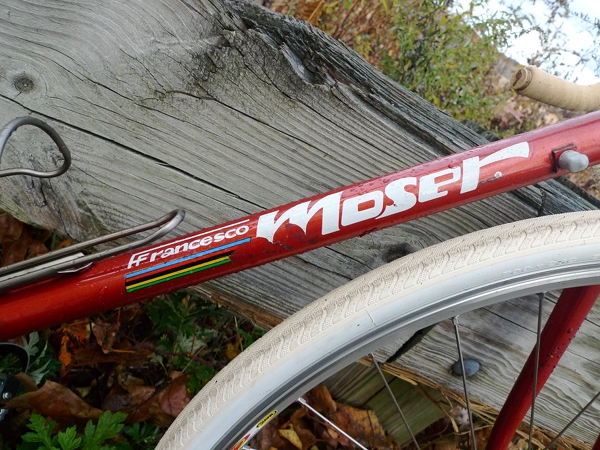
Continuing with the Italian theme, I took Francesco - my fixed gear stallion. How happy he was, basking in the precious minutes of sunshine in between thunderstorms.

Riding a fixed gear roadbike is an experience that fills me with a special kind of enjoyment - I think because it combines the sensations of walking and flying (fly-walking?).

I was worried that I might be too out of shape to make it, but I had forgotten how comfortable Francesco is. The 26 miles of pedaling felt like a stroll in the park. Although, I have learned by now that even if I feel "fine" riding fixed gear while I am actually doing it, it does take more out of me than a free-wheel bicycle. I usually sleep longer after such a ride, and sometimes I am sore the following day.

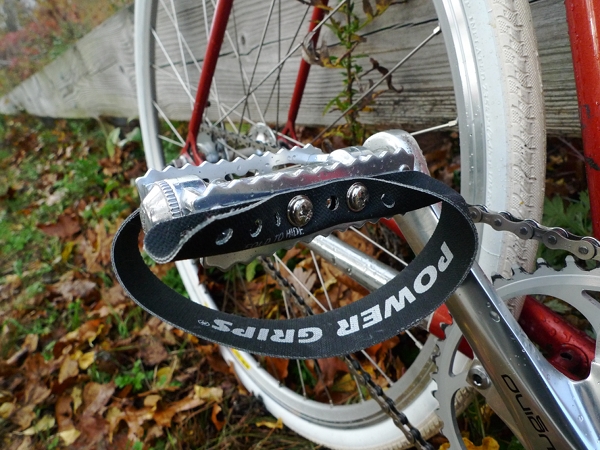
One thing that has improved my comfort level with fixed gear cycling considerably, are these "fixie" Power Grips. I wrote about the standard Power Grips here, and since my initial review I have become addicted to these things. The fixed gear version differs from the standard model, in that it makes it easier to insert and remove your feet while pedals are in motion. I cannot tell what it is about the design that makes this possible, but none the less it seems to work. I insert my right toe at the starting position and start cycling slowly while nudging the left pedal with my left toe - then swiftly insert the toe into the left grip on the first stroke. After some practice this became a familiar and instinctive sequence of movements - though it definitely helped that I was already comfortable using this system on a free-wheel bike prior to trying it on a fixed gear.

Now that I am able to use foot retention on this bicycle, I am no longer apprehensive about cycling over bumps and potholes or going downhill at high speeds. The experience is pretty much perfect and very enjoyable. One thing in particular I have noticed, is how easy it is for me to ride "in the drops" - Francesco almost seems more stable when the handlebars are held this way than higher up. Is that possible?

And another interesting thing: I find it much, much easier to get out of the saddle and pedal standing up on Francesco than I do on my other bicycles. Is it the fixed-gearness that is facilitating this or the geometry? As I've mentioned before, I have a terrible sense of balance, and that is what I believe normally prevents me from pedaling while standing up. But on this bicycle, it seems not to matter.

It rained on and off for the duration of our ride, and the colourful leaves strewn over the trail turned into a mess of a slippery carpet. Was I so excited to be riding Francesco that I began to imagine things, or is it easier to ride in slippery conditions on a fixed gear bike? I have read comments about traction before, but I admit that I don't understand them. Could somebody explain it in layman's terms?

As I prepare for some more pruning of my bicycle overgrowth, it is clear to me that I "need" a fixed gear roadbike. So while I am now considering selling my Trek - which has been fun, but not essential - I will definitely be keeping the Francesco Moser.

In the long run, however - maybe a couple of years from now - I will probably want to replace it with a "real" fixed gear bicycle. Mainly, this is because the Moser's bottom bracket is not as high as it should be - and even though my lean on turns is not aggressive enough to warrant worrying about pedal strike yet, it would be better if this wasn't even a potential issue.

But for now, Francesco is my dashing Italian gentleman and I thank him for my happy feet.
Read More
Posted in diamond frame, fixed gear, Italian bicycles, Moser, roadcycling, technique | No comments

Thursday, October 28, 2010

Lovely Bicycles on a Budget: Vintage vs Modern

Posted on 9:01 PM by dvdsvdsdv
[image via niniferrose]  

In addition to the variety of comments posted on this website, I receive lots of questions from readers via email. And if I had to say what the one most frequently asked question is, it would be a variation of this one:
I am looking for a nice bicycle for commuting around town and my budget is $500. I would love to get a new Dutch bike or a Pashley, but I just can't afford it. What would you recommend in my price range? 
Now, I do have a page on this website called Budget Options, and a link to it is prominently displayed in the upper lefthand corner. On that page I keep an updated list of manufacturers that sell budget versions of classic bicycles for as little as $150. I also have a page on shopping for vintage bikes. So, in emailing me the above question, the reader is usually looking for more than to be directed to one these pages. They are looking for my opinion: What would I do with $500? What do I recommend of all the possible options?

Okay, if you really want to know, I'll tell you. But I can almost guarantee that you won't like it and that you won't follow my recommendation. Do you want to hear it anyway? Well, all right. I would recommend buying a vintage 3-speed and spending the remainder of your budget on modernising it. Here is how I would do it:

[image via Trisha Brink Design]

Step 1: 
Buy a vintage Raleigh Lady Sports in your size and preferred colour. Make sure the frame is in good condition, and that as many components as possible are salvageable. Try to spend under $100 on this purchase, and absolutely no more than $150. It is possible if you do some research and ask around. Even if there is a shortage of vintage bikes in your area, post a "want to buy" ad on your local C-List and chances are someone will dig one out of their basement or barn. Or join bikeforums and a kind enthusiastic soul on the Classic & Vintage subforum will provide you with some local contacts. It can be done if you are motivated.

Step 2:
Buy a modern 26" (ISO 590) wheelset with alloy rims and a 3-speed hub built into the rear wheel (the shifter is usually included). The biggest problem with using vintage 3-speeds for transportation, is that they have caliper brakes and steel rims - a combination that provides inadequate stopping power in wet weather conditions. An alloy wheelset will solve this problem. Several bike shops sell such wheelsets online at reasonable prices: A Sun wheelset from Harris Cyclery will set you back $200. An Alex wheelset from Niagra Cycle Works will set you back $130.  Your local bike shop might be able to order a wheelset from a catalogue as well.

Step 3:
Buy a set of 26" (ISO 590) tires with puncture protection. Schwalbe Delta Cruisers in either black or cream are a good choice, because they look classic, make for a very comfortable ride, and cost only $40 for the pair.

Step 4:
Assuming that you are not skilled in bicycle repair, maintenance or assembly, bring your vintage bike and all the parts to a trusted local shop. Ask them to replace the wheelset, put on the new tires, and give the bicycle a thorough tune up. They will probably end up replacing the chain and some cables as part of that process as well. It should run you about $100.

Step 5:
If the vintage bike you found did not come with a saddle and there is room in your budget, get a Brooks or a lower-priced VO leather saddle. If you are tapped out, look for a vintage saddle, or buy a cheap generic one as a temporary fix until you save up the extra money for a new, quality one.

[image via niniferrose]  

At the end of this process, you will have a bicycle with all the comfort, durability and charm of a vintage 3-speed, but with modern braking power. It should last pretty much forever and should feel great to ride. Yes, organising the bike will be a small adventure - but again, it can be done if you put your mind to it.

Having said that, I realise that most of my readers will opt out. For one thing, it seems difficult and time-consuming. It also probably seems absurd to spend a total of $500 on a vintage 3-speed, when you could go to the store and get one of these for the same price, brand new and shiny. I sincerely understand that. But...
Consider that the second most frequently asked question I get from readers over email is a variation of this one:
Three months ago I bought a [Budget Manufacturer X] bicycle, because my budget was $500. Actually, I ended up spending a bit more than that, because I got the 7-speed version. And Basil panniers. And a Brooks saddle. And cork grips. But anyway, I thought the bicycle looked nice and I liked how it rode when I tested it outside the bike shop. But it's only been 3 months, and now my rear fender is making clunking noises, and my chain has come off twice, and I keep getting flat tires. Also, the bike doesn't feel that great over pot-holes and my hands start to hurt on the handlebars towards the end of my commute from work. My bike shop says that I can update some of the components to fix these problems, but it looks like that's going to cost me another several hundred dollars. I am not sure what to do now. What do you think? 
I never know quite how to answer that one, because at that point the person has already maxed out their budget. Any suggestions? And yes, I am perfectly serious that I get these emails. I respect it when people say they are on a tight budget and I would like to be helpful with solutions instead of saying "save up for a better quality bike". But I honestly cannot think of a solution that I truly believe in other than my vintage 3-speed plan.  I have never received an email from anybody complaining about their vintage Raleigh Sports. 
Read More
Posted in bicycle industry, bike shopping, Raleigh, vintage | No comments

Wednesday, October 27, 2010

A Raven Flies Through the City: The Bella Ciao Corvo Citta Donna

Posted on 3:30 PM by dvdsvdsdv
A couple of weeks ago I received a Bella Ciao bicycle as part of a work-related trade. I have never been compensated for anything in bicycle before, but I think I could get used to this if absolutely forced to (at least for the benefit of providing test ride reports for my readers, right?). The bike was assembled with my preferences in mind, and I was invited to offer an honest critique.

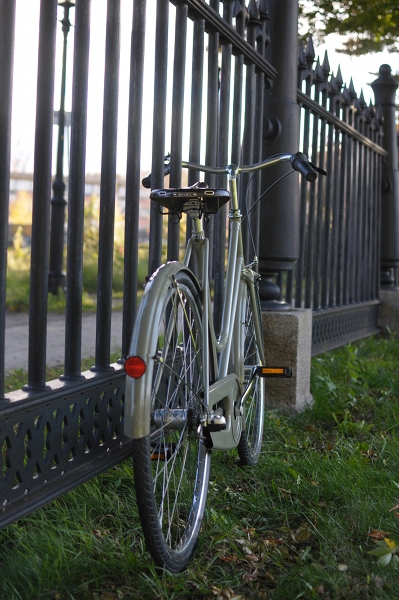
The bicycle is a Bella Ciao "Corvo Citta Donna". The model name translates into something like "urban raven" and donna indicates that it is the lady's version. The colour (chosen by me) is "verde arsenale" - a pastel army green. Half a dozen other colours are available as well. The "Corvo Citta" models can be ordered as single speeds, 3-speeds, or 7/8-speeds, with or without coaster brake. I asked for a 3-speed coasterbrake version.  The accessories are either honey or black, depending on the frame colour, and mine came with the black accessories package.

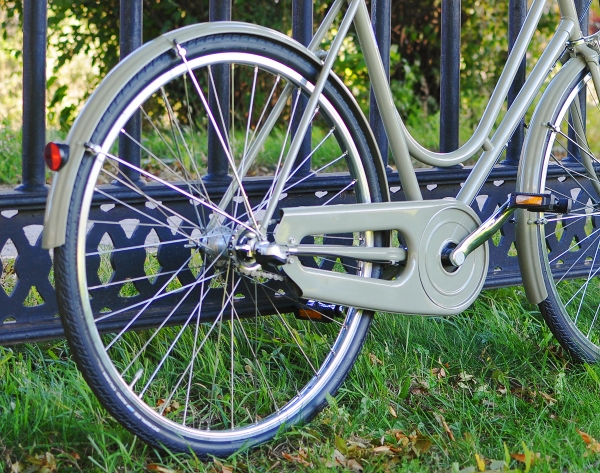
Bella Ciao frames are individually hand-made (brazed and lugged) by a small family-owned manufacturer in Northern Italy that has been building frames for generations. The standard models are cro-moly steel, though there are also limited editions made of Columbus tubing. Standard features on the Corvo Citta Donna include the classic Italian frame construction, 700C wheels with alloy rims, body-coloured fenders, an enclosed chaincase with a rear opening, leather saddle and grips, rear reflector, and a brass bell.
The frame is made in size 54cm (21.5") only, measured the "standard" way. This is an important point, especially if you are trying to compare the Bella Ciao to the Abici, whose sizing is measured differently. I would say that the Bella Ciao frame is slightly larger than the bigger of the two Abici frames.

With its hardy tubing, modest lugwork, and thick powdercoating, the "Corvo Citta" is attractive, but decidedly utilitarian.

It is not a delicate bicycle by any means; the frame feels as if it can take anything that life has to offfer.

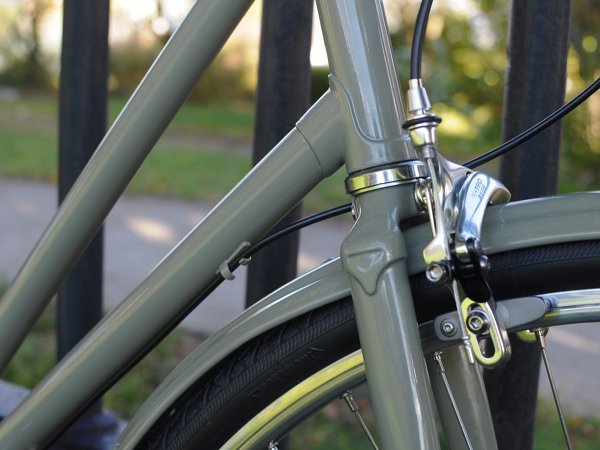
The lugged fork crown warms my heart; very nicely done. And look at the body-coloured cable guide braze-ons.

The only part of the frame that is not lugged, is the connector between the curved top tube and downtube. But if I have to choose between this and the fork crown, the latter is infinitely more important to me. (The connector on my Pashley was not lugged either.)

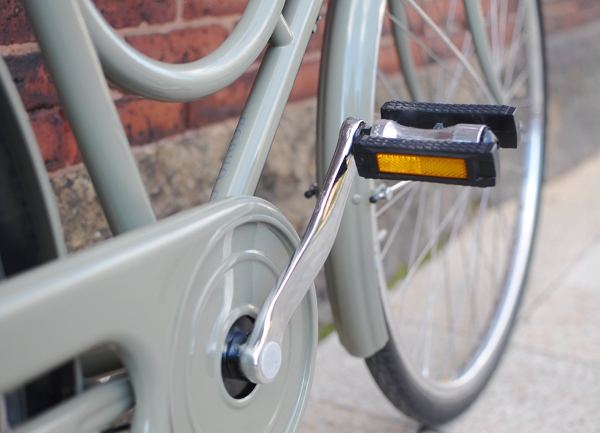
I like the elegant chaincase, and the interesting thing, is that despite being steel it is absolutely silent.

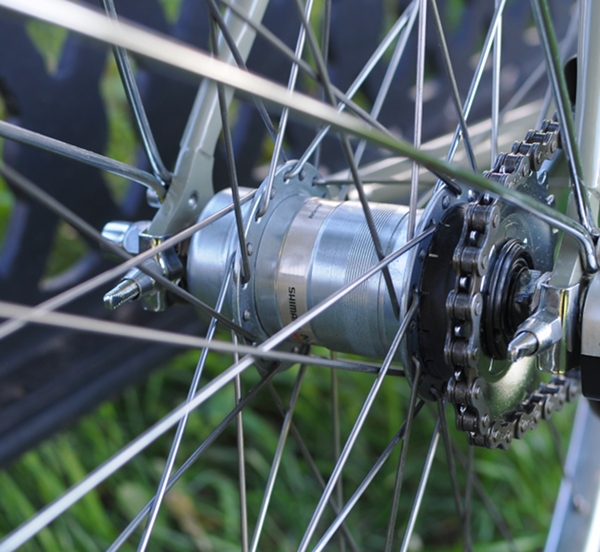
Somewhat disappointing though, was the choice of the Shimano 3-speed hub and gear shifter for such a classic bicycle. The Shimano certainly works fine, but the excruciatingly high-tech looks of the hub and shifter disrupt the bicycle's classic charm. Personally, I feel it would have been better to use the Sturmey Archer hub and shifter on these bikes - though I suspect others will disagree.

The Bella Ciao has straight fork ends, which I prefer on an internally geared hub bicycle. There are also chain tensioners installed - a detail the Co-Habitatant found especially exciting.

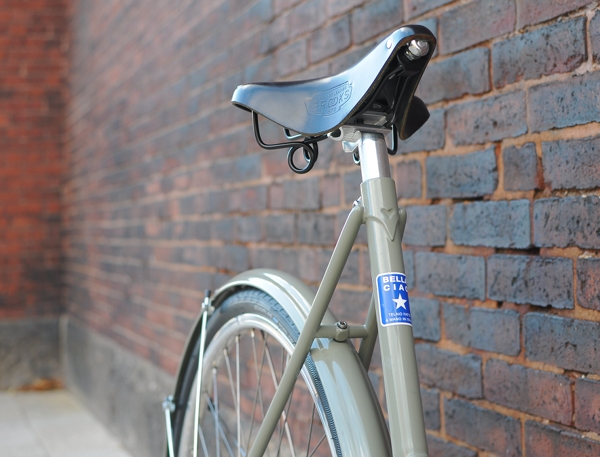
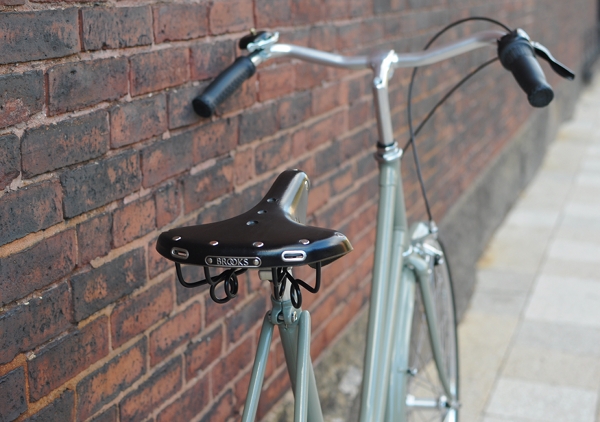
The bicycle arrived to me with a Brooks B17S saddle, but I immediately replaced it with a B72. I am not sure why both Bella Ciao and Abici use B17 saddles on their city bikes, but I think they need to rethink this choice - it is not an appropriate model for an upright ride, especially for women. The B72, on the other hand, feels absolutely at home here.

As long as I am doling out criticism, I will also mention my perplexity over the choice of brake lever: I believe it may be an interruptor lever, because it is very short. The Tektro front caliper brake provides excellent stopping power and the lever is squeezable, but it's just not the right one for this type of bicycle. A normal, full-size city lever would be more suitable.

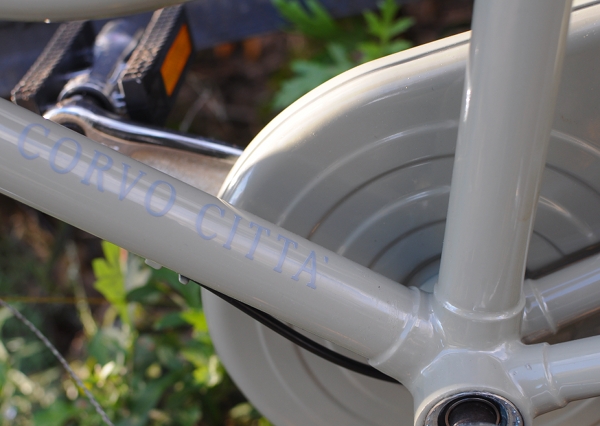
The minimal insignia on the Bella Ciao include a small headbadge on the head tube featuring the black raven logo,  the "Corvo Citta" model name inscription near the bottom bracket, and a "fatto a mano in Italia" sticker on the seat tube.

And one thing I should definitely mention is the handlebars - which are proprietary Bella Ciao. They are shaped similarly to Porteur handlebars, but with just a tad more flare-out to them. The shape is super comfortable for my hands and seems perfectly matched to this bicycle's geometry.

Moving on to ride quality... The most notable sensation I got from the Bella Ciao, was that it did not feel like a new bicycle. It felt very familiar, like an old bike that I have always owned. Lovers of classic bicycles complain that "there is no such thing anymore as a simple, well-made, lugged steel 3-speed bike". Well, I think the Bella Ciao is exactly that. It is easy. It is comfortable. It is uncomplicated. It is not as laid back as a Dutch bike, but definitely not too sporty either (more relaxed than an Abici).  It is maneuverable but unaggressive. It is just a bike. A very nice bike that anybody can ride, and that is light enough for anybody to lift.

When a bicycle is this easy, comfortable and undemanding, you end up riding it all the time... which, ironically, ushers in my next complaint: Where are the lights? And more importantly, where is the rack? I would love to ride the Bella Ciao regularly for transportation, but there is nowhere to attach my bag and all the other stuff I take along, which is frustrating. The design of the bicycle will accommodate the VO Constructeur rear rack, and when I have the money I might get one. But I think that a rack in the style you see on some of these bicycles would be more appropriate. Anybody know where I could source one?

The Bella Ciao "Corvo Citta Donna" might just be the closest I have tried to an "all around, normal" bike out there today among classic lugged bicycles. And that was rather unexpected, given the quirkiness of the manufacturer's self-presentation. Free-association collages, stories of resistance against fascism - it is enough to raise the eyebrows of some and to make others wonder whether Bella Ciao is in reality a contemporary art project rather than a real bicycle company. Well, I suppose there is no reason it can't be both...

Though currently only sold in the EU, Bella Ciao is considering North American distributors and the bicycles may be available for sale in the US sometime in 2011. The Corvo Citta Donna would certainly be welcomed by women looking for more options in classic city bicycles.
Read More
Posted in Bella Ciao, Brooks, Italian bicycles, test rides | No comments

Tuesday, October 26, 2010

A Closer Look at Italian City Bicycles

Posted on 5:23 AM by dvdsvdsdv
[Bella Ciao 'Moscova'; image via Bella Ciao]

As slyly mentioned in the comments of several previous posts, I recently received an Italian bicycle from Bella Ciao, of which a test ride report is forthcoming. Some who have noticed the bike asked about the difference between it and the Abici I test rode earlier, noting the similarities of the designs. So I thought I would take this opportunity to showcase some ladies' Italian city bicycles - and to point out that the frame is not a similarity between Abici and Bella Ciao per se, but a common design feature of Italian bicycles in general - one that differentiates them from the more familiar loop frames of Dutch and English bikes. From the "Mrs. Cinelli" bicycle I photographed at the Larz Anderson show, to the myriad of bicycles spotted in Rome by Chic Cyclists, this distinct "Frascona curve" has been a classic element of the elegant lady's transport bike in Italy for decades.

Here is Abici's take on it. Same distinct top tube curvature, but different proportions (look at the seat tube angle here compared the earlier picture of the Bella Ciao). 

[Abici 'Amante'; image via Abici]

Another Abici model. Completely different in some ways, but look at the curvature of the frame.

[Montante 'Florence'; image via Montante]

Same curvature on a Montante bicycle. (These are the people who created the gold bike on the Forbes "Most Expensive Bicycles" list.)

[Montante 'Fashion'; image via Montante]

Another Montante, for all the lovers of red bikes out there. I am pretty sure they also made the Gucci "Beijing Olympics" bike. 

[Orco Cicli 'Ariel'; image via Orco Cicli]

Same curvature on an Orco Cicli.

[Orco Cicli 'Nilde'; image via Orco Cicli]

And on another Orco Cicli model.

[Umberto Dei 'Regale'; image via Umberto Dei]

And same curvature on an Umberto Dei. I have actually seen a real-life Dei in person - a cream one, in Boston. (I think at some point there was a North American distributor of these bicycles, but they went out of business.) The Dei I saw was stunning, though monstrously heavy - a stark contrast to the lightweight Abici and Bella Ciao bikes. The classic Italian curve remaining a constant, other features can certainly vary. 

As I understand it, there are still many small, family-owned bicycle manufacturers in Italy who produce such traditional frames - brazed and lugged, and each in their own variation of the classic design. Some even still produce their own components and accessories. Amazing, when you consider that this culture is almost non-existent elsewhere. 
Read More
Posted in Bella Ciao, bicycle industry, framebuilding, Italian bicycles, loop frame | No comments

Monday, October 25, 2010

The Bicycle, and on Building (and Protecting) Your World

Posted on 12:27 PM by dvdsvdsdv
For myself and a number of my acquaintances, the desire to get a bicycle corresponded with experiencing what I can only describe as an early midlife crisis. Early, because it hit us some time in our late 20s. And crisis, because it was marked by a devastating discrepancy between what we were achieving in our lives at the time (impressive things, by society's standards) and the absolute lack of personal fulfilment derived from those achievements. Somehow, we were living in a way that did not make us happy, spending money on things we did not enjoy, and advancing along career paths we no longer believed in - yet saw no way of escaping after having dedicated huge portions of our no-longer-that-young lives to the education that led to those careers.

How does the bicycle tie into this?... I cannot yet verbalise it as eloquently as I would like, but I know for certain that it does. Maybe disentangling myself from one aspect of societal expectations and life's inertia made me realise that it was generally possible. Prior to getting a bicycle, I had made some radical changes in my life, and have continued to make others since. Those changes have made me considerably worse off financially, but the quality of my life improved. And most importantly, I feel that I have re-claimed my intellect and creativity, which I now understand was necessary for my sense of personal integrity.

When I ride a bicycle, I experience a heightened awareness of the extent to which we are the architects of our own worlds. Things don't just happen to us, as we like to think when feeling helpless about our situations. Whether we realise it or not, we orchestrate our daily experiences through a complex web of choices and decisions we make - which includes the choice to be passive and let our circumstances, or other people around us, shape our world for us. To live the life we want to live, we must actively build and protect it - not violently or smugly, but committedly and persistently, even if others don't understand us or criticise our choices. For me, this is an important parallel between cycling and life in general.
Read More
Posted in social commentary | No comments
Newer Posts Older Posts Home
Subscribe to: Posts (Atom)

Popular Posts

  • Upside Down!
    Fate has been kind to Marianne! Rather than being torn apart for donor components , she has been spared, and fitted with new handlebars. Wha...
  • Computer Games
    I have never liked computer games, but with the influence of the Co-Habitant I am finally starting to get into them. Here he is, taking a br...
  • Matters of Identity
    Well... I thought that I could quietly change my blogspot username without anybody noticing or caring, but it's caused some confusion. S...
  • Celestial Beings
    [image via Spernicelli ] Depending on who you speak to, it is either the most over-rated vintage bicycle in existence, or the Holy Grail: Th...
  • The Pashley Roadster Sovereign: Review After Two New England Winters
    If you are a regular reader, you probably know that the Co-Habitant owns a Pashley Roadster Sovereign. We bought a pair of Pashleys  when I...
  • Pulling the Trigger vs Doing the Twist: Thoughts on 3-Speed Gear Shifters
    On bicycles with internally geared hubs, we typically see two types of gear shifters. The trigger shifter (pictured above) is a small gadget...
  • Putting Your Foot Down
    Enough people have asked me about this now that I thought it worth writing about: How do I put a toe down in traffic while remaining on the ...
  • Manufacturers with 'History': Does Continuity Matter?
    What does it mean, when we say that a bicycle manufacturer has a long history? There are manufacturers out there, whose names are legendary ...
  • Urbana: Review of a True Transport Bike
    A month ago, I received a bicycle from the Canadian manufacturer Urbana , to test ride and review.  When the offer was initially made, I vis...
  • Rediscovering Familiar Places... and the Hills You Never Knew Were There
    Yesterday was a special occasion for us, and we wanted to do something special to celebrate. We decided to visit an area of Seacoast New Ham...

Categories

  • ANT
  • art
  • bags
  • basket
  • beginners
  • Bella Ciao
  • bicycle events
  • bicycle industry
  • bicycle reviews
  • bike friends
  • bike shopping
  • blog development
  • blogiversary
  • books
  • Boston
  • Brompton
  • Brooks
  • Cape Cod
  • cargo bikes
  • cars
  • cats
  • children
  • clipless
  • clothing
  • Co-Habitant
  • coaster brake
  • comfort
  • Constance
  • countryside
  • diamond frame
  • DIY
  • DL-1
  • dress guards
  • drop bars
  • Eustacia Vye
  • fashion industry
  • fenders
  • films
  • fixed gear
  • flowers
  • food
  • framebuilding
  • Gazelle
  • Geekhouse
  • gender
  • give-away
  • grips
  • handlebars
  • handmade
  • holidays
  • Interbike
  • Italian bicycles
  • Jacqueline
  • knitting
  • lights
  • local bike shops
  • locking up
  • loop frame
  • lugs
  • Maine
  • Marianne
  • mercian
  • Mercier
  • mixte
  • Moser
  • Motobecane
  • Myles
  • night time cycling
  • North Shore
  • paceline
  • Pashley
  • pilen
  • poll
  • product reviews
  • racks
  • rain
  • Raleigh
  • Randonneur
  • randonneuring
  • restoration
  • Rivendell
  • roadcycling
  • rod brakes
  • Rodney
  • Romania
  • Royal H
  • Royal H. Mixte
  • saddles
  • safety
  • Seven
  • shop visits
  • silliness
  • skirt
  • social commentary
  • Soma
  • somervillain
  • stories
  • summer cycling
  • sun and heat
  • Surly
  • tandem
  • technique
  • test rides
  • tires
  • tools
  • traffic
  • trails
  • transportation options
  • travel
  • unpaved
  • urban cycling
  • Urbana
  • Velo Orange
  • Velouria
  • Vienna
  • vintage
  • winter cycling

Blog Archive

  • ▼  2011 (236)
    • ▼  September (17)
      • Frills or Basics?
      • European City Bikes and the North American Market
      • Thoughts on Fixed Gear Cranksets?
      • From Holsters to Corsets: The Cycling Accessory Fe...
      • Yeah Baby! Transportational Elegance Reigns at Int...
      • Handmade Bicycles at Interbike
      • Bleak Prognosis for the Dutch Bicycle?
      • GB Components Are Back! ...And You Can Have Their ...
      • Song, Dance and Bicycle Romance: The Interbike Fas...
      • On Bicycle Reviews
      • What's the Difference?
      • In the Raw
      • Frames of Mind: Why Did We Not Cycle?
      • Embracing Wrinkles
      • Reunited
      • The Art of the Ride Report: a Touring Bicycle Give...
      • If a Branch Falls in a Forest...
    • ►  August (22)
    • ►  July (26)
    • ►  June (27)
    • ►  May (27)
    • ►  April (26)
    • ►  March (30)
    • ►  February (30)
    • ►  January (31)
  • ►  2010 (262)
    • ►  December (28)
    • ►  November (29)
    • ►  October (24)
    • ►  September (23)
    • ►  August (25)
    • ►  July (25)
    • ►  June (20)
    • ►  May (19)
    • ►  April (20)
    • ►  March (17)
    • ►  February (18)
    • ►  January (14)
Powered by Blogger.

About Me

dvdsvdsdv
View my complete profile